Showing posts with label violence. Show all posts

Tuesday, November 19, 2013

Twenty Years Of Living Dangerously


From the very beginning of my adoration of her, I have always viewed Madonna as an actress first and a singer second. Everything about her life is drenched in performance, and every performance she has ever given is drenched in her life. The lines blur in a fascinating way that no doubt plays a role in her longevity and ability to continually evolve both creatively and commercially. In fact, it is easier for me to understand people’s complaints about her singing than it is for me to get the whole “Madonna can’t act” stigma. She has managed to continually deflect criticism of her voice, at least publicly, but she has never been able to hide her vulnerability to critics' savagery about her performances on the big screen.


This paper was written in November/December 2005, when Confessions On A Dancefloor brought about a dramatic resurgence of interest in Madonna’s music after the relative failure of American Life. I was a student at Emerson College, and this was my final assignment in an “American Independent Cinema” course with the great Rachel Thibault. The course rejuvenated my love for indie cinema at the same time that Madonna’s “Confessions” rejuvenated my love for Euro-flavored disco. And when I revisited Abel Ferrara’s Dangerous Game on DVD that Fall, I bridged my in-class and out-of-class identities in celebration of the most criminally underrated work in Madonna’s filmography.


I was working on this up until the literal last minute, when I ran out the door after printing it out. Thus my hand-in version was rougher, and a lot less clear, than I would ever have wanted it to be.  That’s why I have trimmed and polished it a bit more than my other Emerson College compositions previously resurrected for this blog. I’m not sure how effective it is in its current form, as it is essentially a condensed chapter from a book I’ve always dreamed of writing about Madonna’s screen career. Nonetheless, I hope it makes a worthy tribute to a film that is most deserving of celebration on its 20th Anniversary.


Robert E. Jeffrey 12/13/05

MA421: Final.

                                  Dangerous Deconstruction


It could be said that the term “independent film” is an oxymoron. For an artist to make a film, the artist must accept the fundamental, perhaps shattering truth that they cannot be the sole creator of their work. Writing and live performance are forms of expression which can theoretically be executed anywhere, by anyone, with or without assistance. Cinema, on the other hand, necessitates that the most independently functioning of artists break free from a potential mindset of creating art solely for oneself and judging art solely by one’s own standards. Filmmaking is defined by constant interactions among a wide array of individual artists coming together to birth a work that will inevitably turn out to be quite different from what any one of them might have imagined on their own. This disparity between the vision and the aptly titled “product” probably serves to explain the careers of numerous artists whose work in film rarely, if ever, fulfills their artistic potential. In the case of Madonna, the world’s most famous artist of any medium, the perennial challenge of balancing the desire to control and the need to submit has resulted in one of the most high-profile yet almost universally dismissed film careers of any actor with two decades’ worth of leading roles under her belt.


People really need to see things now more than any time before. They want to build a fantasy around you. This is the age of escapism because the world is in such horrible shape right now. They want to enjoy looking at you and have fantasies about being with you, or they are going to have fantasies about being you. I did the same thing as a child. I do the same thing even now. I think it’s really important for people to have something tangible, and if it’s good looking, and interesting, then that’s even better.
                            
                                Madonna, 1984 UK Radio Interview
                                                   
From the beginning of her career, Madonna has continually sought refuge in the world of independent film, both to sharpen her craft as an actress and to shed, reveal, and reconstruct her media persona through self-financed productions. Excluding student films and avant-garde shorts that she filmed in New York, Madonna’s career in independent film began with the 1985 Susan Seidelman screwball satire Desperately Seeking Susan and peaked with Alek Keshisian’s Truth or Dare, a rockumentary cum sociological study centered around “Madonna ‘90” and her extravagant, cinematic Blond Ambition world tour. Both films are the most critically acclaimed of Madonna’s career. The low-budget “Susan” was one of the most profitable comedies of the 1980s, and Truth or Dare went on to be “the most financially successful documentary of all time” (Rettenmund 3, 48, 179) until the unprecedented success of Michael Moore’s Bowling for Columbine and Fahrenheit 9/11 over a decade later. They are also among the most analyzed American films of the past twenty-five years among post-feminists and media scholars—and, presumably, the incoming generations of young people who have been literally “growing up with” Madonna. Independent film, however, has rarely been discussed as a key component to the success of the world’s most recognizable female entertainer. Feminism, religion, sexuality, family, power, and American social mores are frequent points of discussion (or criticism) in the endless canon of books, magazine articles, and academic essays devoted to Madonna. Yet her role as “actress” has been so universally panned that acclaim or even serious discussion of this aspect of her career is as “uncool” as it is nearly unheard of. 
Since the release of the 1986 critical/commercial flop Shanghai Surprise, there seems to have been an inordinate amount of periodical space filled by scathing commentary on Madonna’s supposed inability to act, or the low grosses for most of her screen work, or pleas from film critics begging that Madonna please stop making movies. This would seem to have resulted in an inherent taboo around discussing her work on the big screen with the same level of seriousness with which one might be allowed to write about her songs, live shows, or overall cultural impact. Part of the reason for this is inevitably because Madonna continually demonstrates an ability to remain omnipotent in the media, aided by the rise of entertainment coverage in print, on television, and all over the internet. Madonna has been a perennial staple of MTV for well over twenty years thanks to distinctly cinematic music videos which have defined her public persona more than any other aspect of her work. But music videos are rarely acknowledged as screen performances. In the public eye, Madonna thrives as “international icon” and “a legendary entertainer”. This makes Madonna’s task of forging a distance between audience perception and on-screen characterization an even more difficult challenge than for most other “stars”. Nowhere else in her film career was the desire to meet this challenge as apparent as in Abel Ferrara’s Dangerous Game (aka Snake Eyes), the most emotionally challenging film of Madonna’s career—for both the actress and the audience. 


Excepting his director-for-hire job helming the 1993 Body Snatchers remake, Snake Eyes (Dangerous Game’s shooting title) was Abel Ferrara’s first film after the success of Bad Lieutenant the previous year. It was also the first project to be released by Madonna’s Maverick Films production company (“Interviews: Vol. 2”), and by all accounts Madonna went into Snake Eyes with nothing short of rabid enthusiasm. In a January 1993 American press conference to promote her upcoming film Body of Evidence, Madonna admitted that, in the years since her big screen triumph as “Susan”, she had made mistakes in selecting scripts based on a desire to be a movie star. She suggested that Body of Evidence and the upcoming Snake Eyes offered more substantive characters than the roles she had played in the past, and would ideally boost her reputation as a serious actress. “I love all of [Abel’s] movies. I think he’s a brilliant director and I love his unrelenting honesty about everything. [Snake Eyes] is written by Abel and Nick St. John, and it’s a psychological drama kind of like Truffaut’s Day for night”. (“Interviews: Vol. 2”) Ahead of production, Disney president Joe Roth personally told Madonna that Snake Eyes would only further damage her screen career when he forced her to choose between filming the studio’s Angie I Says or Ferrara’s “dark” new film, both of which began shooting at the same time. Madonna was forced to turn down the title role in what would ultimately be released as Angie—a vehicle written specifically for Madonna. (“Interviews: Vol. 2”)


In Snake Eyes/Dangerous Game, Madonna plays Sarah Jennings, a successful American television star looking to be taken seriously as a screen actor by teaming up with independent film director Eddie Israel and drug-addled method actor Francis Burns in a dark Hollywood drama chronicling the final, violent night of a volatile marriage going down in flames. Harvey Keitel plays Eddie Israel, a director modeled after Abel Ferrara, and James Russo plays Francis Burns, a character possibly modeled after Madonna’s ex-husband, Sean Penn (Rettenmund 45).  The film weaves surreally between the dark lives of the actors and the dark lives of their characters, drawing parallels between the drug use, infidelity, sexual dysfunction, opportunism, and “spiritual death” going on in both worlds. The film rarely adheres to a narrative: it wanders aimlessly through the most uncomfortable sides of adult life, continually reminding its audience of how different the real world is from the movies we are raised on. Throughout its disparaging, boldly anti-commercial journey into Hollywood-as-Hell, Dangerous Game retains its ability to rivet due in large part to three of the most raw, explosive performances to be captured on film in the 1990s.


Madonna, in her first and last Abel Ferrara film, shed the mannered style of Old Hollywood goddesses with whom she had aligned herself in the past and delivered the most human, fearless performance of her career. The New York Times offered that “viewers may actually need to remind themselves that they’ve seen this actress somewhere before” (Rettenmund 45). Rather than attempt to subvert the audience’s past association with the film’s leading lady, Ferrara constantly finds sly, almost cruel ways to remind everyone that that is Madonna onscreen. The character’s sense of humor, fashion, and vampiric use of people to forward her career are all traits of the media myth of Madonna, the one born of scandal sheets and tabloid columns. Here, this unflattering image is satirized with an utterly realistic performance. As the New York Press put it, “Madonna has either learned how to act or finally found a character not so different from herself…either way, she’s terrific”. Madonna agreed with the sentiment, but was so horrified by the differences between the film she thought she was making and the final cut Abel Ferrara delivered that she refused to promote the film. (Rettenmund 45)

It was an entirely different movie when I made it—it was such a great feminist statement and she was so victorious at the end. I loved this character. I thought I could take the role and do a great performance. It was going to be this great thing for me. And even though it’s a shit movie and I hate it, I am good in it. But the way Abel edited it completely changed the ending. It was like someone punched me in the stomach. If I’d have known that was the movie I was making, I would never have done it, and I was very honest with him about that.

                                             Madonna, 1994
                                                                                                                                                  
          (St. Michael 104, 105)

Since the beginning of her career, Madonna's persona in film and on television has consistently equated sexuality with power and self-assurance. But in Dangerous Game, her character of Sarah Jennings is a stereotypically whorish wannabe movie star, one with so much disdain for herself that she uses sex and a lack of empathy as a means to an end in furthering her film career. In Mother of Mirrors, the film-within-a-film, we see this young actress being beaten and raped and humiliated, sometimes in character and sometimes out. This performance is a stark contrast to the “pornography-as-power” exercise in gender reversal that had caused an uproar one year prior with the release of Madonna’s Sex book, a work that she oversaw from conception to release—unlike Snake Eyes/Dangerous Game. “I don’t have the power in the film industry that I have in the music industry. The director is the one in control, and everyone else is a pawn. [The director] can take [your] performance in the editing room and completely change the character.” (St. Michael 105) 
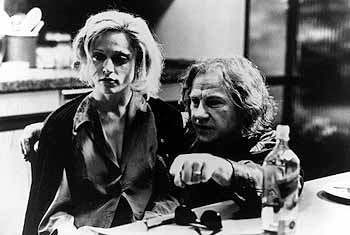

                  In the years since its notoriously unsuccessful release, Dangerous Game has largely been overshadowed by Abel Ferrara’s subsequent films outside of Hollywood and Madonna’s subsequent achievements outside of film. It is scarcely touched upon in retrospectives of Madonna’s career, but Ferrara himself has no desire to mince words when it comes to Madonna. "She's a fuckin' jerk!  Like we sit around taking out the best scenes in the movie to spite her. You know how paranoid you gotta be to fuckin' say something like that?" (Jones 3)  Abel Ferrara’s ex-wife, Nancy Ferrara, who played the character of Eddie Israel's wife, Madlyn, recalls the vitriolic reaction Madonna gave Abel upon seeing the rough cut. Being interviewed for Andrew Morton's 2001 biography Madonna, she recalled a series of fuming fax letters that Nancy Ferrara felt revealed more about Madonna than about what was "wrong" with the film.

She was so angry about the movie. The faxes were just nasty. “You fucker, you’ve fucked my life”, that sort of thing. The whole tone was about her, “I” and “me”, “I” and “me". She looked very vulnerable and that was really pulling her apart. At the end she revealed that when she is not in control, she is not as secure or confident as she would like everyone else to think.  She revealed something of her humanity. That is why she wouldn’t endorse it. It hit too close to the bone. She hit on all that emotion and couldn’t face it.”     
Nancy Ferrara                                                       (Morton 257, 263)

           Madonna has clearly been influenced by Hollywood legends like Bette Davis in her attempts to build a body of cinematic work as both an actress and an icon. But Madonna never worked as often before the camera as stars like Bette Davis, making movies only sporadically and rarely making two films back to back without an album or tour in between. Thus the results of Madonna’s attempts to have a great screen career have more often than not been disappointing. Madonna has never been one to shy away from this, but in the case of Dangerous Game, a tremendous work was unfairly deemed a failure by none other than Madonna herself. One might theorize that Madonna’s violent hatred for the final cut stemmed from being unable to construct her own identity within a film that was, seemingly, the antithesis of values she had come to represent. Yet her dual turn as Sarah Jennings and Sarah’s movie-within-a-movie character, Claire, oozes with the “relentless honesty” that drew Madonna to Ferrara in the first place. One cannot help but wonder why she dared not embrace a performance that was so memorably uncompromising, especially when Ferrara’s assaultive approach to cinema was what prompted Madonna to put faith in his ability to bring out the best in her.

“In an interesting artistic inversion, the perceived realism of Madonna’s documentary, Truth or Dare, merely recorded the essential artifice and staginess of her Blond Ambition tour, while in Ferrara’s movie, supposedly an exploration of make-believe, Ferrara ripped away her carefully contrived mask, the director literally wrenching a draining and difficult performance out of her. Madonna never saw it coming.”
                                                             Andrew Morton
(Morton 260)


SPOILER ALERTDon't watch this unless you've either already seen the film....

or never intend to.


Abel Ferrara certainly did bring out the best in Madonna: she’s arguably never been better onscreen. At least as much as her Golden Globe-winning turn in 1996’s Evita, Dangerous Game is celluloid proof that a gifted actress lay within the seemingly fearless, seemingly unstoppable multimedia megastar cum superheroine known worldwide as “Madonna”. The film reveals human frailty behind the shining armor of a warrior goddess, but like a general snatching back plans before they can fall into enemy hands, Madonna was not ready to let down her guard. Perhaps, now a more evolved artist than ever, Madonna will be so willing to once again be this forthright and revealing on the big screen, as she continues to be in other mediums. Regardless, the immortality of film insures that Dangerous Game, like Desperately Seeking Susan before and Evita after, will live on as proof that “Madonna, Queen of Pop” could very well have been “Madonna, Queen of Hollywood”.  


WORKS CITED

Jones, Kent. “Abel Ferrara, The Man: Who Cares?” Culture Port: Ret. 12/7/05

Madonna. Interviews. Baktabak Recordings. 1995.

Madonna. Interviews: Volume 2. Baktabak Recordings, 1997.

Morton, Andrew. Madonna. New York: St. Martin’s Press, 2001.

Rettenmund, Matthew. Encyclopedia Madonnica. New York: St. Martin’s Press, 1995.

St. Michael, Mick. Madonna: In Her Own Words. Great Britain: Omnibus Press, 1999.

Thursday, November 8, 2012

Wartime Journalism & "Cannibal Holocaust"

I knew what I wanted in high school. I wanted to go to Emerson College and study film. I just assumed that becoming a Hollywood screenwriter would immediately follow suit. My parents were wiser and always encouraged a backup plan, namely in journalism, but rather than listen I chose to gamble.
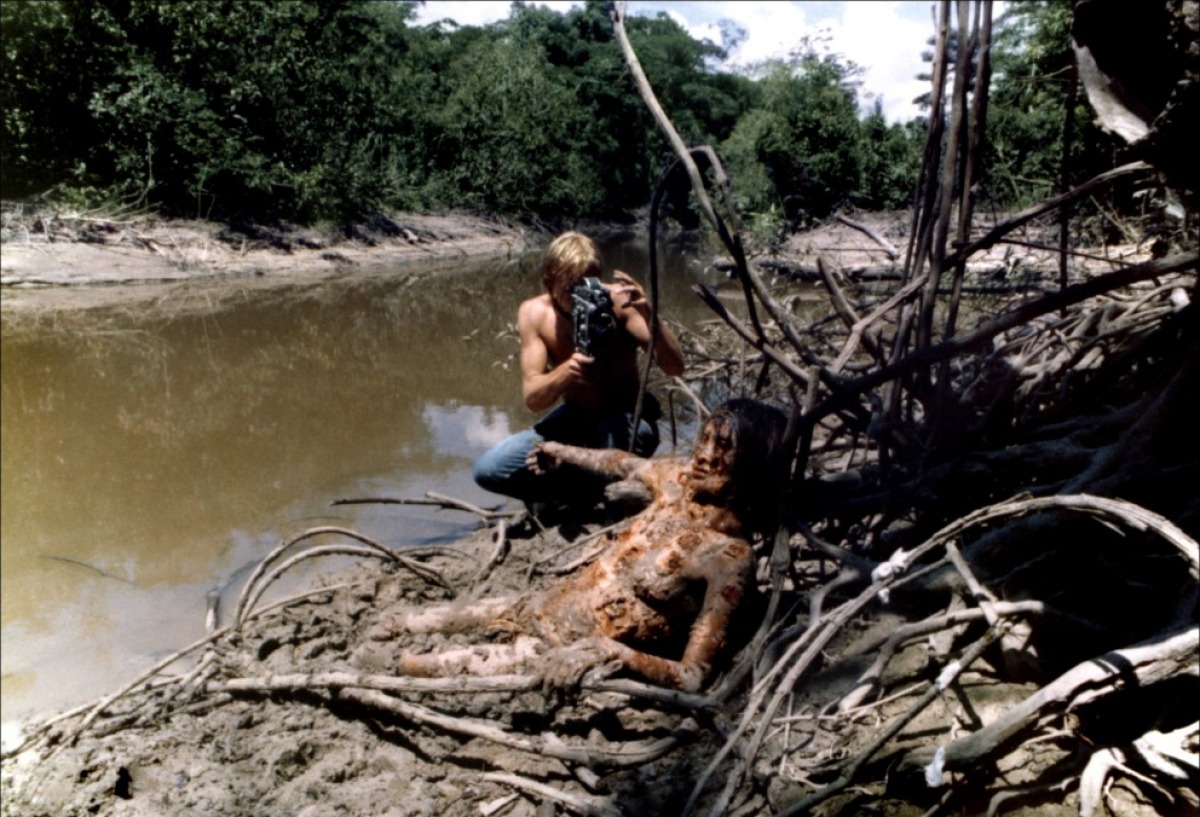
After taking a leave of absence midway through college to work on a failed indie horror film project, I returned to Emerson with a renewed vigor. In an attempt to expand my horizons and appease my parents’ suggestion, I took a “Wartime Journalism” class with the renowned Jerry Lanson...despite the fact that I never watch the news. I like horror onscreen, but I hate it in real life. That class, while amazing, underlined why I was not cut out for journalism. Thus I took the assignment of my final paper as an opportunity to explore my mind and rave about a favorite artist's misunderstood work of art, pastimes that I indulged in at least once a semester. For my Wartime Journalism class, the spotlight was on Ruggero Deodato's unbelievably controversial Cannibal Holocaust. I first saw this film in Summer 2001, after several years of avoidance based on its gruesome content and questionable reputation from both a cinematic and moral standpoint. Much to my shock and delight, I fell in love with the film that day in June. Much to my shock and horror, I relived its impact when the world changed that following September 11th. Barring Madonna and a handful of favorite (scripted) series, I have relentlessly avoided watching television ever since.


Robert E. Jeffrey 4/15/2005

JR485: Final Paper


     Outsider In: Looking at the

                      Psyche of the War Journalist 


I was first intrigued by the concept of wartime journalism in 2001 as a result of two significant works of filmmaking. The first, in the summer of 2001, was my viewing of a highly controversial, oft-banned 1979 Italian horror movie called Cannibal Holocaust, about the ill fate of a US network documentary team who travel the world staging or inciting bloody warfare and filming it to draw record ratings. The second was a documentary which aired on CNN shortly after the September 11th attacks, one which showed the public execution of an Afghan woman convicted of adultery  and the skinned bodies of enemies of the Taliban.

The atrocities in both films, one a satire of the American media and one an insight into life under the Taliban, were similar in tone and content. They also equally provoked my interest in disturbing questions about what should be filmed and broadcast for television, and about the true intentions of the filmmakers who cover the world we live in. At the time, I was angry at what I perceived to be exploitation of current events. In the wake of the impact that Cannibal Holocaust had on my cynicism and the impact that 9/11 had on my paranoiac tendencies, I initially suspected CNN was exploiting literal “snuff” footage for ratings in the wake of a national tragedy and an international panic. These two powerful films shaped my perception of wartime journalism, prompting a unique approach to this course that finally lead to my writing this paper.


Despite being someone with no interest in a career in journalism, I am amazed by how much the experience of journalists who voluntarily commit themselves to the ghoulish horrors of warfare--all for the sake of authentically capturing it through their own eyes--has influenced my artistic endeavors. This is not to suggest that the lifestyle of a wartime journalist (a profession I was admittedly unfamiliar with until recently) has ever guided the formation of my ideas. Rather, it is because the existence of this profession, and the nature of their daily lives, has offered a whole new perspective to me on the role of violence in the media.

When journalist David Filipov spoke before the class, I was emotionally enslaved to his presentation: laughing at some stories, recoiling in horror at others, and vicariously riding the adrenaline rush of his brushes with death. It was a fascinating journey to go on, as an audience member. But to actually experience it must leave an incalculably profound effect. I wondered if his memories weren't far less entertaining without the benefit of an engaged, but naive, audience: going back and forth between enemy sides in a foreign country, performing as an actor or comedian to protect your body and life, witnessing brutality and knowing that your lives and the lives of those around you could vanquish at any second. I tried to imagine going from that lifestyle to sitting at a desk at the Boston Globe. Those front-line atrocities must still seem more real, even more present, than anything happening around him in America possibly could. Having learned that he has two children, both of whose parents are working war journalists, I wondered what home life must be like: after stretches of domesticity, do he and his wife both feel a need to be back in the heat of combat? And does this affect the security of children longing for the protection of Mom and Dad?

Most parents would probably agree that David Filipov and his wife made the right decision in leaving that world behind. Recent international events have demonstrated that the mere thought of a war going on can bring about great anxiety in young children, even those who have no familial connection to it whatsoever. A 2004 article entitled “Controlling What News Your Child Sees From TV” on the memorial website 9-11 Heroes references a study by the Georgetown University Psychology Department on the effects of repeated news footage of the September 11th attacks on elementary school children. (9-11 Heroes) “Of the children in the study, 85 percent indicated that their basic sense of security and safety were shaken by the September 11 attacks.  Psychology Department Chair Deborah  Phillips reported afterwards that 'no one lost a family member…it was children not directly associated with the attacks, so I was surprised to find such high levels of stress. I expected maybe half, not 85 percent.'" (9-11 Heroes)

            These numbers merely refer to young children, with an inevitably limited understanding of the profundity of war but an innate fear of its deadly destruction. On the complete other end of the spectrum, the military and war journalists actually go to that proverbial “front line”, with many of them spending long stretches on the precarious road between a life removed from reality and a death lifted from gory nightmares. And what of their sanity? If children can be rocked to the core by repeatedly broadcast news footage of American skyscrapers tumbling into a city of people screaming in terror and distress (9-11 Heroes), could someone who sees such atrocities on a regular basis, for an extended period of time, possibly hold onto a sound mind?


As a writer of fiction, I was so affected by Mr. Filipov's classroom presentation that it prompted my decision to let the nature of this Wartime Journalism course shape a screenplay that I had been writing, one I already planned to incorporate into a separate class on the nature of violence in literature. This was compounded by the visit of Kevin Sites, who took a less dazzling, more analytical, and ultimately vulnerable approach to his experiences as a war journalist. He revealed that he had suffered the loss of a marriage and more than one engagement due to his commitment to his profession, and before the entire class he openly grappled with questions of what ethics to abide by in his career. It was very clearly an honest search for answers, rather than a demonstration of his career success. 
What most piqued my interest in learning about the profession of a war journalist was a desire to understand the psychological effect that “the news” has on the people who cover it. It seems that a lot of airtime and column space over the past two decades has been devoted to how children are affected when they see bloodshed on the six o’clock news, why teenagers run to slasher movies at the local multiplex, and what all this could mean when said young people enter the adult world. But it would appear, at least on a mainstream level, that less emphasis has been placed on the psyche of the people who broadcast such violence: the executives and editors and censors and newscasters who watch that bloody reality everyday and then decide on how they will break such truths to the rest of the world. At the heart of such mental and moral questions is the war journalist. Often a lone human being with modest protection and a questionable span of life, (s)he is willing to give up everything to potentially write the article or take the photograph that leaves a lasting impression on society. This passion, this monogamy, and this potential for horrible means of destruction has fascinated me since the beginning of the course, and it is what sent me off to at least scratch the surface of how a psychologist would look at the mind of a war journalist.


In 2004, The National Center for Post-Traumatic Stress Disorders (PTSD) released a fact sheet entitled “PTSD in Journalists” written by Dr. Elisa E. Bolton and containing new findings from studies on journalists that were conducted in 2002 and 2003. (Bolton) Dr. Bolton points out that “it has been assumed that journalists are not permanently impacted by death and destruction…[that they are] unusually tough, somehow immune to the reverberating impact of the human suffering they witness.” (Bolton) “Journalists are often exposed to highly stressful, traumatic situations, and required to bear witness to others who have been overwhelmed by traumatic events. While emergency workers have, particularly in the last decade, recognized the need for self-care and organizational safeguards, journalists may not yet have been recognized as potential candidates for employee safeguards and increased support.” (Dart Center “Self-Primer”)
Does the general public care about the minds and lives and fates of war journalists? It’s sad to say, but time and time again the masses seem more apt to be moved by the sight of a fallen soldier--perhaps because the image is unconsciously identified with the most heroic figure in the spectator's life--than by the brutal death of a captured war correspondent. “In recent years there has been growing recognition that being a journalist, especially a war correspondent, can be quite dangerous. In 2001 alone, 100 journalists were killed. Organizations and researchers are recognizing that in addition to the danger of death, journalists are exposed to the risk of great emotional distress. Yet, [recent research] also indicates that few employers of photojournalists recognize the stress and negative impact on mental health that is associated with some assignments. Even fewer employers offer counseling services and education about PTSD symptoms.” (Bolton)
            The irony is that education about what one should or should not do on the front line would not necessarily be put to use anyway. In The Psychology of War, Lawrence LeShan excerpts the reflections of a WWII veteran named William Manchester who was hospitalized in Okinawa but escaped so that he could rejoin his fellow marines on a dangerous mission that they were about to embark on. “It was an act of love. Those men on the line were my family, my home. I had to be with them, rather than let them die and me live with the knowledge that I might have saved them. Men, I now know, do not fight for flag or country, for the Marine Corps or glory or any other global abstraction. They fight for one another.” (LeShan 97)
While William Manchester was speaking as a veteran of combat, he could very well have been speaking as a wartime journalist. David Zucchino, a correspondent embedded with troops in Iraq, described his own experience as though he were a soldier, not a writer. “Peering through one of the Bradley’s three-inch-slits of bulletproof glass, I wasn’t just viewing the battlefield for a news story. I was searching for Iraqi fighters for the gunner to kill.” (Greer)


In War Is A Force That Gives Us Meaning, journalist Chris Hedges asserts that he  managed to retain his morality during his own wartime experience. However, referencing his time covering the first Gulf War, he concedes that, in the midst of the battlefield, a state of amorality is all too easy to sink into. “The prospect of war is exciting. Many young men [believe that they will] discover their worth as human beings in battle. The admiration…the glory…the ideal of nobility beckon[s] us forward. All the more startling [is that] that such fantasy is believed, given the impersonal slaughter of modern industrial warfare. Iraqi soldiers were nothing more on the screens of sophisticated artillery pieces than little dots scurrying around like ants—that is, until they were…reduced to scattered corpses….[by] high explosives fired from huge distances.” (Hedges 84)
Even in our advanced state of technology in the arena of mass murder, the human psyche has yet to be upgraded. It is just as vulnerable to emotional damage from firing today’s high-distance blasters as it was from impaling enemies face-to-face with bayonets a century ago. “Men in modern warfare are in service to technology. Many never actually see the people they are firing at nor those firing at them. To be sure, soldiers who kill innocents pay a tremendous personal, emotional, and spiritual price. But within the universe of total war, soldiers only have time to reflect later. By then these soldiers often have been discarded, left as broken men in a civilian society that does not understand them and does not want to understand them.” (Hedges 83, 86)
Even the most celebrated of wars—the  wars that carve out nations with the greatest of prospects, the wars that restore peace to troubled lands, the wars that literally save the world—the effects of violence prove immune to the glory of the soldiers who fight or to the journalists who cover their fighting. In War and Human Nature, Stephen Peter Rosen discusses the findings of a physiological survey conducted by the U.S. Army in the Spring of 1944. The first element discussed in the original review of the data was the stress level of all of the troops surveyed, which was related to “many factors, but among all of the factors, lack of sleep was cited more often than any other as a factor affecting combat performance”, with  troops citing few hours to sleep even during quiet times at war. (Rosen 110)
However, studies conducted in the 1960s on the effects of sleep deprivation as a stress-inducer lead to retrospective reanalysis of the WWII study, leading to the very possible conclusion that the WWII respondents were  hampered by fatigue and uncertainty moreso than lack of sleep. “Fatigue, the weariness that sets in after performing a task for long periods of time, has complex effects on human thinking and behavior. [In the 1960s studies], a particular kind of stressor—uncertainty—produced an entirely different reaction”. (Rosen 112-113).


Citing the actual test results, Rosen explains that the brain’s “corticosteroids are produced by conditions of novelty, strangeness or unfamiliarity—in which uncertainty is paramount. Unfamiliar situations produce feelings of uncertainty or anxiety which in turn trigger the secretion of cortisol. Cortisol levels are found to be particularly high in anxious or depressed patients.” (Rosen 113) But lest one think that journalists who covered WWII were spared such mental reverberations, Pulitzer Prize-winner Ernie Pyle’s recollections offer a startling account of the inescapable transformation. “Before he died in April 1945, war correspondent Ernie Pyle wrote, 'I’ve been immersed in it too long. My spirit is wobbly and my mind is confused. The hurt has become too great.' If this happens to you, seek counseling from a professional.” (Hight & Smyth, Chapter 4).
Much to my pleasant surprise, the Internet has given birth to a vital organization that was formed specifically to address the oft overlooked psychological needs of journalists who cover traumatic events. “The Dart Center for Journalism & Trauma is a global network of journalists, journalism educators, and health professionals dedicated to improving media coverage of trauma, conflict, and tragedy. The Center also addresses the consequences of such coverage for those working in journalism.” (DartCenter.org) Among the many resources available through their website is a “digital handbook”, Tragedies and Journalists: A Guide for Effective Coverage, by Joe Hight and Frank Smyth. In it, the authors take an empathetic approach to the daily lives and stresses of the modern journalist. “An exceptional thing about journalists is that we alone seem to think that we are exceptional in our reactions. Violence and its emotional aftermath affect all first responders, including police, fire, and ambulance workers as well as journalists.” (Hight & Smyth, Chapter 8).


In their message to journalists, Joe Hight and Frank Smyth integrate throughout each chapter the need for journalists to constantly communicate, to vent out what they see and how they feel in response—perhaps because, the authors suggest, journalists don’t do it enough. “A coffee shop or a bar may provide colleagues with an invaluable venue in which to talk and perhaps debrief each other about the emotions of their work. Recognizing the need for a debriefing forum or the opportunity to articulate emotions in the aftermath of a school-yard massacre or the World Trade Center attacks is not a sign of weakness, as too many journalists seem to think. Instead, when done successfully, debriefing fosters strength. The act of articulation — writing, drawing, painting, talking or crying — seems to change the way a traumatic memory is stored in the brain, as if it somehow moves the memory from one part of the hard drive to another. Journalists are people who, like almost everyone else who is exposed to pain, feel it whether it is theirs or not. Keeping it bottled up may only prolong its impact and make it worse in the future. Journalists, including free-lancers, should seek and take advantage of opportunities for both peer and professional counseling.” (Hight and Smyth, Chapter 8).
As a writer of films that explore the many facets of of sex and the nature of violence, I can relate to a journalist. I see the innate perversity of my screenwriting reflected in journalists' work in a very striking fashion: we both spend our hours penetrating a world of unspeakable depravity as a means of achieving career goals that feel less like signposts than they do missions, on which sanity and mortality is trivial compared to the work left behind. It is clear that journalists, as a group, are as dedicated to constantly expanding and improving upon their coverage as artists are dedicated to enhancing their body of work. Like artists, they are less interested in their safety--physical or mental--than they are in the final product, and they may be inclined to express their thoughts and fears through work rather than conversation. But clearly these related traits are dangerous, and unnecessarily so.
Journalists and artists communicate with the world on a profound level, putting passion and commitment towards work that stretches their emotional landscape. But raising their adrenaline by being exposed to ghastly horrors is as all-consuming in its destructive danger as it is inescapably thrilling. Wartime journalists are  prone to the same effects commonly associated with post-traumatic stress disorder in soldiers, and this is why they need just as many resources and just as much emotional support as an ER doctor or police officer. David Filipov and Kevin Sites have recognized this, and their respective classroom presentations served as a form of the catharsis that is vitally necessary in their profession. But that doesn’t mean that they won’t go back to the front line, because it doesn’t mean that they have grown immune to the euphoric excitement of their brilliantly deadly profession. Like artists, war journalists are passionate about living their lives doing what they love....even if life itself should end on the job. 


Works Cited

Hedges, Chris. War Is A Force That Gives Us Meaning.
Anchor Books, New York. 2003

LeShan, Lawrence. The Psychology of War.
            Helios Press, New York. 2002

Rosen, Stephen Peter. War and Human Nature.
            Princeton University Press, Oxford. 2005

Web Sources

Bolton, Dr. Elisa E. “PTSD In Journalists”. National Center for Post-Traumatic
Stress Disorder: Department of Veterans Affairs.

Greer, Jane. “War and Peace, Human Agency, and
Other Matters”. UUWorld.org

“Self-Care Primer”. DARTCenter.org

Hight, Joe, and Smyth, Frank. Tragedies and Journalists:
A Guide for Effective Coverage. DARTCenter.org

             
Mission Statement”. DartCenter.org


Film Referenced:

Cannibal Holocaust. Dir: Ruggero Deodato, 1979.
EC Entertainment DVD, Netherlands. 2001


Monday, October 29, 2012

You Kill Me: The Shadows Of A Genius


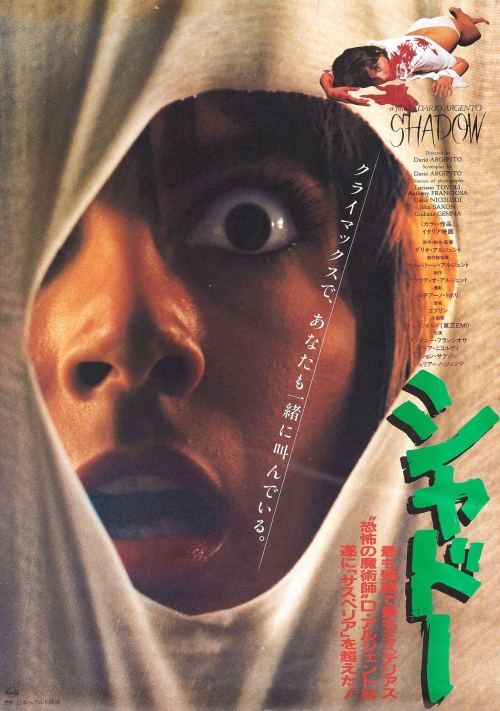
Today marks thirty years since the Italian release of one of Dario Argento’s most acclaimed and popular films: Tenebrae. I have posted to this blog many times before about Dario Argento, from writing about his best films (Suspiria, The Stendhal Syndrome) to his not-so-best films (Trauma) to the massive role he has played in shaping my identity as a child in the mid ‘80s and as a teenager in the late ‘90s. In college, I wrote about Dario Argento’s films almost constantly, and not least of all because I felt his body of work was every bit as worthy of dissection and appreciation as that of any other great filmmaker. Yet while Hitchcock and Kubrick and Godard were all the rage during my film school years, Argento’s appreciation seemed limited to the horror aficionados—and even then, it was primarily limited to Suspiria.


This (slightly revised) piece was one of two essays that I wrote about Tenebrae during my first year of college. I was a nineteen year old movie snob, and the filmmakers whom I was most passionate about were all Italian and all relegated to the “horror film” ghetto by most of academia. Both of my Tenebrae essays were intended to introduce my professors to the film in the hopes that they might one day incorporate it into their curriculum, if not their movie collections. I have no idea if that would ever go on to be the case for my professors, but I hope that it could still be the case for some of you. 


Robert Jeffrey 2/26/01
MA101: History of the Media Arts Part II

                                    Dario Argento’s Tenebrae: Art as Exploitation

When it comes to contemporary exploitation cinema, most American viewers will immediately think of one genre: The Horror Movie. Different viewers might have different interpretations of how horror films exploit. Some would say they exploit women. Others would say that they exploit violence. Many would say that they exploit American youth, who over the past several decades have consistently expressed interest in the most controversial (and most underappreciated) of film genres.
Over the past several years, a number of the genre’s most prominent “exploitation films” have finally been recognized for their artistic merit. The Texas Chainsaw Massacre (1974) is a permanent resident of The Museum of Modern Art. I Spit On Your Grave (1978) has been reevaluated by critics and sociologists. Night of the Living Dead (1968) and Halloween (1978) are now held in the same regard as Alfred Hitchcock’s greatest works. Over the past two years, the films of Italian horror legend Dario Argento have enjoyed similar rediscovery and reevaluation. Since the release of several of his films uncut (for the first time ever in America) on laserdisc in the Fall of 1998, he has finally begun to be appreciated as one of the finest filmmakers of our time, if not of all time.


Although long dubbed “the Italian Hitchcock”, Dario Argento’s body of work has often been regarded as “exploitation” as a result of  its graphic violence. Despite an ever growing legion of devoted fans around the globe, some horror aficionados don’t quite know how to interpret his work. The strict “gorehounds” rarely appreciate the multiple layers of psychology within the confines of his films. Yet many intellectual viewers are unable to get past Argento’s lack of interest in the widely accepted mechanics of “fine filmmaking”. In addition to expressing a disregard for actors, he offers that the actual “mystery” in his mystery films should not be the emphasis of the viewing experience. “We don’t solve mysteries in real life, why should we do it in films? Motivation doesn’t matter to me very much…I’m interested in seeing what goes on in people’s minds..the psychology” (McDonagh 245). Chris Gallant, editor of the book Art of Darkness: The Cinema of Dario Argento, offers that such a daringly different brand of filmmaking is exactly why people continue to explore, and attempt to understand, his filmography. “Perhaps more than anything else, what seems to invite analysis is the placement of this body of work on an overlap between European art cinema and a genre labeled ‘Exploitation’. These films disrupt what is so often perceived as an inflexible divide between the artistic and commercial, high and low art, forcing a surprisingly easy cohesion between the two” (Gallant 7).
 Dario Argento’s 1982 film Tenebrae is, upon initial viewing, a fairly straightforward mystery/thriller. Peter Neal (American television star Anthony Franciosa) is a hugely successful American writer of horror novels. When Peter Neal arrives in Rome to promote his latest book, Tenebrae, a series of murders are committed which seem to have been lifted from the pages of Neal’s latest work. With each murder, the killer sends a passage of the novel to Peter Neal, enticing the author to investigate himself. As Neal is drawn deeper into the mystery of uncovering the killer’s identity, the body count mounts, and Neal himself becomes the final target of the maniac’s killing spree. Tenebrae is effective as a mystery, as a thriller, and as a horror movie. But it is the psychological subtext which invites repeat viewings and continued analysis. This is what sets it apart from the (seemingly) similar thrillers that lack its symbolism and nihilistic wit.


A large part of Dario Argento’s appeal to fans is often used by his detractors to criticize him: the hyper-stylization inherent in his filmmaking. Within the Argento canon, Tenebrae could almost be described as one of Argento’s realistic efforts, although “gritty crime drama” it is not. One of the most controversial and thoroughly Hitchcockian aspects of Argento’s genius is his ability to portray graphic violence with the glamour and sensuality that most directors would apply to a romantic scene. The most striking and disquieting example of this in Tenebrae is the film’s most graphically violent scene, in which a woman’s upper arm is chopped off by an axe. The scene is not portrayed with the realistic attempts of a contemporary horror movie. Nor does it boast the outrageousness of Herschell Gordon Lewis drive-in fare, or the exploitive violence of gruesome slasher films. Instead, the depiction is far more terrifying in its spectacle: the camera pans to follow the character, blood literally painting the bleach white wall beside her as she slowly and fruitlessly backs away from her killer. The overtly seductive audience appeal in Argento’s murder sequences, particularly this one, make the acts of violence all the more disturbing. The portrayal is so fluid, and so effectively woven into the canvas of the viewing experience, that the audience is not inclined to look away. The audience may potentially find itself riveted by the hypnotic depiction of violent death in Argento’s world, a stark contrast to the more realistic depictions of violence that audiences are generally more accustomed to. Argento’s deviant delight in toying with his audience’s psyche injects each viewing experience with a thread of black humor, present to varying extents in every one of his films.


It could be argued that since 1970, when Dario Argento made his directorial debut with The Bird With the Crystal Plumage, no other director has been quite as influential as he has been in the use of telling a story first and foremost with the camera. The films of such directors as John Carpenter, Brian DePalma, David Fincher, and The Wachowski Brothers have all evidenced Argento’s influence, often using the benefits of bigger budgets to expand upon Argento’s innovations. In addition to a number of devices used to generate suspense and shock, Tenebrae boasts two very simple yet seminal techniques that have served to define Argento’s style. One is the film’s famous “louma crane sequence”. It begins with a shot of a woman looking outside of the window of her house. The camera pans up, gliding across the second story, peering into the windows of the house, before settling on the window of the woman’s lover. The camera begins to move in, before pulling back and panning up again. The camera moves over the roof, and then moves down, looking into the windows of the other side of the house. It finally settles on the ground floor, where the killer is breaking into the home. All of this is caught on film in one uninterrupted shot that lasts for more than two minutes. On paper, the sequence reads like a classic suspense setup. However, the rebellious Argento instead uses it as a means of taking the viewer’s mind in a completely different direction. Rather than attempt to generate suspense here, he chooses to throw a cinematic curveball, in which for no apparent reason the viewer explores the house in which the next killing is about to take place. The scene adds to the film’s stylishness, but furthermore it pulls the viewer into the film’s twisted landscape. A similar concept would be revisited—much more elaborately and with the benefit of CGI effects—in David Fincher’s Fight Club (1999).


Another one of Argento’s innovations is put to use in the film’s final ten minutes. In this scene, the killer is in an apartment crouching near the body of the final victim when two characters walk in to discover both of them there. Argento shot a master shot of this encounter using a static camera. The three characters fill up the entire 1.85:1 frame, with sparing cuts to close ups, making the confines of the location seem even tighter than they already are. The frightening effect of this is heightened by the darkness of the room and the pouring rain outside, as this is one of the few set pieces in the film not set in broad daylight. Here, Argento creates tension amongst the three characters so tangible that it is almost unbearable. This claustrophobic encounter may well have been mimicked in the classic Hong Kong action film City on Fire (1987), which according to legend inspired similar scenes in the Quentin Tarantino films Reservoir Dogs (1992), True Romance (1993), and Pulp Fiction (1994).
Among the most striking (and famous) of Tenebrae’s many artistic merits is the film’s fluorescent, washed out visual scheme, courtesy of legendary Italian director of photography Luciano Tovoli. Dario Argento had previously collaborated with Tovoli in 1977 for his most famous film, Suspiria. In that film, Tovoli utilized an outdated Technicolor film process to achieve a kaleidoscopic array of vivid colors that added tremendously to the film’s terrifyingly dreamlike surrealism (McDonagh 144). In Tenebrae, Argento wanted something more much more realistic. Argento was attracted to “American television series like Columbo and Charlie’s Angels...people spit on this kind of police show, but personally I find in them a very precise aesthetic..[with a style] which is deranged by way of its directness” (McDonagh 171). In Italian, “tenebrae” is translated as “darkness” or “shadow” (McDonagh 163). As such, the use of harsh lighting and a washed out cinematographic process to add to the film’s super-brightness serves as an inventive juxtaposition. Argento has often pointed out that this aesthetic underlines the title being a reference to spiritual, rather than literal, darkness (World of Horror). But it also illustrates a consistent defiance of convention, something which marks so many of Argento’s so-called “horror” films.


Equally interesting is the fact that Dario Argento chose not to display any of Rome’s defining landmarks in the film. Maitland McDonagh, author of Broken Mirrors, Broken Minds: The Dark Dreams of Dario Argento, noted that Tenebrae “takes place in a Rome that has no past: there are no shots of the Colosseum, the Trevi fountain, classical statuary, Renaissance paintings or churches..[the film] takes place in a city of dazzling white concrete. It’s all cool, stark, and slightly remote” (McDonagh 166). Argento’s choice of harsh lighting and ambiguous architecture serves to complement the lesser known fact that the film is set several years in the future—though the viewer is never made aware of this. “Tenebre occurs in a world inhabited by fewer people, with the results that the remainder are wealthier and less crowded. Something has happened to make it that way, but no one remembers, or wants to remember” (McDonagh 166). With this knowledge, the viewer can recognize the common theme that runs throughout the film: underneath a sunny façade, everyone hides dark secrets that can come back to haunt them.


Dario Argento has never been apt to employ traditional scare tactics. His debut, The Bird With the Crystal Plumage, drew immediate comparison to Alfred Hitchcock because it demonstrated Argento’s ability to generate classical suspense that the Master himself would be proud of. His subsequent works are arguably even more Hitchcockian, though this has less to do with their style than with their approach to Hitchcock’s favorite instrument of terror: the human mind.  This is most apparent in Tenebrae, where the secrets hidden and the guilt  lived with serve to bring about the downfall of the film’s characters. Wrote Maitland McDonough, “in the gloom one can hide what one wants to reject, what one doesn’t dare show. But we are ill at ease in the harsh glare. We have everything right in front of us” (McDonagh 171). Thus the “darkness” of the title is not found in the exteriors of the film’s locations, but rather in the interiors of the killer’s soul. “Tenebre is about a very modern kind of horror; not monsters, not witches, but the horror of a twisted mind” (McDonagh 244).


Using the knowledge gained by the revelation of the killer’s identity in the final minutes of the film, the viewer can abandon “the whodunit experience” and go back to more closely observe the twisted mind of the film’s killer. To explore the psychology of Tenebrae, one must know the identity of the film’s killer, but to spoil the ending of this film for the uninitiated would be a disservice to any true fan of cinema. Tenebrae boasts one of the most brilliant identity revelations in film history, on par with the shocking finale of Hitchcock’s Psycho (1960). Yet what makes Tenebrae stand out is that the killer’s identity works so beautifully into the canvas of the film’s psychology—it’s as if the whole movie were leading the viewer to an understanding of a deranged mind before we know whose mind it is. To guess the identity of the killer, one need not put the pieces of a puzzle together, as in conventional murder mysteries. Rather, the viewer must attempt to fully understand the psychology of the killer in order to predict a conclusion that is genuinely shocking yet perfectly rational.


The reason that Tenebrae could be placed into the exploitation subgenre has less to do with the film itself than with its distribution—particularly in America. Although the film premiered in Italy in October of 1982 (Gallant 280), it was not until 1984 that it finally made it to American audiences (McDonagh 165). When it finally opened in limited release, its American distributor, Bedford Entertainment/Film Gallery Inc., had cut the film by more than ten minutes. Violence was censored. Vital exposition was trimmed from the American release along with half of the louma crane shot and even the heel-in-mouth shot. Hoping to cash in on the slasher film craze of the day (rather late in the game, considering how much it had waned since its 1981 heyday), the film was strangely retitled Unsane and promoted as a gory horror movie (McDonagh 165). In 1987, this version of Tenebre was released on home video. Until 1998, American fans not lucky enough to import a Japanese laserdisc had to settle for this bastardized version of the film (Gallant 297).
Aside from its trashy American release, Tenebrae could still easily be mistaken for an exploitation film. It is extremely violent. It does not always adhere to the conventions of mystery/thrillers. And, like most Italian films, it was acted and filmed in English but ALL of its dialogue was dubbed in post-production—and not always by the actors appearing onscreen. Yet despite all of these seemingly defining factors, in the end, it is not Dario Argento who is making “exploitation movies”. Rather, it is the distributors of his films who take his art and sell it as exploitation. Thus far, only a handful of Argento films have played to American audiences in unadulterated form. Most were severely reedited, censored, and even “dumbed down”, bringing the violence to the front and center. Audiences also play a role in branding Argento’s oeuvre as “exploitation”, as proven by the fact that many of his fans seem to appreciate the violence of Tenebrae more than they do its layers of psychology. Worse yet, the very film connoisseurs that should relish such genius are often unable to look past the film’s vital but graphic bloodshed. Thus, as is perhaps the case with all of Dario Argento’s films, you could say that one ultimately takes away from Tenebrae what one brings to it. But with an open mind, and a dark sense of humor, one is unable not to appreciate power of one of the most complex and expertly crafted thrillers ever made.


Works Cited
Dario Argento’s World of Horror. Dir: Michele Soavi, 1985.
Synapse Entertainment DVD, USA. 1999

Gallant, Chris, ed. Art of Darkness: The Cinema of Dario Argento.
England: Fabpress Publishing, 2000.

McDonagh, Maitland. Broken Mirrors, Broken Minds: The Dark Dreams of Dario Argento. New York: Citadel Publishing, 1991.

Tenebrae. Dir: Dario Argento, 1982.
Anchor Bay Entertainment DVD, USA. 1999