Today marks thirty-five years since Dario Argento's Suspiria was released in the United States. It remains his most internationally lucrative and critically acclaimed film, despite or because of being a thematic and stylistic departure from the 'giallo' films that have made Dario Argento a filmmaking legend. I have written before about the role that Suspiria played in my life at the end of high school. This piece marks the last time that I wrote about it in college.


This was originally my final assignment for a class at
Emerson College that explored portrayals of the occult throughout cinematic history. The class was taught by Peg Aloi, the writer and film critic and my favorite professor. It was the summer of 2005, and I was working on an occult horror screenplay. In the midst of doing lots of research
for my own project, I took the class to expand knowledge for
my work and to introduce what I was finding to Professor Aloi and my
fellow students. Dario Argento’s Suspiria, one of my favorite movies of all
time, was part of the curriculum. But one particularly fascinating piece of
television history that I uncovered that summer was a 1989 broadcast of The
Oprah Winfrey Show that the class watched on the last day. It was about a horrific tragedy: the brutal murder
of Mark Kilroy, a young man on spring break in Mexico. The coverage in 1989,
however, suggested his death was the work of a global network of devil worshippers. In 2005, and particularly to a room full of Emerson College
students, the tone of the broadcast took on an amusing quality despite the
humorless subject matter. The part that seemed amusing was the “Satanic Panic” that
swept the nation in the 80s, and how dated it was two decades later. But I remember when those fears were too embedded in mainstream society to evoke laughs. Childhood memories of that disturbing cultural phenomenon were at the
root of both my screenplay and this essay.
Robert E. Jeffrey
MA405: Final Paper
Suspiria: Paving the Way for Hysteria
When Suspiria was unleashed upon American
audiences by 20th Century Fox in 1977, few could have predicted the
success enjoyed by its distributors or by famed Italian horror director Dario
Argento. At this point in time, Argento’s American success was distinctly
limited: he had had two U.S. successes in his 1970 debut thriller The Bird With the Crystal Plumage and 1975’s Profondo Rosso,
released in the U.S. as The Deep Red
Hatchet Murders. Both films were blockbusters in his native Italy. A Japan
Following the huge
success of Twentieth Century Fox's The Omen in 1976, the
internationally lucrative Suspiria must have seemed
like a sure bet for a the studio to continue capitalizing on American
moviegoers’ fear of a Satanic influence over our everyday lives.
Indeed, Suspiria would go on to
become Dario Argento’s most widely released, heavily publicized, critically
acclaimed, and commercially successful film in the United States
If the more densely scripted Inferno had been given a properU.S.
If the more densely scripted Inferno had been given a proper
In the ten years following the
release of Suspiria , America America
Although the roots of the 'Satanic Panic' began with the dozens of reports of ritualized child molestations going on at daycare centers across the country, the origin of the brand of “panic”
that I associate with Dario Argento’s vision was galvanized, if not born, in
the small town of Northport , Long
Island . There, in the summer of 1984, seventeen year old Ricky Kasso and his friend Jimmy Troiano were arrested for the horrific stabbing death of their classmate, Gary Lauwers. Although the crime was primarily
related to use of the hard drug PCP, Ricky Kasso’s interest in the Devil, as
manifested in “black metal” music, became a paramount issue in the case. Says
then-and-current Newport
Perhaps the most horrific and defining cult murder of the
Satanic Panic scare was the murder of Texas college student Mark Kilroy, and the
discovery of his and twelve other dismembered corpses in a mass grave in Matamoros, Mexico. Kilroy was kidnapped on
spring break in 1989 and brutally tortured and murdered by a drug
lord cum "black magic" practitioner Adolfo de Jesus Constanzo and his
followers/crime partners, all as a means of magically attaining protection and immunity from
police and fellow drug traffickers. Although Constanzo's practice came from a
family tradition of an extreme interpretation of the Palo Mayombe
"voodoo" tradition, early reports, naturally, claimed Satanism (Newton
.jpg)
One of the most defining time capsules of this era was
a historically relevant broadcast of "The Oprah Winfrey Show" on
May 1, 1989 , in
which Winfrey interviews one guest in particular would become infamous among
critics of the controversial "Satanic Ritual Abuse" syndrome. That
“anti-Satanist” would be Patricia Pulling, best known as the founder of B.A.D.D.,
“Bothered About Dungeons and Dragons”, which she formed in response to the
tragic suicide of her son, an event she blamed on the deadly occult influence
of the Dungeons and Dragons role-playing game. (Stackpole)
On
the broadcast, Pulling offered a list of “warning signs” for parents of children
susceptible to becoming involved in Satanic acts.
In teenagers you look for obsessive behavior in some heavy
metal music, not all. Obsessive behavior of kids that like gory slasher films:
Poltergeist type films, Friday the 13th. If they have an obsession
with this, an obsession with evil, if you start to see the signs and symbols of
things that you don't recognize..... if the child actually hates
God....drawing pictures of death, dying, dismemberment mutilation....this is
sick, and they need help. A lot of professionals are passing this off as a fad
they will pass through. and many of them are not passing through. Many are
dying, and killing other people. (“Oprah”)


In a scathing attack on Pulling’s years as an “anti-Devil crusader”, Michael A. Stackpole thoroughly discredits Pulling’s
ability to offer such advice.
Many supposed victims of Satanic ritual abuse are widely believed to be likely candidates for childhood sexual abuse, occurring at a time when the human imagination is running so rampant that the abuse may have stored
itself in the victims’ subconscious under the guise of being a Satanic rite
(Holmes 3). This theory is prefaced in Suspiria by the character of Dr.
Mandel (Udo Kier) when he addresses the disappearance of Sara (Stefania Cassini) and her
hysterical beliefs in a witch cult hunting her down.
“She had a nervous breakdown after her mother's death and
she came to me for treatment. After she got better again, we remained friends.
But lately she was upset about some notions put into her head by a friend
of hers. They were kind of wild ideas. She had discovered that the Tanz
Akademie was founded in 1895 by a certain Helena Markos, a Greek immigrant, and
that the local people believed her to be a witch. That really got Sarah's
imagination going. Madame Markos died in a fire. That's all there is as far as
witchcraft is concerned. The school was taken over by her favorite pupil, the
study of the occult was abandoned, and soon the place became the famous dance
academy....As a believer in the material world and a psychologist to boot, I'm
convinced that the current spread of belief in magic and the occult is part of
mental illness. Bad luck isn't brought by broken mirrors, but by broken minds.”
Although “mental illness” might be
an overstated response to the cultural interest in the occult during the 1970s,
Dr. Mandel hits on a very potent point about the time period: people were looking for something
to scapegoat. Associating ill fate with the Devil was recognized as
“medieval thinking” throughout the progressively modernized 20th century, but in
the wake of Rosemary’s Baby and, even more
so, The Exorcist, belief in the
existence of Satan and, more tellingly, his role on Earth, was becoming increasingly popular in the mainstream American culture. This was particularly evident throughout the
1980s as evidenced by books and TV specials on the subject
and a revolving cast of authors and frequent TV/radio guests making frequent media appearances during the so-called Satanic Panic. The common fear of witchcraft in the 1980s was prophetically illustrated in Suspiria by the character of
Professor Milius (Rudolf Schundler) when he describes to the protagonist, Suzy (Jessica Harper), what he learned from writing his defining book, Paranoia and Magic.
[Witches] are malefic. Negative and destructive.
Their knowledge of the art of the occult brings them tremendous powers. They
can change the course of events, and people's lives. But only to do harm. Their
goal is to accumulate great personal wealth, but that can only be achieved by
injury to others. They can cause suffering, sickness, and even the death of
those that, for whatever reason, have offended them. A woman becomes queen of her
coven if her magic is 100 times more powerful than the rest of the coven,
which is like a serpent. Its strength rests with its leader, which is likes it
head. A coven deprived of its leader is like a headless cobra: harmless.
Skepticism is the natural reaction of people today, but magic is ever present.
Magic is everywhere, and all over the world, it's a recognized fact, always.


Patricia Pulling could not have said it any better herself. Indeed, this defining exchange is the most blatant misrepresentation of witchcraft-as-Satanism in the entire film. But a more careful deconstruction of this classic scene—specifically, with the aid of Argento’s view of the Suzy character—offers a very different interpretation. “[Suzy] does not know she is a white witch, but she has a great strength that drives back everything. Indeed, when she meets the professor it is the moment in which she begins to realize. She can fight because of her strength” (Locane, “Dark Dreams”). Of course, it would be virtually impossible to decipher this from what seems a straightforward condemnation of witchcraft in any form.
Prior to 1977, serious Satanic horror in America was
generally packaged for TV (Look What's Happened to Rosemary's Baby, The Devil's Daughter), EuroHorror imports (The Antichrist, The Devil's Nightmare, To the Devil....a Daughter), hardcore
porn (The Devil in Miss Jones, Through the Looking Glass), and, most commonly, prime drive-in meat (Race the Devil, The Brotherhood of Satan). Satanic horror films that came in the wake of Rosemary's Baby typically aimed to be frightening in a campy, cathartic, "fun time at the movies" manner, employing tried-and-true horror techniques. Dario Argento's Suspiria demonstrates a more diverse array of genre influences: the warped world of German Expressionism, the gothic chills of
silent American horror, and the subtly insidious anti-witch scares of Victor Fleming's The Wizard of Oz and Walt Disney's Snow White and the Seven Dwarfs (“Suspiria
25”, Jones 83). Ultimately, I
would argue that the very effectiveness of Suspiria is why it serves as an
inevitable precursor to the Satanic Panic. The film exists on a primal level, affects on a primal level, and stays with the viewer on a primal level. When looking back on Suspiria, one consciously remembers the striking barrage of jarring sound and vivid color even more than the prevalent element of witchcraft. As such, one could be
frightened by ideas presented in the film years later, with no specific
recollection as to where such fears originate from.

Michael Brandon,
star of Argento’s 1973 thriller Four Flies on Grey Velvet, shared with UK

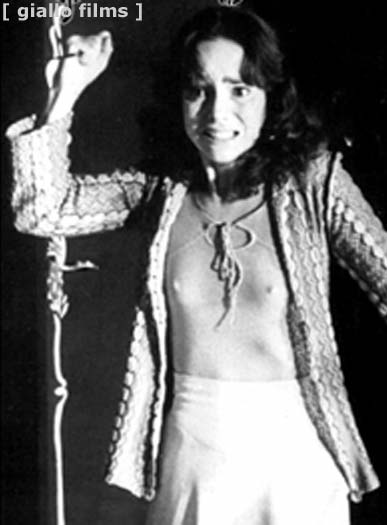
Dario Argento grew up and achieved success in the most Catholicized nation in the world. Could he have been, perhaps subconsciously,
combatting his own innermost fears about the world of witchcraft, a world that at
once utterly fascinated and completely terrified him? Pop-rock extraordinaire
Keith Emerson, who composed the score to Inferno,
has offered that “Dario was probably more scared of the films that he made than
his audience was. I've seen the guy just shaking watching his own film” (“Eye
for Horror”). American horror legend John Carpenter, a friend and colleague of
Dario’s, points out “the story he tells over and over again” as the foundation
of Argento’s fear of the unknown. “There was a hallway at the back of his
house, and when he had to go to sleep at night, for whatever reason, when he
would walk there, he would imagine these things behind the doorways in this
hallway. By the time he got to his room he was in complete terror” (“Eye for
Horror”). Another genre titan, George A. Romero, puts in his own take on how these fears are passed on to audiences around the globe, infecting
the world with manifested realities of Argento's private nightmares. “I think when
Dario gets an idea he is basically trying to communicate either a kind of
horror or an allegory about certain human behavior. He's like Van Gogh, someone who says this is the
way I want it to be, and this is the world. Take from it what you will” (“Eye
for Horror”). As the Satanic Panic stormed through the American 80s, it was
clear that the country had taken Argento’s view of the world very literally
indeed.
WORKS CITED
Holmes, Dr. Leonard. “What the Hell is Satanic Ritual
Abuse”. About.com
Acc. 6/26/05
Jones, Alan. Profondo Argento.
FabPress, London
Locane, Francesco. “Dario Talks to Dark Dreams”.
Darkdreams.org
Acc. 6/29/05
Newton, Michael. “Adolfo de Jesus Constanzo”.
CrimeLibrary.com
Acc. 6/23/05
Stackpole, Michael A.
“The Pulling Report”.
Acc. 6/23/05 .
DVD Sources
Dario Argento: An Eye
for Horror. Dir: Leon Ferguson, 2000.
Image Entertainment DVD ,
USA
Inferno. Dir: Dario Argento, 1980.
Anchor Bay Entertainment DVD , USA
Satan in the Suburbs. Dir:
Scott Hillier, 2000.
WMI Media DVD ,
USA
Suspiria. Dir:
Dario Argento, 1977.
Suspiria: 25th
Anniversary. Dir: Gary Hertz, 2001.

No comments:
Post a Comment