Showing posts with label Emerson College. Show all posts

Tuesday, November 19, 2013

Twenty Years Of Living Dangerously


From the very beginning of my adoration of her, I have always viewed Madonna as an actress first and a singer second. Everything about her life is drenched in performance, and every performance she has ever given is drenched in her life. The lines blur in a fascinating way that no doubt plays a role in her longevity and ability to continually evolve both creatively and commercially. In fact, it is easier for me to understand people’s complaints about her singing than it is for me to get the whole “Madonna can’t act” stigma. She has managed to continually deflect criticism of her voice, at least publicly, but she has never been able to hide her vulnerability to critics' savagery about her performances on the big screen.


This paper was written in November/December 2005, when Confessions On A Dancefloor brought about a dramatic resurgence of interest in Madonna’s music after the relative failure of American Life. I was a student at Emerson College, and this was my final assignment in an “American Independent Cinema” course with the great Rachel Thibault. The course rejuvenated my love for indie cinema at the same time that Madonna’s “Confessions” rejuvenated my love for Euro-flavored disco. And when I revisited Abel Ferrara’s Dangerous Game on DVD that Fall, I bridged my in-class and out-of-class identities in celebration of the most criminally underrated work in Madonna’s filmography.


I was working on this up until the literal last minute, when I ran out the door after printing it out. Thus my hand-in version was rougher, and a lot less clear, than I would ever have wanted it to be.  That’s why I have trimmed and polished it a bit more than my other Emerson College compositions previously resurrected for this blog. I’m not sure how effective it is in its current form, as it is essentially a condensed chapter from a book I’ve always dreamed of writing about Madonna’s screen career. Nonetheless, I hope it makes a worthy tribute to a film that is most deserving of celebration on its 20th Anniversary.


Robert E. Jeffrey 12/13/05

MA421: Final.

                                  Dangerous Deconstruction


It could be said that the term “independent film” is an oxymoron. For an artist to make a film, the artist must accept the fundamental, perhaps shattering truth that they cannot be the sole creator of their work. Writing and live performance are forms of expression which can theoretically be executed anywhere, by anyone, with or without assistance. Cinema, on the other hand, necessitates that the most independently functioning of artists break free from a potential mindset of creating art solely for oneself and judging art solely by one’s own standards. Filmmaking is defined by constant interactions among a wide array of individual artists coming together to birth a work that will inevitably turn out to be quite different from what any one of them might have imagined on their own. This disparity between the vision and the aptly titled “product” probably serves to explain the careers of numerous artists whose work in film rarely, if ever, fulfills their artistic potential. In the case of Madonna, the world’s most famous artist of any medium, the perennial challenge of balancing the desire to control and the need to submit has resulted in one of the most high-profile yet almost universally dismissed film careers of any actor with two decades’ worth of leading roles under her belt.


People really need to see things now more than any time before. They want to build a fantasy around you. This is the age of escapism because the world is in such horrible shape right now. They want to enjoy looking at you and have fantasies about being with you, or they are going to have fantasies about being you. I did the same thing as a child. I do the same thing even now. I think it’s really important for people to have something tangible, and if it’s good looking, and interesting, then that’s even better.
                            
                                Madonna, 1984 UK Radio Interview
                                                   
From the beginning of her career, Madonna has continually sought refuge in the world of independent film, both to sharpen her craft as an actress and to shed, reveal, and reconstruct her media persona through self-financed productions. Excluding student films and avant-garde shorts that she filmed in New York, Madonna’s career in independent film began with the 1985 Susan Seidelman screwball satire Desperately Seeking Susan and peaked with Alek Keshisian’s Truth or Dare, a rockumentary cum sociological study centered around “Madonna ‘90” and her extravagant, cinematic Blond Ambition world tour. Both films are the most critically acclaimed of Madonna’s career. The low-budget “Susan” was one of the most profitable comedies of the 1980s, and Truth or Dare went on to be “the most financially successful documentary of all time” (Rettenmund 3, 48, 179) until the unprecedented success of Michael Moore’s Bowling for Columbine and Fahrenheit 9/11 over a decade later. They are also among the most analyzed American films of the past twenty-five years among post-feminists and media scholars—and, presumably, the incoming generations of young people who have been literally “growing up with” Madonna. Independent film, however, has rarely been discussed as a key component to the success of the world’s most recognizable female entertainer. Feminism, religion, sexuality, family, power, and American social mores are frequent points of discussion (or criticism) in the endless canon of books, magazine articles, and academic essays devoted to Madonna. Yet her role as “actress” has been so universally panned that acclaim or even serious discussion of this aspect of her career is as “uncool” as it is nearly unheard of. 
Since the release of the 1986 critical/commercial flop Shanghai Surprise, there seems to have been an inordinate amount of periodical space filled by scathing commentary on Madonna’s supposed inability to act, or the low grosses for most of her screen work, or pleas from film critics begging that Madonna please stop making movies. This would seem to have resulted in an inherent taboo around discussing her work on the big screen with the same level of seriousness with which one might be allowed to write about her songs, live shows, or overall cultural impact. Part of the reason for this is inevitably because Madonna continually demonstrates an ability to remain omnipotent in the media, aided by the rise of entertainment coverage in print, on television, and all over the internet. Madonna has been a perennial staple of MTV for well over twenty years thanks to distinctly cinematic music videos which have defined her public persona more than any other aspect of her work. But music videos are rarely acknowledged as screen performances. In the public eye, Madonna thrives as “international icon” and “a legendary entertainer”. This makes Madonna’s task of forging a distance between audience perception and on-screen characterization an even more difficult challenge than for most other “stars”. Nowhere else in her film career was the desire to meet this challenge as apparent as in Abel Ferrara’s Dangerous Game (aka Snake Eyes), the most emotionally challenging film of Madonna’s career—for both the actress and the audience. 


Excepting his director-for-hire job helming the 1993 Body Snatchers remake, Snake Eyes (Dangerous Game’s shooting title) was Abel Ferrara’s first film after the success of Bad Lieutenant the previous year. It was also the first project to be released by Madonna’s Maverick Films production company (“Interviews: Vol. 2”), and by all accounts Madonna went into Snake Eyes with nothing short of rabid enthusiasm. In a January 1993 American press conference to promote her upcoming film Body of Evidence, Madonna admitted that, in the years since her big screen triumph as “Susan”, she had made mistakes in selecting scripts based on a desire to be a movie star. She suggested that Body of Evidence and the upcoming Snake Eyes offered more substantive characters than the roles she had played in the past, and would ideally boost her reputation as a serious actress. “I love all of [Abel’s] movies. I think he’s a brilliant director and I love his unrelenting honesty about everything. [Snake Eyes] is written by Abel and Nick St. John, and it’s a psychological drama kind of like Truffaut’s Day for night”. (“Interviews: Vol. 2”) Ahead of production, Disney president Joe Roth personally told Madonna that Snake Eyes would only further damage her screen career when he forced her to choose between filming the studio’s Angie I Says or Ferrara’s “dark” new film, both of which began shooting at the same time. Madonna was forced to turn down the title role in what would ultimately be released as Angie—a vehicle written specifically for Madonna. (“Interviews: Vol. 2”)


In Snake Eyes/Dangerous Game, Madonna plays Sarah Jennings, a successful American television star looking to be taken seriously as a screen actor by teaming up with independent film director Eddie Israel and drug-addled method actor Francis Burns in a dark Hollywood drama chronicling the final, violent night of a volatile marriage going down in flames. Harvey Keitel plays Eddie Israel, a director modeled after Abel Ferrara, and James Russo plays Francis Burns, a character possibly modeled after Madonna’s ex-husband, Sean Penn (Rettenmund 45).  The film weaves surreally between the dark lives of the actors and the dark lives of their characters, drawing parallels between the drug use, infidelity, sexual dysfunction, opportunism, and “spiritual death” going on in both worlds. The film rarely adheres to a narrative: it wanders aimlessly through the most uncomfortable sides of adult life, continually reminding its audience of how different the real world is from the movies we are raised on. Throughout its disparaging, boldly anti-commercial journey into Hollywood-as-Hell, Dangerous Game retains its ability to rivet due in large part to three of the most raw, explosive performances to be captured on film in the 1990s.


Madonna, in her first and last Abel Ferrara film, shed the mannered style of Old Hollywood goddesses with whom she had aligned herself in the past and delivered the most human, fearless performance of her career. The New York Times offered that “viewers may actually need to remind themselves that they’ve seen this actress somewhere before” (Rettenmund 45). Rather than attempt to subvert the audience’s past association with the film’s leading lady, Ferrara constantly finds sly, almost cruel ways to remind everyone that that is Madonna onscreen. The character’s sense of humor, fashion, and vampiric use of people to forward her career are all traits of the media myth of Madonna, the one born of scandal sheets and tabloid columns. Here, this unflattering image is satirized with an utterly realistic performance. As the New York Press put it, “Madonna has either learned how to act or finally found a character not so different from herself…either way, she’s terrific”. Madonna agreed with the sentiment, but was so horrified by the differences between the film she thought she was making and the final cut Abel Ferrara delivered that she refused to promote the film. (Rettenmund 45)

It was an entirely different movie when I made it—it was such a great feminist statement and she was so victorious at the end. I loved this character. I thought I could take the role and do a great performance. It was going to be this great thing for me. And even though it’s a shit movie and I hate it, I am good in it. But the way Abel edited it completely changed the ending. It was like someone punched me in the stomach. If I’d have known that was the movie I was making, I would never have done it, and I was very honest with him about that.

                                             Madonna, 1994
                                                                                                                                                  
          (St. Michael 104, 105)

Since the beginning of her career, Madonna's persona in film and on television has consistently equated sexuality with power and self-assurance. But in Dangerous Game, her character of Sarah Jennings is a stereotypically whorish wannabe movie star, one with so much disdain for herself that she uses sex and a lack of empathy as a means to an end in furthering her film career. In Mother of Mirrors, the film-within-a-film, we see this young actress being beaten and raped and humiliated, sometimes in character and sometimes out. This performance is a stark contrast to the “pornography-as-power” exercise in gender reversal that had caused an uproar one year prior with the release of Madonna’s Sex book, a work that she oversaw from conception to release—unlike Snake Eyes/Dangerous Game. “I don’t have the power in the film industry that I have in the music industry. The director is the one in control, and everyone else is a pawn. [The director] can take [your] performance in the editing room and completely change the character.” (St. Michael 105) 
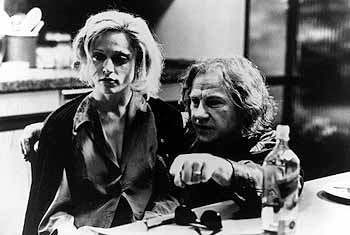

                  In the years since its notoriously unsuccessful release, Dangerous Game has largely been overshadowed by Abel Ferrara’s subsequent films outside of Hollywood and Madonna’s subsequent achievements outside of film. It is scarcely touched upon in retrospectives of Madonna’s career, but Ferrara himself has no desire to mince words when it comes to Madonna. "She's a fuckin' jerk!  Like we sit around taking out the best scenes in the movie to spite her. You know how paranoid you gotta be to fuckin' say something like that?" (Jones 3)  Abel Ferrara’s ex-wife, Nancy Ferrara, who played the character of Eddie Israel's wife, Madlyn, recalls the vitriolic reaction Madonna gave Abel upon seeing the rough cut. Being interviewed for Andrew Morton's 2001 biography Madonna, she recalled a series of fuming fax letters that Nancy Ferrara felt revealed more about Madonna than about what was "wrong" with the film.

She was so angry about the movie. The faxes were just nasty. “You fucker, you’ve fucked my life”, that sort of thing. The whole tone was about her, “I” and “me”, “I” and “me". She looked very vulnerable and that was really pulling her apart. At the end she revealed that when she is not in control, she is not as secure or confident as she would like everyone else to think.  She revealed something of her humanity. That is why she wouldn’t endorse it. It hit too close to the bone. She hit on all that emotion and couldn’t face it.”     
Nancy Ferrara                                                       (Morton 257, 263)

           Madonna has clearly been influenced by Hollywood legends like Bette Davis in her attempts to build a body of cinematic work as both an actress and an icon. But Madonna never worked as often before the camera as stars like Bette Davis, making movies only sporadically and rarely making two films back to back without an album or tour in between. Thus the results of Madonna’s attempts to have a great screen career have more often than not been disappointing. Madonna has never been one to shy away from this, but in the case of Dangerous Game, a tremendous work was unfairly deemed a failure by none other than Madonna herself. One might theorize that Madonna’s violent hatred for the final cut stemmed from being unable to construct her own identity within a film that was, seemingly, the antithesis of values she had come to represent. Yet her dual turn as Sarah Jennings and Sarah’s movie-within-a-movie character, Claire, oozes with the “relentless honesty” that drew Madonna to Ferrara in the first place. One cannot help but wonder why she dared not embrace a performance that was so memorably uncompromising, especially when Ferrara’s assaultive approach to cinema was what prompted Madonna to put faith in his ability to bring out the best in her.

“In an interesting artistic inversion, the perceived realism of Madonna’s documentary, Truth or Dare, merely recorded the essential artifice and staginess of her Blond Ambition tour, while in Ferrara’s movie, supposedly an exploration of make-believe, Ferrara ripped away her carefully contrived mask, the director literally wrenching a draining and difficult performance out of her. Madonna never saw it coming.”
                                                             Andrew Morton
(Morton 260)


SPOILER ALERTDon't watch this unless you've either already seen the film....

or never intend to.


Abel Ferrara certainly did bring out the best in Madonna: she’s arguably never been better onscreen. At least as much as her Golden Globe-winning turn in 1996’s Evita, Dangerous Game is celluloid proof that a gifted actress lay within the seemingly fearless, seemingly unstoppable multimedia megastar cum superheroine known worldwide as “Madonna”. The film reveals human frailty behind the shining armor of a warrior goddess, but like a general snatching back plans before they can fall into enemy hands, Madonna was not ready to let down her guard. Perhaps, now a more evolved artist than ever, Madonna will be so willing to once again be this forthright and revealing on the big screen, as she continues to be in other mediums. Regardless, the immortality of film insures that Dangerous Game, like Desperately Seeking Susan before and Evita after, will live on as proof that “Madonna, Queen of Pop” could very well have been “Madonna, Queen of Hollywood”.  


WORKS CITED

Jones, Kent. “Abel Ferrara, The Man: Who Cares?” Culture Port: Ret. 12/7/05

Madonna. Interviews. Baktabak Recordings. 1995.

Madonna. Interviews: Volume 2. Baktabak Recordings, 1997.

Morton, Andrew. Madonna. New York: St. Martin’s Press, 2001.

Rettenmund, Matthew. Encyclopedia Madonnica. New York: St. Martin’s Press, 1995.

St. Michael, Mick. Madonna: In Her Own Words. Great Britain: Omnibus Press, 1999.

Monday, April 22, 2013

A Decade Of Madonna's So-Called "Life"


Madonna’s American Life album put me on the path towards completing my very first screenplay, the title of which would go on to be the theme of every script I have written in the ten years since: Disillusion. The realization that I was fantasy-obsessed, and patterning my life after Madonna's career, was obvious to my loved ones ever since I poured all of my nine year old creative energies into that video tribute to "Vogue". But my own epiphany would not come about until the release of American Life, ten years ago today. I figured there would already be plenty of fellow SuperFans putting this album and its unprecedented commercial failure against the backdrop of the cultural climate that followed the horrors of 9/11 and preceded the horrors of The Iraq War. So instead of a sociopolitical context, I thought I'd do what I do best and put this album into the context of....Me.

Hi. 

Rather than a proper multimedia retrospective, I offer a random assembly of thoughts, linked by some of my favorite tracks from one of my favorite albums. It's me at my most honest and unstructured because American Life is Madonna at her most honest and unstructured. And who would I be if not someone who lives and breathes to pay tribute to Her? Whereas now I can say that as a tongue-in-cheek nod to my trademark penchant for idol worship, such a statement would have been a lot less ironic ten years ago. Up until “The American Life Era”, my devotion to Madonna could theoretically have been read as amusing, admirable, or pathetic. It was Madonna herself who not-so-subtly encouraged me to look deeper into myself and how I could contribute to the world with the same passion with which I contributed to her record sales. It was, specifically, a statement she made when performing before an audience of SuperFans at an HMV Record Store in London on May 9th, 2003. 

"In the process I forgot....that I was special too."


It was the sort of promotion one would expect from an artist at the launch of their career, not the relaunch. Fans slept on the street to get into that ultra-exclusive, never-broadcast mini-concert. Yet while Madonna thanked them for their worship, she also encouraged them to put it towards their own betterment, not just hers. As she worded it herself that day: 

“If you want to pay tribute to me, do something important with your life.”


Those three words rang through my head, for they gave me permission to love myself as much as I loved Madonna. Initially, “maximizing my own potential”, as a guru might put it, was the ultimate tribute to my idol. But in time (thanks to my impeccable taste in idols) the desire to do good had (roughly) as much to do with love for humanity as it did with worshipping a Goddess. Thanks to the impact that Madonna’s American Life had on my American life, today my devotion to Madonna is defined by self-respect and a commitment to my own growth as an artist and human being. It all began the summer after the album was released, when I sacrificed my busy social life to commit myself to the isolation I required in order to complete a screenplay. Whereas my life before American Life was dominated by watching movies, my life after American Life has been dominated by writing movies: nearly all of my film viewership since 2003 has, for better or worse, been a part of my own artistic process. And it was Madonna's "Life" which opened the creative floodgates. 

Thanks, Madonna!

Even though American Life continues the journey Madonna embarked upon with Ray of Light and subsequently Music, in many ways this is, in fact, a reboot of her career—hence those record store gigs on both sides of the pond.  If Confessions On A Dancefloor was the 21st century reincarnation of her eponymous first album, then this was the debut record of the artist who Madonna was before she ever signed a recording contract, back when she shifted between rock and disco in New York clubs. Her guitar work on this album is apparently amateurish (I wouldn't know one way or another) but it's also as painfully honest as an adolescent love letter (which I can vouch for with more assurance). Ditto her youthful, almost child-like singing, a far cry from the post-Evita vocal training that impressed and divided listeners of Ray of Light and Music. For the "calculating" SuperDiva to have been so vulnerable and unpolished remains among the ballsiest moves Madonna ever made. It also defined the "screw the career, I'm finally happy" quality of both the album itself and how it was sold to the record-buying public.


The first televised performance of one of my all-time favorite songs. 

I was convinced American Life would be a smash, though that didn't stop me from buying ten copies of the CD in its first week of release to help it debut at #1 in America—which it did, giving Madonna her first back-to-back #1 albums in the U.S. since the 80s. Alas, it was soon to tumble down the charts. Fearing my overspending was bad karma and lead to weak sales, I went on to buy another eighteen copies on CD, vinyl, and eventually digital download between 2003-2005. This meant a lot of people were gifted copies of American Life during the two and a half years when it was "the new Madonna album". I gave a copy to the security guard at my building. I handed out a few to fellow college stoners after passing around my old bong, “Veronica Electronica”, while not-so-subtly playing the full length album. (Cannabis has never diminished my ability to be a fascist host to my company.) I even mailed CDs to friends and relatives along with a wordy letter about how Madonna's new album was her best ever and yet was being totally ignored by radio stations and in turn record buyers. In fact, quite a few of those friends and relatives became bigger Madonna fans after they actually heard the album. I even gave a CD to one of the first guys I ever hooked up with on his way out my door. The encounter was lovely, but the greatest pleasure that came out of that afternoon was learning that the album made him a bigger Madonna fan, too.

"How could it hurt you when it looks so good?"

Like many fans, I often wonder where Madonna's career would have lead, or what completely new shape it might have taken, had American Life sold as many copies in America as did the two albums that preceded it. It could have been the political mood of the country. It could have been the hostile reaction to the panned performances Madonna gave onstage in Up For Grabs and on the big-screen in Swept Away and Die Another Day. Or maybe it was just the same good old-fashioned misogyny that made the life-after-forty years of Bette Davis and Joan Crawford an uphill battle against "you already made it, so now be quiet" ageism.

"Do I have to chaaaange?!"


Ultimately, American Life's commercial failure shaped the subsequent decade of Madonna's career. She began to embrace her "greatest hits" catalogue on The Re-Invention Tour, and returned to a full-on dance music album after American Life's commercial and promo-only remixes dominated the Billboard Dance/Club Play charts for two years. Like most fans, I thought Confessions On A Dancefloor was an even better album--in fact, it's my personal favorite of all time, and I imagine it always will be. But “Confessions” is not simply a great album: it is the perfect companion to the downtempo American Life, and I could never have loved "Confessions" if I had not first fallen in love with "Life". Personally, I have always regarded both as Disc 1 & Disc 2 of a haphazard Double LP sent from the Gods and Goddesses of Pop Utopia. You cannot fully appreciate the exquisite pleasures of one without the other, and you cannot deny that each takes the listener on a journey from hard thumping to pleasant release. (Feel free to view those words as an aural, lyrical, sexual, or spiritual reference: all four interpretations apply to both albums.) And so today I honor not only American Life, one of Madonna's best albums and one of my favorite works of art, but also the incomparable changes it lead to in my life. I cannot put into words just how grateful I am to Madonna for weathering an embarrassing commercial failure in the (X-static) process of inspiring countless artists like myself. And to think, it's only been ten years....I'm thrilled to imagine the influence that this truly timeless, ever-listenable album will continue to have on my life and millions of others in the decades to come.

"And the world can look so sad....only you make me feel good."

Thursday, November 15, 2012

Confessions Of A Love Whore

During my freshman year at an all-male Catholic high school, I was infatuated with a straight classmate. As in past entries, I refer to him as "James", because he so strongly resembled my teen romance ideal: James Marsden. James was only in two of my classes, and we never hung out off campus because he lived in another city. Yet I spent the next several years of my life in love with him—even though I never saw him again after the ninth grade. 

Just over a year ago, I rediscovered a love letter that I wrote to James back in high school. I never sent it, but I decided to share it with the world, because  it captured being hopelessly in love and hopelessly sixteen in a way that is universally relatable regardless of gender or sexuality. I timed its posting with the anniversary of Madonna’s Confessions On A Dance Floor, because I love that album like no other and wanted to underline that with an extra special blog post. This year, as the first in a series of deeply personal new entries, I thought I would celebrate “Confessions Day” by sharing the sobering follow-up to my unrequited high school love story. For some of you, it may turn out to be as empathetic as last year’s post, if less nostalgic and more humiliating.


I was convinced that James had feelings for me during that first year of high school, based on many brief but seemingly revealing exchanges. Even accounting for my overemotional adolescent perspective, I don’t doubt I was a little bit right: he was straight, but there still appeared to be something between James and I when we were fifteen...despite of our lack of any physical contact. It was fleeting and youthful, so much so that it would not have lingered on in the memories of people like James who live and grow in the real world. But for a cinematically inclined escapist such as myself, the experience was an unbelievably potent high, and I refused to leave it in my past. So I shed any semblance of shame and relentlessly pursued this literal dream romance. That is, until what began so subtly in our freshman year of high school came to an operatic finish in our freshman year of college.

I spent my sophomore and junior years waiting for my secretly admired to phone me out of the blue, revealing he’d been in love and waiting for my call until it became unbearable to harbor his feelings any longer. After two years of that never happening, I spent much of senior year trying to arrange an opportunity to hang out, hopeful that we could reignite a friendship if I could hide my feelings long enough to make him fall in love with me. Every effort to see one another failed, and I should have left it at that. But I could not allow myself to believe that James would not love me one day. I knew that to an outsider (which, at thirty-one, is what I am today) all of this would appear crazy. But to my eighteen year old self, the craziness was precisely what made it feel so romantic. Or, should I say, “so romantic comedy”.


By the first year of the 21st century, everyone but James knew about my feelings for James. Endlessly bemoaning the hole in my heart took its toll on my social life in the first semester of college, and never more than on New Year's Eve 2000. I was lonely and depressed, so I deliberately avoided Midnight by sitting in a movie theater by myself for the late show of The Family Man. It was my second viewing of the Brett Ratner film in which Nicolas Cage was a wealthy businessman who found happiness in an alternate reality where he’d married and had children with his great love, played by Tea Leoni.  At that time, I was living a life of privilege and being afforded opportunities that I would not be able to fully appreciate until many years later. But I was consumed by the perceived void left behind when James went to a new school and I turned him into a benchmark which no other guy could match. I constantly dreamed of giving up all the monetary perks of my life in order to be with him, if only because such a sacrifice, I thought, would prove that my love had always been real.

My freshman year at Emerson College, and James’s first year in the military, both coincided with the peak of AOL Instant Messenger’s popularity. Somehow I got a hold of James’s screen name on there, and before long we were, like in my dreams come true, "talking" all the time. 
Right after Valentine’s Day 2001, following weeks of daily correspondence, I decided to throw caution to the wind and tell James everything. And when I say everything, I mean EVERYTHING. What I wrote was not that far off from my unsent love letter in its massive length and total shamelessness. But the difference was that what was sweet when I was sixteen was desperate when I was nineteen. I shared the unsent love letter with the world because I thought it was relatable for anyone who remembers being that age and feeling those feelings. But I cannot bring myself to ever re-read the one that I did send.

James did not get to read the letter for several days, during which time we continued chatting online regularly. Then, one afternoon, I decided to escape my anticipation anxiety with film that I felt paralleled my longing: John Cromwell’s 1934 Bette Davis-Leslie Howard adaptation of W. Somerset Maughm’s Of Human Bondage. It was my second viewing, having seen the film two years prior when I began appreciating the films that made Bette Davis a star. But that day, it was not a piece of cinema history. It was a piece of reflective glass, and it was my life that was being reflected. 


As soon as it ended, I went from my living room to my bedroom, where my pre-wireless laptop was connected to the modem. My AIM Away Message was onscreen, awaiting a response from James. That day, the message was a quote from Edgar G. Ulmer’s film noir classic Detour.

“That’s life: whichever way you turn, fate sticks out a foot to trip you.”

There was no word from James when I got to my laptop, but seconds later, before I could look away from the screen, his response appeared before my eyes. I don’t remember all of what he wrote, except that it was the longest piece of text I’d ever seen on AOL Instant Messenger written by anyone but me. Only the Cliffs Notes version remains in my mind: that he appreciated my friendship and respected me tremendously as a person but that he didn’t share these romantic feelings and would not be comfortable continuing to communicate with me at that point in his life. He was never anything but respectful, kind, classy….all the traits that made me fall for him in the first place. He did not respond the way I had dreamed of, but he wished me well on the rest of my life journey. Had I respected his wishes, we might have crossed paths down the line and formed some sort of friendship as mature adults. I should have left things there, because his message, while unbelievably disheartening, gave me the chance to quit while I was (sort of) ahead.

Alas, I had to continue playing the role, in my mind, of the hopelessly-in-love ingénue who would stop at nothing until she won the heart of her leading man. We shared our last correspondence mere minutes after I’d watched Bette Davis die onscreen in Of Human Bondage, and yet I was still convinced that my relationship with James was following a screwball comedy archetype. At the time, I thought I was being quirky. I now realize I was overbearingly obsessive. I continued to send long emails. I uncovered his new AIM contact information after he changed screen names.  I even tried to buy his love the following Christmas by mailing him a gift: a CD book containing twenty favorite movies on forty Video CDs. The package, and its included letter, was opened and returned to me, minus any written response. From that moment on, I feared I was, to James, becoming the star of a different kind of film. The movie collection looked like a generous peace offering when I mailed it out. But it looked more like a threat than a gift when it was spat back at me. I trembled at the thought that James now saw me as Jessica Walter in Play Misty For Me, whereas all along I saw myself as Madonna in Who’s That Girl. Mainstream audiences clearly never appreciated the outrageous charm of Who's That Girl the way that I did. And James, clearly, did not find anything charming about my outrageous persistence.


Eighteen months after the worst Christmas gift idea of my life, I had finally purged this infatuation from my system. Prior to that, every few months I would find myself unable to resist emailing self-indulgent letters to James, letters that inevitably were really being written to/for myself.  With each letter I was deliberately inviting him to loathe me, instead of wanting him to love me. At that time in my life, the former came much easier to me than the latter, and I knew it would for James, too. I hoped we could share, if nothing else, that same contempt. As I grew to forgive and love myself for acting in such an over-the-top manner, I moved past that moment in my life, and opened the door to meeting my best friend and entering my first relationship. I don’t know if James ever did end up hating me, but I have often hoped that he forgot me.

The conclusion of my story about the young man I refer to as “James” may not be what some readers of last year’s entry had hoped for. It certainly was not what I was hoping for when I was a teenager. But today, I’m thankful for the way things turned out. In interviews collected in the book The Girl Who Walked Home Alone, Bette Davis told author Charlotte Chandler that “a watched telephone never rings”. I know that firsthand from the years I wasted as a lonely teenager relishing the role of “lonely teenager” far too much. Admitting my defeat forced me to finally acknowledge and improve upon the aspects of my personality that are adorable onscreen but destructive in real life. And, combined with my ABBA love, it gave me a unique appreciation that eventually lead to “Hung Up” becoming my favorite Madonna single of all time.


Thursday, November 8, 2012

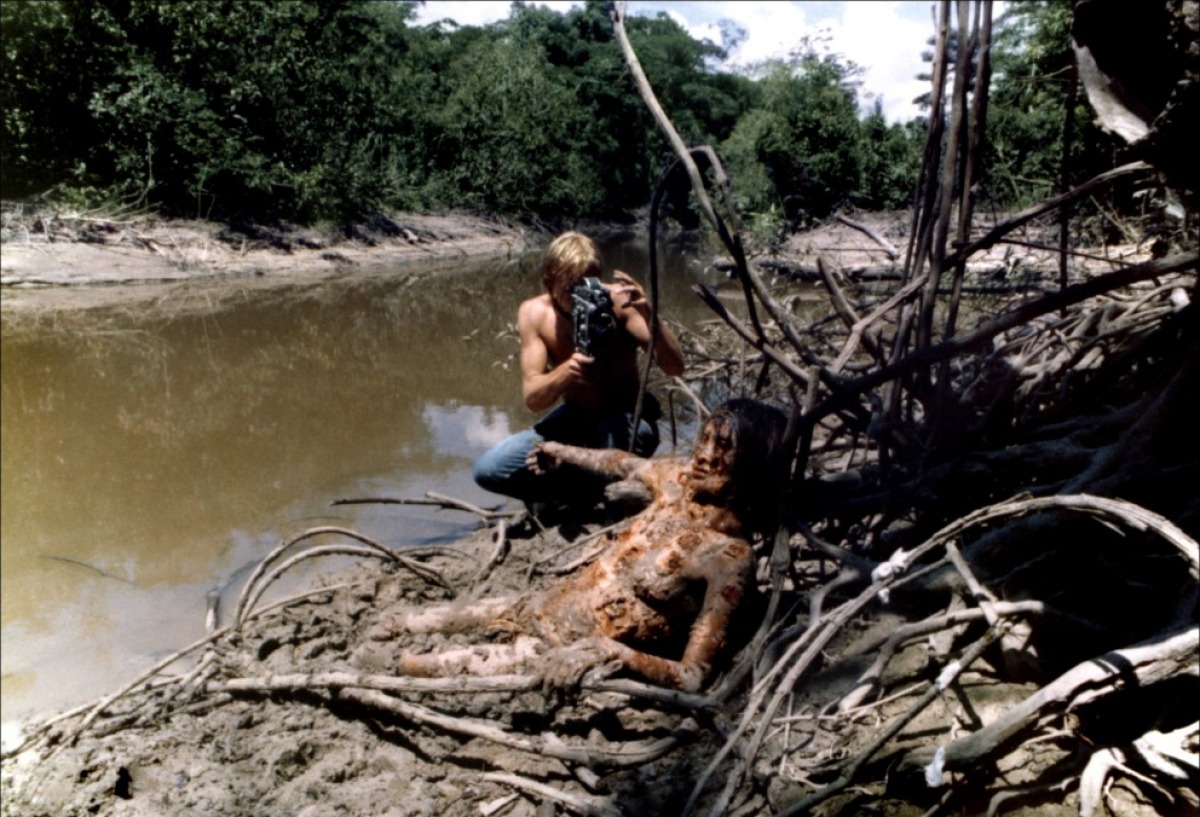
Wartime Journalism & "Cannibal Holocaust"

I knew what I wanted in high school. I wanted to go to Emerson College and study film. I just assumed that becoming a Hollywood screenwriter would immediately follow suit. My parents were wiser and always encouraged a backup plan, namely in journalism, but rather than listen I chose to gamble.
After taking a leave of absence midway through college to work on a failed indie horror film project, I returned to Emerson with a renewed vigor. In an attempt to expand my horizons and appease my parents’ suggestion, I took a “Wartime Journalism” class with the renowned Jerry Lanson...despite the fact that I never watch the news. I like horror onscreen, but I hate it in real life. That class, while amazing, underlined why I was not cut out for journalism. Thus I took the assignment of my final paper as an opportunity to explore my mind and rave about a favorite artist's misunderstood work of art, pastimes that I indulged in at least once a semester. For my Wartime Journalism class, the spotlight was on Ruggero Deodato's unbelievably controversial Cannibal Holocaust. I first saw this film in Summer 2001, after several years of avoidance based on its gruesome content and questionable reputation from both a cinematic and moral standpoint. Much to my shock and delight, I fell in love with the film that day in June. Much to my shock and horror, I relived its impact when the world changed that following September 11th. Barring Madonna and a handful of favorite (scripted) series, I have relentlessly avoided watching television ever since.


Robert E. Jeffrey 4/15/2005

JR485: Final Paper


     Outsider In: Looking at the

                      Psyche of the War Journalist 


I was first intrigued by the concept of wartime journalism in 2001 as a result of two significant works of filmmaking. The first, in the summer of 2001, was my viewing of a highly controversial, oft-banned 1979 Italian horror movie called Cannibal Holocaust, about the ill fate of a US network documentary team who travel the world staging or inciting bloody warfare and filming it to draw record ratings. The second was a documentary which aired on CNN shortly after the September 11th attacks, one which showed the public execution of an Afghan woman convicted of adultery  and the skinned bodies of enemies of the Taliban.

The atrocities in both films, one a satire of the American media and one an insight into life under the Taliban, were similar in tone and content. They also equally provoked my interest in disturbing questions about what should be filmed and broadcast for television, and about the true intentions of the filmmakers who cover the world we live in. At the time, I was angry at what I perceived to be exploitation of current events. In the wake of the impact that Cannibal Holocaust had on my cynicism and the impact that 9/11 had on my paranoiac tendencies, I initially suspected CNN was exploiting literal “snuff” footage for ratings in the wake of a national tragedy and an international panic. These two powerful films shaped my perception of wartime journalism, prompting a unique approach to this course that finally lead to my writing this paper.


Despite being someone with no interest in a career in journalism, I am amazed by how much the experience of journalists who voluntarily commit themselves to the ghoulish horrors of warfare--all for the sake of authentically capturing it through their own eyes--has influenced my artistic endeavors. This is not to suggest that the lifestyle of a wartime journalist (a profession I was admittedly unfamiliar with until recently) has ever guided the formation of my ideas. Rather, it is because the existence of this profession, and the nature of their daily lives, has offered a whole new perspective to me on the role of violence in the media.

When journalist David Filipov spoke before the class, I was emotionally enslaved to his presentation: laughing at some stories, recoiling in horror at others, and vicariously riding the adrenaline rush of his brushes with death. It was a fascinating journey to go on, as an audience member. But to actually experience it must leave an incalculably profound effect. I wondered if his memories weren't far less entertaining without the benefit of an engaged, but naive, audience: going back and forth between enemy sides in a foreign country, performing as an actor or comedian to protect your body and life, witnessing brutality and knowing that your lives and the lives of those around you could vanquish at any second. I tried to imagine going from that lifestyle to sitting at a desk at the Boston Globe. Those front-line atrocities must still seem more real, even more present, than anything happening around him in America possibly could. Having learned that he has two children, both of whose parents are working war journalists, I wondered what home life must be like: after stretches of domesticity, do he and his wife both feel a need to be back in the heat of combat? And does this affect the security of children longing for the protection of Mom and Dad?

Most parents would probably agree that David Filipov and his wife made the right decision in leaving that world behind. Recent international events have demonstrated that the mere thought of a war going on can bring about great anxiety in young children, even those who have no familial connection to it whatsoever. A 2004 article entitled “Controlling What News Your Child Sees From TV” on the memorial website 9-11 Heroes references a study by the Georgetown University Psychology Department on the effects of repeated news footage of the September 11th attacks on elementary school children. (9-11 Heroes) “Of the children in the study, 85 percent indicated that their basic sense of security and safety were shaken by the September 11 attacks.  Psychology Department Chair Deborah  Phillips reported afterwards that 'no one lost a family member…it was children not directly associated with the attacks, so I was surprised to find such high levels of stress. I expected maybe half, not 85 percent.'" (9-11 Heroes)

            These numbers merely refer to young children, with an inevitably limited understanding of the profundity of war but an innate fear of its deadly destruction. On the complete other end of the spectrum, the military and war journalists actually go to that proverbial “front line”, with many of them spending long stretches on the precarious road between a life removed from reality and a death lifted from gory nightmares. And what of their sanity? If children can be rocked to the core by repeatedly broadcast news footage of American skyscrapers tumbling into a city of people screaming in terror and distress (9-11 Heroes), could someone who sees such atrocities on a regular basis, for an extended period of time, possibly hold onto a sound mind?


As a writer of fiction, I was so affected by Mr. Filipov's classroom presentation that it prompted my decision to let the nature of this Wartime Journalism course shape a screenplay that I had been writing, one I already planned to incorporate into a separate class on the nature of violence in literature. This was compounded by the visit of Kevin Sites, who took a less dazzling, more analytical, and ultimately vulnerable approach to his experiences as a war journalist. He revealed that he had suffered the loss of a marriage and more than one engagement due to his commitment to his profession, and before the entire class he openly grappled with questions of what ethics to abide by in his career. It was very clearly an honest search for answers, rather than a demonstration of his career success. 
What most piqued my interest in learning about the profession of a war journalist was a desire to understand the psychological effect that “the news” has on the people who cover it. It seems that a lot of airtime and column space over the past two decades has been devoted to how children are affected when they see bloodshed on the six o’clock news, why teenagers run to slasher movies at the local multiplex, and what all this could mean when said young people enter the adult world. But it would appear, at least on a mainstream level, that less emphasis has been placed on the psyche of the people who broadcast such violence: the executives and editors and censors and newscasters who watch that bloody reality everyday and then decide on how they will break such truths to the rest of the world. At the heart of such mental and moral questions is the war journalist. Often a lone human being with modest protection and a questionable span of life, (s)he is willing to give up everything to potentially write the article or take the photograph that leaves a lasting impression on society. This passion, this monogamy, and this potential for horrible means of destruction has fascinated me since the beginning of the course, and it is what sent me off to at least scratch the surface of how a psychologist would look at the mind of a war journalist.


In 2004, The National Center for Post-Traumatic Stress Disorders (PTSD) released a fact sheet entitled “PTSD in Journalists” written by Dr. Elisa E. Bolton and containing new findings from studies on journalists that were conducted in 2002 and 2003. (Bolton) Dr. Bolton points out that “it has been assumed that journalists are not permanently impacted by death and destruction…[that they are] unusually tough, somehow immune to the reverberating impact of the human suffering they witness.” (Bolton) “Journalists are often exposed to highly stressful, traumatic situations, and required to bear witness to others who have been overwhelmed by traumatic events. While emergency workers have, particularly in the last decade, recognized the need for self-care and organizational safeguards, journalists may not yet have been recognized as potential candidates for employee safeguards and increased support.” (Dart Center “Self-Primer”)
Does the general public care about the minds and lives and fates of war journalists? It’s sad to say, but time and time again the masses seem more apt to be moved by the sight of a fallen soldier--perhaps because the image is unconsciously identified with the most heroic figure in the spectator's life--than by the brutal death of a captured war correspondent. “In recent years there has been growing recognition that being a journalist, especially a war correspondent, can be quite dangerous. In 2001 alone, 100 journalists were killed. Organizations and researchers are recognizing that in addition to the danger of death, journalists are exposed to the risk of great emotional distress. Yet, [recent research] also indicates that few employers of photojournalists recognize the stress and negative impact on mental health that is associated with some assignments. Even fewer employers offer counseling services and education about PTSD symptoms.” (Bolton)
            The irony is that education about what one should or should not do on the front line would not necessarily be put to use anyway. In The Psychology of War, Lawrence LeShan excerpts the reflections of a WWII veteran named William Manchester who was hospitalized in Okinawa but escaped so that he could rejoin his fellow marines on a dangerous mission that they were about to embark on. “It was an act of love. Those men on the line were my family, my home. I had to be with them, rather than let them die and me live with the knowledge that I might have saved them. Men, I now know, do not fight for flag or country, for the Marine Corps or glory or any other global abstraction. They fight for one another.” (LeShan 97)
While William Manchester was speaking as a veteran of combat, he could very well have been speaking as a wartime journalist. David Zucchino, a correspondent embedded with troops in Iraq, described his own experience as though he were a soldier, not a writer. “Peering through one of the Bradley’s three-inch-slits of bulletproof glass, I wasn’t just viewing the battlefield for a news story. I was searching for Iraqi fighters for the gunner to kill.” (Greer)


In War Is A Force That Gives Us Meaning, journalist Chris Hedges asserts that he  managed to retain his morality during his own wartime experience. However, referencing his time covering the first Gulf War, he concedes that, in the midst of the battlefield, a state of amorality is all too easy to sink into. “The prospect of war is exciting. Many young men [believe that they will] discover their worth as human beings in battle. The admiration…the glory…the ideal of nobility beckon[s] us forward. All the more startling [is that] that such fantasy is believed, given the impersonal slaughter of modern industrial warfare. Iraqi soldiers were nothing more on the screens of sophisticated artillery pieces than little dots scurrying around like ants—that is, until they were…reduced to scattered corpses….[by] high explosives fired from huge distances.” (Hedges 84)
Even in our advanced state of technology in the arena of mass murder, the human psyche has yet to be upgraded. It is just as vulnerable to emotional damage from firing today’s high-distance blasters as it was from impaling enemies face-to-face with bayonets a century ago. “Men in modern warfare are in service to technology. Many never actually see the people they are firing at nor those firing at them. To be sure, soldiers who kill innocents pay a tremendous personal, emotional, and spiritual price. But within the universe of total war, soldiers only have time to reflect later. By then these soldiers often have been discarded, left as broken men in a civilian society that does not understand them and does not want to understand them.” (Hedges 83, 86)
Even the most celebrated of wars—the  wars that carve out nations with the greatest of prospects, the wars that restore peace to troubled lands, the wars that literally save the world—the effects of violence prove immune to the glory of the soldiers who fight or to the journalists who cover their fighting. In War and Human Nature, Stephen Peter Rosen discusses the findings of a physiological survey conducted by the U.S. Army in the Spring of 1944. The first element discussed in the original review of the data was the stress level of all of the troops surveyed, which was related to “many factors, but among all of the factors, lack of sleep was cited more often than any other as a factor affecting combat performance”, with  troops citing few hours to sleep even during quiet times at war. (Rosen 110)
However, studies conducted in the 1960s on the effects of sleep deprivation as a stress-inducer lead to retrospective reanalysis of the WWII study, leading to the very possible conclusion that the WWII respondents were  hampered by fatigue and uncertainty moreso than lack of sleep. “Fatigue, the weariness that sets in after performing a task for long periods of time, has complex effects on human thinking and behavior. [In the 1960s studies], a particular kind of stressor—uncertainty—produced an entirely different reaction”. (Rosen 112-113).


Citing the actual test results, Rosen explains that the brain’s “corticosteroids are produced by conditions of novelty, strangeness or unfamiliarity—in which uncertainty is paramount. Unfamiliar situations produce feelings of uncertainty or anxiety which in turn trigger the secretion of cortisol. Cortisol levels are found to be particularly high in anxious or depressed patients.” (Rosen 113) But lest one think that journalists who covered WWII were spared such mental reverberations, Pulitzer Prize-winner Ernie Pyle’s recollections offer a startling account of the inescapable transformation. “Before he died in April 1945, war correspondent Ernie Pyle wrote, 'I’ve been immersed in it too long. My spirit is wobbly and my mind is confused. The hurt has become too great.' If this happens to you, seek counseling from a professional.” (Hight & Smyth, Chapter 4).
Much to my pleasant surprise, the Internet has given birth to a vital organization that was formed specifically to address the oft overlooked psychological needs of journalists who cover traumatic events. “The Dart Center for Journalism & Trauma is a global network of journalists, journalism educators, and health professionals dedicated to improving media coverage of trauma, conflict, and tragedy. The Center also addresses the consequences of such coverage for those working in journalism.” (DartCenter.org) Among the many resources available through their website is a “digital handbook”, Tragedies and Journalists: A Guide for Effective Coverage, by Joe Hight and Frank Smyth. In it, the authors take an empathetic approach to the daily lives and stresses of the modern journalist. “An exceptional thing about journalists is that we alone seem to think that we are exceptional in our reactions. Violence and its emotional aftermath affect all first responders, including police, fire, and ambulance workers as well as journalists.” (Hight & Smyth, Chapter 8).


In their message to journalists, Joe Hight and Frank Smyth integrate throughout each chapter the need for journalists to constantly communicate, to vent out what they see and how they feel in response—perhaps because, the authors suggest, journalists don’t do it enough. “A coffee shop or a bar may provide colleagues with an invaluable venue in which to talk and perhaps debrief each other about the emotions of their work. Recognizing the need for a debriefing forum or the opportunity to articulate emotions in the aftermath of a school-yard massacre or the World Trade Center attacks is not a sign of weakness, as too many journalists seem to think. Instead, when done successfully, debriefing fosters strength. The act of articulation — writing, drawing, painting, talking or crying — seems to change the way a traumatic memory is stored in the brain, as if it somehow moves the memory from one part of the hard drive to another. Journalists are people who, like almost everyone else who is exposed to pain, feel it whether it is theirs or not. Keeping it bottled up may only prolong its impact and make it worse in the future. Journalists, including free-lancers, should seek and take advantage of opportunities for both peer and professional counseling.” (Hight and Smyth, Chapter 8).
As a writer of films that explore the many facets of of sex and the nature of violence, I can relate to a journalist. I see the innate perversity of my screenwriting reflected in journalists' work in a very striking fashion: we both spend our hours penetrating a world of unspeakable depravity as a means of achieving career goals that feel less like signposts than they do missions, on which sanity and mortality is trivial compared to the work left behind. It is clear that journalists, as a group, are as dedicated to constantly expanding and improving upon their coverage as artists are dedicated to enhancing their body of work. Like artists, they are less interested in their safety--physical or mental--than they are in the final product, and they may be inclined to express their thoughts and fears through work rather than conversation. But clearly these related traits are dangerous, and unnecessarily so.
Journalists and artists communicate with the world on a profound level, putting passion and commitment towards work that stretches their emotional landscape. But raising their adrenaline by being exposed to ghastly horrors is as all-consuming in its destructive danger as it is inescapably thrilling. Wartime journalists are  prone to the same effects commonly associated with post-traumatic stress disorder in soldiers, and this is why they need just as many resources and just as much emotional support as an ER doctor or police officer. David Filipov and Kevin Sites have recognized this, and their respective classroom presentations served as a form of the catharsis that is vitally necessary in their profession. But that doesn’t mean that they won’t go back to the front line, because it doesn’t mean that they have grown immune to the euphoric excitement of their brilliantly deadly profession. Like artists, war journalists are passionate about living their lives doing what they love....even if life itself should end on the job. 


Works Cited

Hedges, Chris. War Is A Force That Gives Us Meaning.
Anchor Books, New York. 2003

LeShan, Lawrence. The Psychology of War.
            Helios Press, New York. 2002

Rosen, Stephen Peter. War and Human Nature.
            Princeton University Press, Oxford. 2005

Web Sources

Bolton, Dr. Elisa E. “PTSD In Journalists”. National Center for Post-Traumatic
Stress Disorder: Department of Veterans Affairs.

Greer, Jane. “War and Peace, Human Agency, and
Other Matters”. UUWorld.org

“Self-Care Primer”. DARTCenter.org

Hight, Joe, and Smyth, Frank. Tragedies and Journalists:
A Guide for Effective Coverage. DARTCenter.org

             
Mission Statement”. DartCenter.org


Film Referenced:

Cannibal Holocaust. Dir: Ruggero Deodato, 1979.
EC Entertainment DVD, Netherlands. 2001