Today marks thirty years since the Italian release of one of
Dario Argento’s most acclaimed and popular films: Tenebrae. I have posted to this blog many times before about Dario
Argento, from writing about his best films (Suspiria,
The Stendhal Syndrome) to his not-so-best
films (Trauma) to the massive role he
has played in shaping my identity as a child in the mid ‘80s and as a teenager in the late ‘90s. In college, I wrote about Dario Argento’s films almost
constantly, and not least of all because I felt his body of work was every bit as
worthy of dissection and appreciation as that of any other great filmmaker. Yet
while Hitchcock and Kubrick and Godard were all the rage during my film school
years, Argento’s appreciation seemed limited to the horror aficionados—and even
then, it was primarily limited to Suspiria.
This (slightly revised) piece was one of two essays
that I wrote about Tenebrae during my
first year of college. I was a nineteen year old movie snob, and the filmmakers whom I was most passionate about were all Italian and all relegated to the “horror
film” ghetto by most of academia. Both of my Tenebrae essays were intended to introduce my professors to the
film in the hopes that they might one day incorporate it into their
curriculum, if not their movie collections. I have no idea if that would ever
go on to be the case for my professors, but I hope that it could still be the case for
some of you.


Robert Jeffrey 2/26/01
MA101: History of the Media Arts Part II
Dario Argento’s Tenebrae:
Art as Exploitation
When it comes to
contemporary exploitation cinema, most American viewers will immediately think
of one genre: The Horror Movie. Different viewers might have different
interpretations of how horror films exploit. Some would say they exploit women.
Others would say that they exploit violence. Many would say that they exploit
American youth, who over the past several decades have consistently expressed
interest in the most controversial (and most underappreciated) of film genres.
Over the past
several years, a number of the genre’s most prominent “exploitation films” have
finally been recognized for their artistic merit. The Texas Chainsaw
Massacre (1974) is a permanent resident of The Museum of Modern Art.
I Spit On Your Grave (1978) has been reevaluated by critics and
sociologists. Night of the Living Dead (1968) and Halloween (1978)
are now held in the same regard as Alfred Hitchcock’s greatest works. Over the
past two years, the films of Italian horror legend Dario Argento have enjoyed
similar rediscovery and reevaluation. Since the release of several of his films
uncut (for the first time ever in America) on laserdisc in the Fall of 1998, he
has finally begun to be appreciated as one of the finest filmmakers of our
time, if not of all time.


Although long
dubbed “the Italian Hitchcock”, Dario Argento’s body of work has often been regarded
as “exploitation” as a result of its graphic
violence. Despite an ever growing legion of devoted fans around the globe, some
horror aficionados don’t quite know how to interpret his work. The strict “gorehounds”
rarely appreciate the multiple layers of psychology within the confines of his
films. Yet many intellectual viewers are unable to get past Argento’s lack of
interest in the widely accepted mechanics of “fine filmmaking”. In addition to
expressing a disregard for actors, he offers that the actual “mystery” in his
mystery films should not be the emphasis of the viewing experience. “We don’t
solve mysteries in real life, why should we do it in films? Motivation doesn’t
matter to me very much…I’m interested in seeing what goes on in people’s
minds..the psychology” (McDonagh 245). Chris Gallant, editor of the book Art
of Darkness: The Cinema of Dario Argento, offers that such a daringly
different brand of filmmaking is exactly why people continue to explore, and
attempt to understand, his filmography. “Perhaps more than anything else, what
seems to invite analysis is the placement of this body of work on an overlap
between European art cinema and a genre labeled ‘Exploitation’. These films
disrupt what is so often perceived as an inflexible divide between the artistic
and commercial, high and low art, forcing a surprisingly easy cohesion between
the two” (Gallant 7).
Dario Argento’s 1982 film Tenebrae is,
upon initial viewing, a fairly straightforward mystery/thriller. Peter Neal
(American television star Anthony Franciosa) is a hugely successful American
writer of horror novels. When Peter Neal arrives in Rome to promote his latest book,
Tenebrae, a series of murders are committed which seem to have been
lifted from the pages of Neal’s latest work. With each murder, the killer sends
a passage of the novel to Peter Neal, enticing the author to investigate
himself. As Neal is drawn deeper into the mystery of uncovering the killer’s
identity, the body count mounts, and Neal himself becomes the final target of
the maniac’s killing spree. Tenebrae is effective as a mystery, as a
thriller, and as a horror movie. But it is the psychological subtext which
invites repeat viewings and continued analysis. This is what sets it apart from
the (seemingly) similar thrillers that lack its symbolism and nihilistic wit.


A large part of
Dario Argento’s appeal to fans is often used by his detractors to criticize
him: the hyper-stylization inherent in his filmmaking. Within the Argento
canon, Tenebrae could almost be described as one of Argento’s realistic
efforts, although “gritty crime drama” it is not. One of the most controversial
and thoroughly Hitchcockian aspects of Argento’s genius is his ability to
portray graphic violence with the glamour and sensuality that most directors would
apply to a romantic scene. The most striking and disquieting example of this in
Tenebrae is the film’s most graphically violent scene, in which a
woman’s upper arm is chopped off by an axe. The scene is not portrayed with the
realistic attempts of a contemporary horror movie. Nor does it boast the outrageousness
of Herschell Gordon Lewis drive-in fare, or the exploitive violence of gruesome
slasher films. Instead, the depiction is far more terrifying in its spectacle:
the camera pans to follow the character, blood literally painting the bleach
white wall beside her as she slowly and fruitlessly backs away from her killer.
The overtly seductive audience appeal in Argento’s murder sequences,
particularly this one, make the acts of violence all the more disturbing. The
portrayal is so fluid, and so effectively woven into the canvas of the viewing
experience, that the audience is not inclined to look away. The audience may
potentially find itself riveted by the hypnotic depiction of violent death in
Argento’s world, a stark contrast to the more realistic depictions of violence
that audiences are generally more accustomed to. Argento’s deviant delight in toying
with his audience’s psyche injects each viewing experience with a thread of
black humor, present to varying extents in every one of his films.


It could be argued
that since 1970, when Dario Argento made his directorial debut with The Bird
With the Crystal Plumage, no other director has been quite as influential
as he has been in the use of telling a story first and foremost with the
camera. The films of such directors as John Carpenter, Brian DePalma, David
Fincher, and The Wachowski Brothers have all evidenced Argento’s influence, often
using the benefits of bigger budgets to expand upon Argento’s innovations. In
addition to a number of devices used to generate suspense and shock, Tenebrae
boasts two very simple yet seminal techniques that have served to define
Argento’s style. One is the film’s famous “louma crane sequence”. It begins
with a shot of a woman looking outside of the window of her house. The camera
pans up, gliding across the second story, peering into the windows of the
house, before settling on the window of the woman’s lover. The camera begins to
move in, before pulling back and panning up again. The camera moves over the
roof, and then moves down, looking into the windows of the other side of the
house. It finally settles on the ground floor, where the killer is breaking
into the home. All of this is caught on film in one uninterrupted shot that
lasts for more than two minutes. On paper, the sequence reads like a classic
suspense setup. However, the rebellious Argento instead uses it as a means of
taking the viewer’s mind in a completely different direction. Rather than
attempt to generate suspense here, he chooses to throw a cinematic curveball,
in which for no apparent reason the viewer explores the house in which the next
killing is about to take place. The scene adds to the film’s stylishness, but
furthermore it pulls the viewer into the film’s twisted landscape. A similar
concept would be revisited—much more elaborately and with the benefit of CGI
effects—in David Fincher’s Fight Club (1999).
Another one of
Argento’s innovations is put to use in the film’s final ten minutes. In this
scene, the killer is in an apartment crouching near the body of the final
victim when two characters walk in to discover both of them there. Argento shot
a master shot of this encounter using a static camera. The three characters
fill up the entire 1.85:1 frame, with sparing cuts to close ups, making the
confines of the location seem even tighter than they already are. The
frightening effect of this is heightened by the darkness of the room and the
pouring rain outside, as this is one of the few set pieces in the film not set
in broad daylight. Here, Argento creates tension amongst the three characters so
tangible that it is almost unbearable. This claustrophobic encounter may well
have been mimicked in the classic Hong Kong action film City on Fire (1987),
which according to legend inspired similar scenes in the Quentin Tarantino
films Reservoir Dogs (1992), True Romance (1993), and Pulp
Fiction (1994).
Among the most
striking (and famous) of Tenebrae’s many artistic merits is the film’s
fluorescent, washed out visual scheme, courtesy of legendary Italian director
of photography Luciano Tovoli. Dario Argento had previously collaborated with
Tovoli in 1977 for his most famous film, Suspiria. In that film, Tovoli
utilized an outdated Technicolor film process to achieve a kaleidoscopic array
of vivid colors that added tremendously to the film’s terrifyingly dreamlike
surrealism (McDonagh 144). In Tenebrae, Argento wanted something more
much more realistic. Argento was attracted to “American television series like Columbo
and Charlie’s Angels...people spit on this kind of police show, but
personally I find in them a very precise aesthetic..[with a style] which is
deranged by way of its directness” (McDonagh 171). In Italian, “tenebrae” is
translated as “darkness” or “shadow” (McDonagh 163). As such, the use of harsh
lighting and a washed out cinematographic process to add to the film’s super-brightness
serves as an inventive juxtaposition. Argento has often pointed out that this
aesthetic underlines the title being a reference to spiritual, rather than
literal, darkness (World of Horror). But
it also illustrates a consistent defiance of convention, something which marks
so many of Argento’s so-called “horror” films.


Equally
interesting is the fact that Dario Argento chose not to display any of Rome’s
defining landmarks in the film. Maitland McDonagh, author of Broken Mirrors, Broken Minds: The Dark
Dreams of Dario Argento, noted that Tenebrae
“takes place in a Rome that has no past: there are no shots of the
Colosseum, the Trevi fountain, classical statuary, Renaissance paintings or
churches..[the film] takes place in a city of dazzling white concrete. It’s all
cool, stark, and slightly remote” (McDonagh 166). Argento’s choice of harsh
lighting and ambiguous architecture serves to complement the lesser known fact
that the film is set several years in the future—though the viewer is never
made aware of this. “Tenebre occurs in a world inhabited by fewer
people, with the results that the remainder are wealthier and less crowded.
Something has happened to make it that way, but no one remembers, or wants to
remember” (McDonagh 166). With this knowledge, the viewer can recognize the
common theme that runs throughout the film: underneath a sunny façade, everyone
hides dark secrets that can come back to haunt them.


Dario Argento has
never been apt to employ traditional scare tactics. His debut, The Bird With
the Crystal Plumage, drew immediate comparison to Alfred Hitchcock because
it demonstrated Argento’s ability to generate classical suspense that the
Master himself would be proud of. His subsequent works are arguably even more
Hitchcockian, though this has less to do with their style than with their
approach to Hitchcock’s favorite instrument of terror: the human mind. This is most apparent in Tenebrae,
where the secrets hidden and the guilt
lived with serve to bring about the downfall of the film’s characters.
Wrote Maitland McDonough, “in the gloom one can hide what one wants to reject,
what one doesn’t dare show. But we are ill at ease in the harsh glare. We have
everything right in front of us” (McDonagh 171). Thus the “darkness” of the
title is not found in the exteriors of the film’s locations, but rather in the
interiors of the killer’s soul. “Tenebre is about a very modern kind of
horror; not monsters, not witches, but the horror of a twisted mind” (McDonagh
244).
Using the
knowledge gained by the revelation of the killer’s identity in the final
minutes of the film, the viewer can abandon “the whodunit experience” and go
back to more closely observe the twisted mind of the film’s killer. To explore
the psychology of Tenebrae, one must know the identity of the film’s
killer, but to spoil the ending of this film for the uninitiated would be a
disservice to any true fan of cinema. Tenebrae boasts one of the most
brilliant identity revelations in film history, on par with the shocking finale
of Hitchcock’s Psycho (1960). Yet what makes Tenebrae stand out
is that the killer’s identity works so beautifully into the canvas of the
film’s psychology—it’s as if the whole movie were leading the viewer to an
understanding of a deranged mind before we know whose mind it is. To guess the
identity of the killer, one need not put the pieces of a puzzle together, as in
conventional murder mysteries. Rather, the viewer must attempt to fully
understand the psychology of the killer in order to predict a conclusion that
is genuinely shocking yet perfectly rational.


The reason that Tenebrae could be placed into the
exploitation subgenre has less to do with the film itself than with its
distribution—particularly in America. Although the film premiered in Italy in
October of 1982 (Gallant 280), it was not until 1984 that it finally made it to
American audiences (McDonagh 165). When it finally opened in limited release,
its American distributor, Bedford Entertainment/Film Gallery Inc., had cut the
film by more than ten minutes. Violence was censored. Vital exposition was
trimmed from the American release along with half of the louma crane shot and
even the heel-in-mouth shot. Hoping to cash in on the slasher film craze of the
day (rather late in the game, considering how much it had waned since its 1981
heyday), the film was strangely retitled Unsane and promoted as a gory
horror movie (McDonagh 165). In 1987, this version of Tenebre was
released on home video. Until 1998, American fans not lucky enough to import a
Japanese laserdisc had to settle for this bastardized version of the film
(Gallant 297).

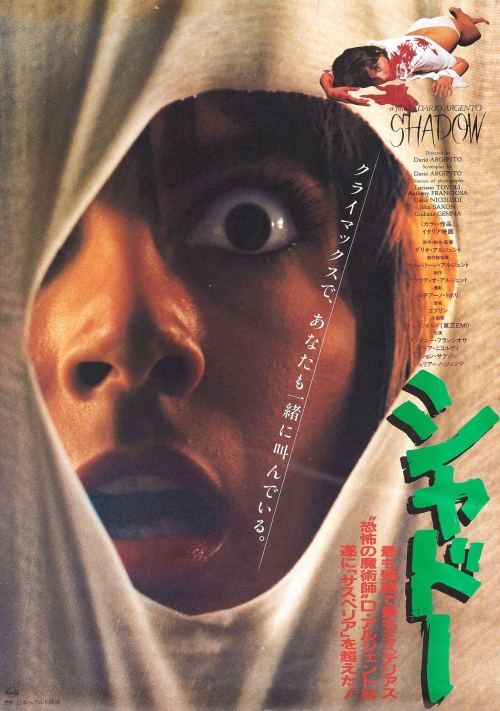
Aside from its trashy American release, Tenebrae
could still easily be mistaken for an exploitation film. It is
extremely violent. It does not always adhere to the conventions of mystery/thrillers.
And, like most Italian films, it was acted and filmed in English but ALL of its
dialogue was dubbed in post-production—and not always by the actors appearing
onscreen. Yet despite all of these seemingly defining factors, in the end, it
is not Dario Argento who is making “exploitation movies”. Rather, it is the
distributors of his films who take his art and sell it as exploitation. Thus
far, only a handful of Argento films have played to American audiences in
unadulterated form. Most were severely reedited, censored, and even “dumbed
down”, bringing the violence to the front and center. Audiences also play a
role in branding Argento’s oeuvre as
“exploitation”, as proven by the fact that many of his fans seem to appreciate
the violence of Tenebrae more than
they do its layers of psychology. Worse yet, the very film connoisseurs that should relish such genius are often
unable to look past the film’s vital but graphic bloodshed. Thus, as is perhaps
the case with all of Dario Argento’s films, you could say that one ultimately takes
away from Tenebrae what one brings to it. But with an open mind, and a
dark sense of humor, one is unable not
to appreciate power of one of the most complex and expertly crafted thrillers
ever made.


Works Cited
Dario Argento’s World
of Horror. Dir: Michele Soavi, 1985.
Synapse Entertainment DVD, USA. 1999
Gallant, Chris, ed. Art of Darkness: The Cinema of Dario
Argento.
England: Fabpress Publishing, 2000.
McDonagh, Maitland. Broken Mirrors, Broken Minds: The
Dark Dreams of Dario Argento. New York: Citadel Publishing, 1991.
Tenebrae. Dir:
Dario Argento, 1982.
Anchor Bay Entertainment DVD, USA. 1999

This movies freaks me out! rr
ReplyDelete~Dana@Adam4Adam