After taking a leave of absence midway through college to
work on a failed indie horror film project, I returned to Emerson with
a renewed vigor. In an attempt to expand my horizons and appease my parents’
suggestion, I took a “Wartime Journalism” class with the renowned Jerry Lanson...despite the fact that I never watch the news. I like horror onscreen, but I
hate it in real life. That class, while amazing, underlined why I was not cut
out for journalism. Thus I took the assignment of my final paper as an opportunity
to explore my mind and rave about a favorite artist's misunderstood work of art, pastimes that I
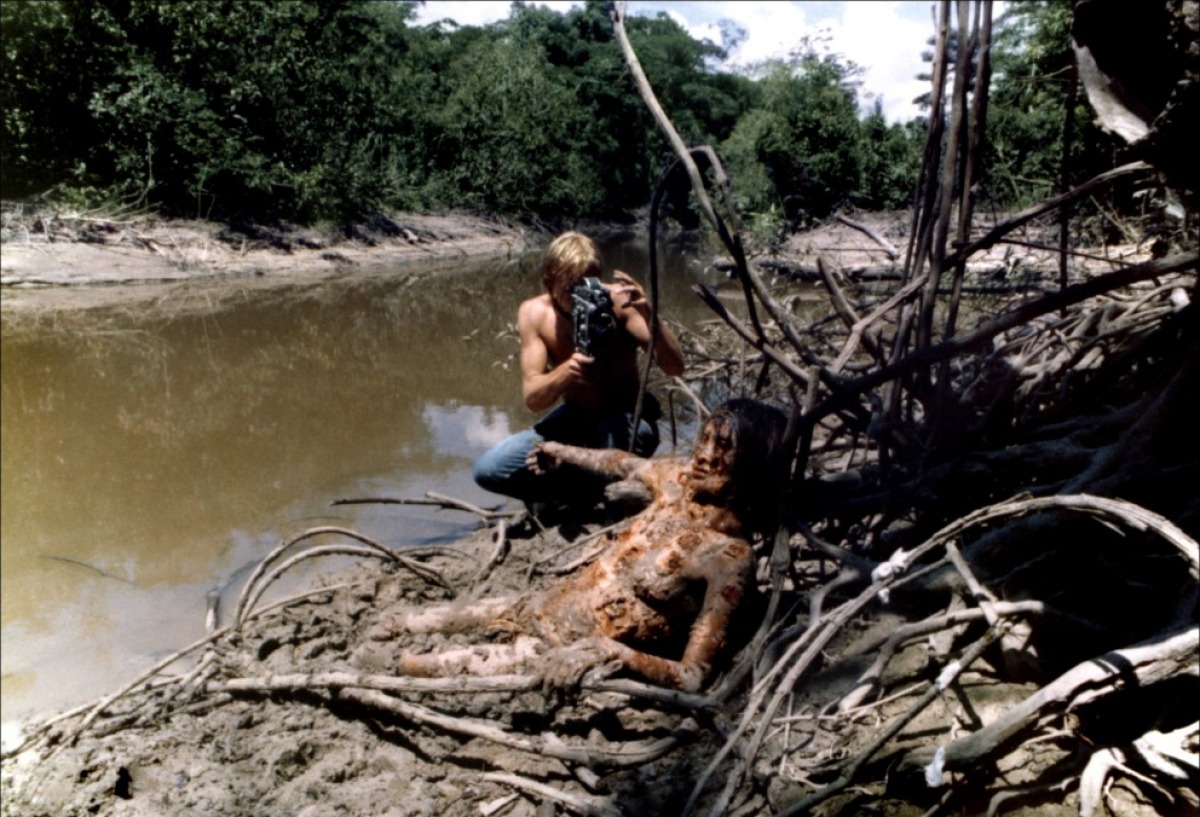
indulged in at least once a semester. For my Wartime Journalism class, the spotlight was on Ruggero Deodato's unbelievably controversial Cannibal Holocaust. I first saw this film in Summer 2001, after several years of avoidance based on its gruesome content and questionable reputation from both a cinematic and moral standpoint. Much to my shock and delight, I fell in love with the film that day in June. Much to my shock and horror, I relived its impact when the world changed that following September 11th. Barring Madonna and a handful of favorite (scripted) series, I have relentlessly avoided watching television ever since.
Robert E. Jeffrey 4/15/2005
JR485: Final Paper
Outsider In: Looking at the
Psyche of the War
Journalist
I was first
intrigued by the concept of wartime journalism in 2001 as a result of two significant works of filmmaking. The first, in the summer of 2001, was my viewing of a highly
controversial, oft-banned 1979 Italian horror movie called Cannibal Holocaust, about the ill fate of a US
The atrocities in
both films, one a satire of the American media and one an insight into life under the Taliban, were similar in tone and content. They also equally provoked my interest in disturbing questions about what should be
filmed and broadcast for television, and about the true intentions of the
filmmakers who cover the world we live in. At the time, I was angry at
what I perceived to be exploitation of current events. In the wake of the impact that Cannibal Holocaust had on my cynicism and the impact that 9/11 had on my paranoiac tendencies, I initially suspected CNN was exploiting literal
“snuff” footage for ratings in the wake of a national tragedy and an
international panic. These two powerful films shaped my
perception of wartime journalism, prompting a unique
approach to this course that finally lead to my writing this paper.


Despite being someone with no interest in a career in journalism, I am amazed by how much the experience of journalists who voluntarily commit themselves to
the ghoulish horrors of warfare--all for the sake of authentically capturing it through their own eyes--has influenced my artistic
endeavors. This is not to suggest that the lifestyle of a wartime journalist (a profession I
was admittedly unfamiliar with until recently) has ever guided the formation of
my ideas. Rather, it is because the existence of this profession, and the nature of their daily lives, has offered a whole new perspective to me on the role of
violence in the media.
When journalist David Filipov
spoke before the class, I was emotionally enslaved to his presentation: laughing at some
stories, recoiling in horror at others, and vicariously riding the adrenaline rush of his brushes
with death. It was a fascinating journey to go on, as an audience member. But to actually experience it must leave an incalculably profound effect. I wondered if his memories weren't far less entertaining without the benefit of an engaged, but naive, audience: going back and forth between enemy sides in a foreign country, performing as an
actor or comedian to protect your body and life, witnessing brutality and
knowing that your lives and the lives of those around you could vanquish at any second. I tried to imagine going from that lifestyle to sitting at a desk at the Boston Globe. Those front-line atrocities must still seem more real, even more present, than anything happening around him in America possibly could. Having learned that he has two children, both of
whose parents are working war journalists, I wondered what home life must be
like: after stretches of domesticity, do he and his wife both feel a need to be back in the heat of combat? And does this affect the security of children longing for the protection
of Mom and Dad?
Most parents would
probably agree that David Filipov and his wife made the right decision in leaving that world behind. Recent international events have demonstrated that the mere thought of a war going on can bring about great anxiety in young children, even those
who have no familial connection to it whatsoever. A
2004 article entitled “Controlling What News Your Child Sees From TV” on the
memorial website 9-11 Heroes references a study by the Georgetown University Psychology Department on the
effects of repeated news footage of the September 11th attacks on elementary school children. (9-11 Heroes) “Of the children in the study, 85
percent indicated that their basic sense of security and safety were shaken by
the September 11 attacks.
Psychology Department Chair Deborah Phillips reported afterwards
that 'no one lost a family member…it was children not directly associated
with the attacks, so I was surprised to find such high levels of stress. I
expected maybe half, not 85 percent.'" (9-11 Heroes)
These
numbers merely refer to young children, with an inevitably limited understanding of
the profundity of war but an innate fear of its deadly destruction. On the
complete other end of the spectrum, the military and war journalists actually go to that proverbial “front line”, with many of them spending long stretches on the precarious road between a life removed from reality and a death lifted from
gory nightmares. And what of their sanity? If children can be rocked to the
core by repeatedly broadcast news footage of American skyscrapers tumbling into
a city of people screaming in terror and distress (9-11 Heroes), could someone who
sees such atrocities on a regular basis, for an extended period of time,
possibly hold onto a sound mind?


As a writer of fiction, I was so affected by Mr. Filipov's classroom presentation that it prompted my decision to let the nature of
this Wartime Journalism course shape a screenplay that I had been writing, one I already planned to
incorporate into a separate class on the nature of violence in literature. This was
compounded by the visit of Kevin Sites, who took a less dazzling, more
analytical, and ultimately vulnerable approach to his experiences as a war
journalist. He revealed that he had suffered the loss of a
marriage and more than one engagement due to his commitment to his profession,
and before the entire class he openly grappled with questions of what ethics to abide by in his career. It was very clearly an honest search for answers, rather than a
demonstration of his career success.
What most piqued
my interest in learning about the profession of a war journalist was a desire to understand the
psychological effect that “the news” has on the people who cover it. It seems that a lot of
airtime and column space over the past two decades has been devoted to how children are affected when they see bloodshed on the six o’clock news, why teenagers run to slasher movies at the local multiplex, and what all this could mean when said young people enter the
adult world. But it would appear, at least on a mainstream level, that less emphasis has been placed on the psyche of the people who broadcast such violence: the executives
and editors and censors and newscasters who watch that bloody reality
everyday and then decide on how they will break such truths to the rest of the world. At
the heart of such mental and moral questions is the war journalist. Often a lone
human being with modest protection and a questionable span of life, (s)he is willing to give up everything to potentially write the article or
take the photograph that leaves a lasting impression on society. This passion, this
monogamy, and this potential for horrible means of destruction has fascinated
me since the beginning of the course, and it is what sent me off to at least scratch the
surface of how a psychologist would look at the mind of a war journalist.


In 2004, The
National Center for Post-Traumatic Stress Disorders (PTSD) released a fact
sheet entitled “PTSD in Journalists” written by Dr. Elisa E. Bolton and
containing new findings from studies on journalists that were conducted in 2002
and 2003. (Bolton ) Dr. Bolton
points out that “it has been assumed that journalists are not permanently
impacted by death and destruction…[that they are] unusually tough, somehow
immune to the reverberating impact of the human suffering they witness.” (Bolton ) “Journalists are often exposed to highly
stressful, traumatic situations, and required to bear witness to others who
have been overwhelmed by traumatic events. While emergency workers have, particularly
in the last decade, recognized the need for self-care and organizational
safeguards, journalists may not yet have been recognized as potential
candidates for employee safeguards and increased support.” (Dart Center
Does the
general public care about the minds and lives and fates of war
journalists? It’s sad to say, but time and time again the masses seem more apt to be moved
by the sight of a fallen soldier--perhaps because the image is unconsciously identified with the
most heroic figure in the spectator's life--than by the brutal
death of a captured war correspondent. “In recent years there has been growing
recognition that being a journalist, especially a war correspondent, can be
quite dangerous. In 2001 alone, 100 journalists were killed. Organizations and
researchers are recognizing that in addition to the danger of death,
journalists are exposed to the risk of great emotional distress. Yet, [recent
research] also indicates that few employers of photojournalists recognize the stress
and negative impact on mental health that is associated with some assignments.
Even fewer employers offer counseling services and education about PTSD
symptoms.” (Bolton )
The
irony is that education about what one should or should not do on the front line would not necessarily be put to use anyway. In The
Psychology of War, Lawrence LeShan excerpts the reflections of a WWII
veteran named William Manchester who was hospitalized in Okinawa
but escaped so that he could rejoin his fellow marines on a dangerous mission
that they were about to embark on. “It was an act of love. Those men on the line
were my family, my home. I had to be with them, rather than let them die and me
live with the knowledge that I might have saved them. Men, I now know, do not
fight for flag or country, for the Marine Corps or glory or any other global
abstraction. They fight for one another.” (LeShan 97)
While William Manchester was speaking as a veteran of combat, he could very well have been
speaking as a wartime journalist. David Zucchino, a correspondent embedded
with troops in Iraq


In War Is A Force That Gives Us Meaning, journalist Chris Hedges asserts that he managed to retain his morality during his own wartime experience. However, referencing his time covering the first Gulf War,
he concedes that, in the midst of the battlefield, a state of amorality is all too
easy to sink into. “The prospect of war is exciting. Many young men [believe
that they will] discover their worth as human beings in battle. The
admiration…the glory…the ideal of nobility beckon[s] us forward. All the more
startling [is that] that such fantasy is believed, given the impersonal
slaughter of modern industrial warfare. Iraqi soldiers were nothing more on the
screens of sophisticated artillery pieces than little dots scurrying around
like ants—that is, until they were…reduced to scattered corpses….[by] high
explosives fired from huge distances.” (Hedges 84)
Even in our advanced state of technology in the arena of mass murder, the human psyche has yet to be upgraded. It is just as vulnerable to
emotional damage from firing today’s high-distance blasters as it was from impaling enemies face-to-face with bayonets a century
ago. “Men in modern warfare are in service to technology. Many never actually
see the people they are firing at nor those firing at them. To be sure, soldiers
who kill innocents pay a tremendous personal, emotional, and spiritual price. But
within the universe of total war, soldiers only have time to reflect later. By
then these soldiers often have been discarded, left as broken men in a civilian
society that does not understand them and does not want to understand them.”
(Hedges 83, 86)
Even the most
celebrated of wars—the wars that carve
out nations with the greatest of prospects, the wars that restore peace to
troubled lands, the wars that literally save the world—the effects of violence
prove immune to the glory of the soldiers who fight or to the journalists who cover their fighting. In War and Human Nature, Stephen Peter
Rosen discusses the findings of a physiological survey conducted by the U.S. Army in
the Spring of 1944. The first element discussed in the original review of the
data was the stress level of all of the troops surveyed, which was related to
“many factors, but among all of the factors, lack of sleep was cited more often
than any other as a factor affecting combat performance”, with troops citing few hours to sleep even
during quiet times at war. (Rosen 110)
However, studies conducted in the 1960s on the effects of sleep deprivation as a stress-inducer lead to retrospective reanalysis of the WWII study, leading to the very possible conclusion that the WWII respondents were hampered by fatigue and uncertainty moreso than lack of sleep. “Fatigue, the weariness that sets in after performing a task for long periods of time, has complex effects on human thinking and behavior. [In the 1960s studies], a particular kind of stressor—uncertainty—produced an entirely different reaction”. (Rosen 112-113).

However, studies conducted in the 1960s on the effects of sleep deprivation as a stress-inducer lead to retrospective reanalysis of the WWII study, leading to the very possible conclusion that the WWII respondents were hampered by fatigue and uncertainty moreso than lack of sleep. “Fatigue, the weariness that sets in after performing a task for long periods of time, has complex effects on human thinking and behavior. [In the 1960s studies], a particular kind of stressor—uncertainty—produced an entirely different reaction”. (Rosen 112-113).

Citing the actual
test results, Rosen explains that the brain’s “corticosteroids are produced by
conditions of novelty, strangeness or unfamiliarity—in which uncertainty is
paramount. Unfamiliar situations produce feelings of uncertainty or anxiety
which in turn trigger the secretion of cortisol. Cortisol levels are found to
be particularly high in anxious or depressed patients.” (Rosen 113) But lest
one think that journalists who covered WWII were spared such mental
reverberations, Pulitzer Prize-winner Ernie Pyle’s recollections offer a startling account of the
inescapable transformation. “Before he died in April 1945, war correspondent
Ernie Pyle wrote, 'I’ve been immersed in it too long. My spirit is wobbly and
my mind is confused. The hurt has become too great.' If this happens to you,
seek counseling from a professional.” (Hight & Smyth, Chapter 4).
Much to my
pleasant surprise, the Internet has given birth to a vital organization that
was formed specifically to address the oft overlooked psychological needs of
journalists who cover traumatic events. “The Dart Center

In their message
to journalists, Joe Hight and Frank Smyth integrate throughout each chapter the
need for journalists to constantly communicate, to vent out what they see and
how they feel in response—perhaps because, the authors suggest, journalists
don’t do it enough. “A coffee shop or a bar may provide colleagues with an
invaluable venue in which to talk and perhaps debrief each other about the
emotions of their work. Recognizing the need for a debriefing forum or the
opportunity to articulate emotions in the aftermath of a school-yard massacre
or the World Trade Center
As a writer of
films that explore the many facets of of sex and the nature of violence, I
can relate to a journalist. I see the innate perversity of my screenwriting reflected in journalists' work in a very striking fashion: we both spend our hours penetrating a
world of unspeakable depravity as a means of achieving career goals that feel less like signposts than they do missions, on which sanity and mortality
is trivial compared to the work left behind. It is clear that
journalists, as a group, are as dedicated to constantly expanding and improving
upon their coverage as artists are dedicated to enhancing their body of work.
Like artists, they are less interested in their safety--physical or mental--than they are in the final product, and they may be inclined to express their
thoughts and fears through work rather than conversation. But clearly these
related traits are dangerous, and unnecessarily so.
Journalists and artists communicate with the world on a profound level, putting passion and commitment towards work that stretches their emotional landscape. But raising their adrenaline by being exposed to ghastly horrors is as all-consuming in its destructive danger as it is inescapably thrilling. Wartime journalists are prone to the same effects commonly
associated with post-traumatic stress disorder in soldiers, and this is why they need just as many resources and just as much emotional support as an ER
doctor or police officer. David Filipov and Kevin Sites have
recognized this, and their respective classroom presentations served as a form of the catharsis that is vitally necessary in their profession. But that doesn’t mean that they won’t go back
to the front line, because it doesn’t mean that they have grown immune to the
euphoric excitement of their brilliantly deadly profession. Like artists, war
journalists are passionate about living their lives doing what they love....even if life itself should end on the job.

Works Cited
Hedges, Chris. War Is A Force That Gives Us Meaning.
Anchor Books, New York
LeShan, Lawrence. The Psychology of War.
Helios
Press, New York
Rosen, Stephen Peter. War and Human Nature.
Web Sources
Stress Disorder: Department of
Veterans Affairs.
Greer, Jane. “War and Peace, Human Agency, and
Other Matters”. UUWorld.org
“Self-Care Primer”. DARTCenter.org
Hight, Joe, and Smyth, Frank. Tragedies and Journalists:
A Guide for Effective Coverage.
DARTCenter.org
“Mission Statement”.
DartCenter.org
Film Referenced:
Cannibal Holocaust. Dir:
Ruggero Deodato, 1979.
EC Entertainment DVD, Netherlands

No comments:
Post a Comment