Showing posts with label 40s movies. Show all posts

Wednesday, March 19, 2014

FYI File: Fantasy, Nostalgia, and "The 2014 Project"

Now that this blog has been given its third and final (I swear!!) name, I thought I would shake things up a bit. Nothing so crazy as dropping the pink text color or updating the general appearance to a post-1997 look, of course. But there's a lot I've been wanting to say, so rather than post a succession of lengthy blog posts, I thought I'd post this variety pack of short ones. 

The Twentieth Anniversary of My Obsession With Anniversaries


The hits package that redefined my life. Like, seriously!

January '14 marked the 20th anniversary of my obsession with anniversaries. My first-time viewings of Starman, The Shining, Dawn of the Dead, and Working Girl on blistery and/or snowy Friday nights in January '94 mobilized in me a 1980s nostalgia that never went away. But it wasn't just the movies I watched that month, it was also buying THE album: Totally 80s, the 2-CD Razor & Tie compilation that was advertised on TV all the time before becoming the soundtrack to most of my life in the sixth grade. From 1994 on I was fetishizing every aspect of '80s pop culture while lambasting everything I could about the '90s. However, happy Friday nights ritualistically spent at the local multiplex limited my aptness for thrashing then-contemporary film. 


It is now a time capsule for what the world looked like in March '94,
but The Paper also remains grown-up Hollywood fare at its most brilliantly entertaining.

For the Class of 2000, 1994 was the year when the sixth grade ended and the seventh grade began. Thus the year closed with my being knee deep in adolescent angst, which only kept me going back into the past. I continually found myself disappointed by reality, so I was constantly choosing fantasies that were constructed in another era. My pre-pubescent childhood had been so happy, and the spirit of the '80s was so inextricably linked to my own soul, that I lamented the decade until it became an over-idealized Heaven that I dreamed of dying and going back to. I was not unaware of this being unhealthy, but that didn't make it any less painful to push forward, not when I discovered that being a teenager was to be a lot less pleasant than I had been imagining in the '80s. Instead of forging a new path that would make childhood dreams come true, I clung to the past as an escape while reality came crashing down in the present. And, for better or for worse, I've been inclined to do this ever since.


I related to Tess McGill when I was twelve. I still do now.
And I'll bet many of you reading this feel the exact same way.


A Sorta-Facade On The Verge of Sorta-Crumbling

There has been so much that I have wanted to communicate through this blog over the last fifteen months, but during said fifteen months my life has been in a major state of upheaval. Actually, it was in upheaval when I started this blog back in 2011. But way back then, things in my life were just starting to turn upside down, and the coinciding mini-phenomenon of “Vogue Boy” allowed me to escape reality like never before. For a moment in Summer '11, it felt like my dreams of being an artist and a star had been instantly realized when that video achieved its peak popularity in one weekend. It was during that delightfully manic moment that I quickly decided to become a blogger, and my early entries here are thus defined by an optimism, and even a sense of fulfillment, that apparently represents me at my purest.  
The-blog-formerly-known-as-RobWorld has been a tremendous outlet in the three years since since then, for it has allowed me to unlock and release parts of myself through the written word in a way that I could never do within the format of a screenplay. But for well over a year, I have not been inclined to do any unlocking or releasing, for I have discovered that my life experiences are a lot less vivid in my mind after I make them public here. And, as evidenced in past entries, my memories, and the role they play in shaping my creative output, are too precious to me to be sacrificed.
On some level, I've gotten more screenwriting done by not blogging. But on most levels it has denied me an outlet that I need: not only to write, but to be read. I might not have a huge readership on here, but the feedback I've received in personal messages has been too awesome to be ignored. There is no better feeling than knowing a handful of people were affected by work that they personally related to, or which made them look at a movie or a person or a similar life experience in a new light. I don’t know if I’ll start writing again more regularly, because I thought that that would be the case last November....and it wasn’t. But I think this has a lot to do with my wanting to make every post an event, in turn defeating the purpose that this blog serves, for me, in the first place. I am a hopeless neurotic, still in the middle of a challenging and annoyingly long life chapter, and I need a place to let all this shit out. Some people go to therapy. I go to the stage. And that’s exactly what this blog is to me.


From Sixteen To Thirty-Two: "The 2014 Project"

Like the film itself, I'll NEVER forget the first time I saw this trailer!

When I was sixteen, I realized that Wes Craven's Scream was released exactly eighteen years after John Carpenter's Halloween, which itself had been released exactly eighteen years after Alfred Hitchcock's PsychoYears later, I would realize that Val Lewton and Jacque Tourneur's Cat People’s limited release in December 1942 meant it was the movie that launched this every-eighteen-years cycle. Since then, I’ve been anticipating "The 2014 Project", a film that would, like the aforementioned four films, inject the horror-viewing experience with enough wit and suspense to change the cinematic landscape and redefine the genre for another two decades.


The most bewitching of Hollywood films and
possibly the most influential horror movie ever made.


Since the late '90s, I have secretly hoped that the Universe would see fit to choose me to write this 2014 horror film, and much of my creative life has been spent preparing myself to be worthy of such an opportunity. Alas, I've proven far more adept at writing screenplays than actually getting them made into movies. And without ever seeing your work on some screen, one can hardly feel like a real screenwriter. So last year I attempted to put work of which I remain as proud as ever temporarily behind me, and to instead take a stab at crafting "The 2014 Project". I spent the entirety of 2013 working on eight different scripts, each of which I had hoped could potentially reinvent "the American horror film", but none of which ever made it to their respective finish lines. By New Year’s Eve, I was forced to admit defeat. I was proud of the work I had done, and confident that one day the characters and story elements from this arsenal of partial completion would find their way into my future projects. But by no means did I come close to striking the gold that I was digging for.


If every attempt at crafting a pure suspense picture was even half
as effective as Halloween, the world would be a much better place.

It was not until the very end of 2013 and the very beginning of 2014 that a burst of renewed inspiration and ambition (my favorite cocktail) launched me on a new path. My dream, in this easy-to-shoot-but-hard-to-distribute world of modern indie filmmaking, was that the work flowing out of me would find its way into the right hands, and a quickly-realized project (Cat People, Psycho, Halloween, and Scream were themselves low-cost/high-speed shoots) could theoretically find its way onto a VOD platform or into an early 2015 film festival. But nearly a third of the way into 2014, I'm inclined to believe that that dream will not come true....and I'm okay with that. It’s very likely that a great horror film will come along and make the impact I was hoping to make while I'm still pining away, and if that happens, I can finally say I was right all along. And hopefully, if that happens, 'my little horror film', whenever it makes its way to the screen, will still earn itself a place in the hearts of like-minded movie lovers. But for now, I think I'll put my faith in "The 2032 Project": I have good reason to believe I might be capable of writing something worthy of comparison to the aforementioned films when I'm fifty. In the meantime, I intend to enjoy the writing process instead of mourning my failure to be where I thought I would be when I was half the age that I am right now. 


No movie-going experience has come close to the first two times I saw Scream on the big screen. And I'm 99.44% sure that this will always be the case.

Furthermore, assuming that the every-eighteen-years cycle really does extend into this century, I'll be keeping my eyes peeled for the film that will ultimately redefine our collective concept of modern horror movies. There are already a few potential contenders in the pipeline, and 2014 has only just begun...


Sunday, March 10, 2013

Happy 75th Anniversary, "Jezebel"!


We all know the couple: the hot-headed lover who keeps testing the patience of an even-keeled partner who forever winks and smiles and puts-up-with. We've all been witness to it, and many of us have been or will be a part of that cycle--perhaps playing both parts in different relationships. And for those of us more apt to personally identify with the former personality than the latter, there is no greater fear than that of a partner who one day throws up their hands and says "I've had enough!"....and means it. Under the direction of the peerless Hollywood master William Wyler, Bette Davis and Henry Fonda play out such a scenario against the backdrop of Louisiana in 1852. The film was Jezebelan Oscar-winning box office smash that opened at Radio City Music Hall on March 10th, 1938, launching Bette's reign as Queen of Hollywood.

Bette Davis on the role William Wyler's Jezebel played in shaping her future.

Jezebel is rightfully touted as an epic Southern melodrama, but its impact is derived from how easily its characters and relationships could be transplanted to any other time or place. This, among many other reasons, is why I consider it vastly superior to the classic film which it has always lived in the shadow of: Gone With The Wind. Last year, I wrote a 75th Anniversary tribute to Marked Woman, the unsung classic that began the greatest chapter of Bette Davis's career. William Wyler's Jezebel, released eleven months later, was the film that Miss Davis always credited with "making me a box office star", so I felt I should write another tribute. Alas, time kept that from happening. Instead, here's a recently discovered paper I wrote in high school for a favorite teacher, Mr. Raymond Carrey. Mr. Carrey was already a passionate feminist, but I hoped to expand his canon of great feminist texts by encouraging him to look at the films of Bette Davis in a new way. I'm happy to say he liked my work.


Robert Jeffrey 5/18/99
The Rise and Fall of Hollywood’s Studio System
            When I set out to research Hollywood’s studio system from its beginning to its ultimate demise, I had no idea that such a task would involve researching every single studio’s individual history. In spite of the fact that Hollywood’s studio system had always been a practice and an institution which I have found to be complex and fascinating, I had always been under the false impression that it was some kind of a sprawling Empire. I knew that there was a great deal of individual studios promoting their own stars and filmmakers, but what I did not know was that each individual studio began their own, private Hollywood journeys at different times and for different reasons. Therefore, I have decided that it would be best to pursue the rise and fall of The Warner Brothers Studio. In addition to the studio’s interesting timeline, Warner Bros. was well known at the time for making films that were about cultural significance as opposed to scope and glamour. “Warner’s….was more closely associated with realism and some excellent social-problem films,” said actress Agnes Moorehead at one time. “MGM was bigger, but today the critics esteem Warner’s highly.” (Hadleigh, 155)


            The Warner Bros. Studio came into the Hollywood power game relatively late. When the studio began to form, in the early 1920s, MGM and Paramount dominated the industry. (Schatz, 58) The studio that would be Warner Bros. was the  brain child of four brothers from the East Coast: Sam, Abe, Harry, and Jack. The brothers started out by distributing films during the period of 1910-1919, aided by the powerful Wall Street broker, Goldman Sachs. Sachs saw the potential for the film industry to become a major force in American economics, and was sure that he could propel the Warner Brothers ahead in this boom. (Schatz, 59)
            In 1920, the brothers emigrated to the West Coast, where they leased a facility for producing films. There, they produced several feature films. In 1922, the brothers moved on and bought a 10 acre plot of land, where they developed The Warner Bros. West Coast Studio. In 1923, the evolution of a studio was in full swing. The name of the studio/production company became “Warner Bros.”, and the brothers received a donation of half a million dollars from an LA banker by the name of Motley Flint. The money was split between upgrading the studio development, buying rights to several stage plays, and producing the first ever “Rin Tin Tin” movie, Where The North Begins. (Schatz, 59-60)


            The studio continued to grow and enjoy smashing success throughout the 1920s. By 1925, the studio had released more than 25 films, and signed several solid stars to contract. The studio upped its budget/production schedule to thirty pictures per year, and the studio expanded its distribution by buying more second-run movie houses (theaters in small, suburban areas with less splendor than first-run film houses) and by building several huge, extravagant first-run movie houses. (Schatz, 60-61)
            It was in 1927 that Warner Bros. forever changed the medium of filmmaking. In February of that year, several studios had announced that they would not be incorporating sound into their films for at least another year. The studios apparently felt that this was too risky a venture, and that the orchestration that accompanied films in first-run movie houses was appropriate enough. (Schatz 64) Warner Bros., in an attempt to compete with more well-established studios like Paramount, MGM, and Universal, opted to take a risk and woo a larger audience with the attraction that sound offered. The risk paid off. (Schatz 64)


            The studio’s first feature to offer sound was The Jazz Singer, a film that offered little plot but still a great deal of music and minimal spoken dialogue. The Jazz Singer was a box office phenomenon, earning a then-spectacular $3 million and prompting Warner bros. to churn out more “talkies”, as sound-capable films were called, so as to beat the other studios to the punch. Once again, their plans paid off, as the studio continued to soar as a result of this technical advantage over Warner Bros.’ competitors. (Schatz 64)
            The 1930s is considered by some to be the finest decade in American cinema. It was also one of the most influential. The ‘30s marked the beginning of Technicolor, the introduction of some of American cinema’s brightest stars, and the first time in American history when a nation of audiences could escape to a fantastical world of fiction and fantasy during the harsh reality of their lives. (Schatz 199) Coinciding with the public’s definitive embrace of American cinema was the beginning of the stars’ resistance towards the oppressive studio system. (Schatz 200) While numerous stars would take part in the rebellion against the oppressive studios, perhaps the earliest and most public rebel was screen legend Bette Davis.


            Warner Bros., not unlike every other studio, was willing to go far to publicize a new movie. In the case of the 1939 film Juarez, the studio reportedly paid a man to jump into a cab, tell the driver to “Take me to Juarez!”’, and then travel all the way to Juarez, Mexico. The next day, headlines appeared in newspapers proclaiming that “Fan Drives 2500 Miles to See Juarez!”. Such an extravagant and original publicity stunt was not especially uncommon during the era when studios controlled filmmaking. (Hadleigh, 198) However, controlling all aspects of filmmaking also meant controlling actors, and such a dominating presence was eventually resisted by actors hungry for artistic freedom.
            “Well, the so-called Golden Age of Hollywood was not necessarily that golden…it was damn trying at times,” said Bette Davis of her days as a young actress. “We were properties of Warner Bros. We were contractually bound. We were indentured. Of course, I fought to help end the feudal system…[Myself and other actors] fought to improve it, but the studio system was a form of slavery, undeniably.” (Hadleigh, 57) Davis’s sentiment reflected the view of many performers in Hollywood. Actor Tyrone Power once even compared Hollywood to “a gilded cage”. (Hadleigh 57) Unlike today’s studio system, in which actors are cast in individual pictures or perhaps commit to several films as part of a contract, in the 1930s the majority of actors worked for one studio all the time. The studio would “own” them for a certain period of time, provide them with steady work and a steady pay, and require them to comply with certain studio demands or risk suspension or revocation of contract. (Davis 30) In addition, female performers faced harsh punishments if they did not comply with certain “sexual obligations” that the studio had placed upon them. Furthermore, reporting such harassment could result in a woman’s career coming to an abrupt end, as Bette Davis would later describe in an interview:

I’m so thankful I never had to rely on my looks. I survived on talent and temperament. If I’d had to make it on the casting touch, I’d have screamed “Rape!” and that would have ended my career! Oh, it was terribly unfair—much more unfair on the actresses.
                                                                                         (Hadleigh 58)

           Although Davis did not detail the corruption of the studio system until later in her life in various interviews and publications, she ended up making positive improvements in the system—without even intending to. Her persistence and perseverance in the demand for challenging roles would go on to make her a star, and to eventually open more doors for actors and actresses to come. (Staiger 205)
By the time 1934 rolled around, Bette Davis had completed 21 films, most of them supporting roles with little depth. Tired of being written off as a supporting player in paper-thin roles, Davis fought hard for Warner Bros. to “loan her out” to RKO Pictures to make a film entitled Of Human Bondage. Although studios did, on occasion, loan a contract player to another studio for an individual film, this particular move seemed especially unusual because she was fighting hard for a non-glamorous role that had been turned down by virtually every actress in Hollywood. Whether it was out of having been convinced or simply tired of Davis’s persistence, Jack Warner, who at the time made the majority of decisions regarding the artistic side of filmmaking, allowed her to go. “Go ahead, hang yourself!”, he reportedly told Davis, referring to the fact that the role could very well end her potential career. (Wiley & Bona 53)


         To say the least, Jack Warner was wrong. Though Of Human Bondage was only modestly successful at the box office, critics and audiences hailed Davis’s performance as a revelation, with Life magazine going so far as to call it “probably the best performance ever recorded on the screen by a U.S. actress”. (Wiley & Bona 53) Davis’s rebellious tendencies would also yield two other smashing success stories during the 1930s. In 1936, still dissatisfied with her roles, Davis was suspended by Warner Bros. for refusing to work until demands were met for a new contract. During her suspension, Davis traveled to England to discuss a possible film contract with an independent production company. Warner Bros. successfully sued Davis to prevent her from signing. Bette was unfazed by the lawsuit, and immediately after returned to work at Warner Bros., no longer pleading for modifications in her contract. In retrospect, it is widely believed that the lawsuit was just what Davis wanted, for when she returned the studio began to offer her far better material, starting with a role in the film Jezebel. David was ecstatic about the role in Jezebel, which would offer her far more depth than many of her previous screen endeavors. The enthusiasm apparently translated to the screen as well. Jezebel, which predated the similarly themed Gone With The Wind, was an acclaimed box office blockbuster. The Southern epic earned Davis a Best Actress Academy Award and solidified her as one of the nation’s top box office stars. (Staiger, 79-80)


1938's Best Actor & Best Actress: Spencer Tracy for Captains Courageous 
and Bette Davis for Jezebel

    In 1939, Bette Davis fought for a role in the film Dark Victory, the tragic and inspiring tale of a wealthy young socialite who is stricken with a brain tumor. The film was initially seen as being too dark and depressing, with Jack Warner proclaiming that “no one wants to see a story about a girl who dies”. However, the film was released, became a box office success, and earned Davis her third Academy Award nomination. (Hadleigh 95-96) Although it marked a tremendous personal achievement for Davis, it marked perhaps an even greater achievement for all women. Although pictures with strong female leads been successful in Hollywood throughout the 1930s, Dark Victory ushered in a period in Hollywood during the early 1940s when women did more than just make up a large portion of the box office: they controlled it. Dark Victory was written for and about a complex female lead, and explored numerous emotions that were not always typical of the glamorous leading ladies of archetypal Hollywood films. In the years to come, Miss Davis would lead the pack of numerous actresses who spoke directly to the emotions and plights of all women, at times delving into emotional territory that has not since been seen on the screen. (Hadleigh 111)
The 1940s offered a chance for Hollywood to become even more embedded in American society than ever before. World War II was going on at the time, and many actors, like most Americans, were feeling a great sense of nationalism. It was during this period that stars began to entertain troops in barracks, serving food and socializing at the Bette Davis-run Hollywood Canteen. It was also when celebrities began to promote the sale of war bonds, either through contractual obligation to a studio or, perhaps more commonly, through their own will to be patriotic. (Schatz 302)


Bette serving troops at The Hollywood Canteen


         It was also during this period, in 1940 in particular, that Hollywood began to incorporate non-white actors in significant roles in mainstream film. No example is more well-known or significant than the casting of African American actress Hattie McDaniel in the phenomenally successful Gone With The Wind. Segregation was still very firmly a part of society during the film’s release in 1939, so much in fact that McDaniel was excluded from the film’s Atlanta premiere. However, in 1940, she became the first African American to be nominated for an Academy Award. On February 29th, 1940, Hattie McDaniel became the first-ever African American to win an Academy Award. Presenter Fay Bainter, before announcing the award’s recipient, told the audience that the night was “a tribute to a country where people are free to honor noteworthy achievements regardless of creed, race, or color.” At the announcement of McDaniel’s name, she received the biggest cheer of the whole night, and called this “the happiest moment of my life”. (Wiley & Bona, 98-100)


         In spite of McDaniel’s achievement as both an actress and an African American, and Hollywood’s enthusiasm for her merit, Hollywood has since been accused of putting McDaniel in a stereotypical role that mocked her ethnicity as opposed to celebrating it. In addition, Hollywood took a great deal of heat for casting black actors and actresses only in roles that offered entertaining stereotypes to the studios’ target white audiences. Such an accusation is most certainly justified, but the situation of black actors in films during the 1940s actually exposes the dramatic differences between the mindsets of Hollywood filmmakers and actors and the studio heads. Hollywood was known for being a “safe” place for homosexuals, for most actors were far more accepting of this lifestyle than the majority of Americans. In addition, the majority of Hollywood personalities were open to equality and civil rights, even at a time when segregation existed and racism ran rampant in every city and town in America. Many of the studio heads were, on a personal level, sympathetic towards black actors, but felt the need to play to an audience that did not necessarily have as open a heart as the people who made up Hollywood. (Schatz 315) Such an example involved The Hollywood Canteen. Bette Davis, who was President of this establishment that provided entertainment and recreation for troops, refused to permit segregation of any kind. To anyone that dared defy her, she reminded them that “the blacks got the same bullets the whites did and therefore should have the same treatment.” (Davis 128) However, the studios feared the possibility of white troops being photographed with black hostesses, for if word got to the South, potential donors to the Canteen might back out. (Davis 128)
       Such a profit-over-humanity mentality hindered the beliefs of a slightly more progressive group of people, and thus many talented black performers were force to reduce themselves to stereotypes for the sake of “not coming on too strong” for the white audiences. Even though the casting of black actors in somewhat offensive roles was not the way to go about promoting equality, the awarding of an Oscar to Hattie McDaniel was perhaps indication of a desire for equality and acceptance, even if it was only within the confines of Hollywood. (Staiger 168)
         The 1950s offered far more progressiveness, but also a sense of independence that would ultimately lead to the fall of the Studio System. The extremely popular 1957 film Sayonara, which starred Marlon Brando and dealt with the then-controversial subject of interracial romance, earned supporting actress Miyoshi Umeki an Academy Award, making her the first Asian actress to earn the Oscar. (Sackett 131) Marilyn Monroe broke new grounds for actresses when she became the first woman ever to start her own production company. (Staiger 192) In addition, actors and filmmakers were becoming more independent, with only a handful of the decade’s top stars contractually attached to a studio. More and more actors and directors were free to work with whichever studio they chose, and this independence allowed for greater freedom both artistically and personally. (Schatz 417) Additionally, new, younger audiences were being targeted during this period with such teen-oriented films as the classic drama Rebel Without A Cause and popcorn hits like Beach Blanket Bingo. The studios were certainly not losing any money, and they still did exhibit power. (Staiger 299) However, this time the power was directed in the area of promotion as opposed to near-slavery. Studios spent a great deal of money producing documentaries to promote their films, and also sought out specific demographics to target at the box office. (Staiger 304)


My favorite scene from Rebel Without A Cause


    By the time the 1950s were over, so was Hollywood’s Studio System. Film historian Thomas Schatz made an interesting statement when he claimed that perhaps Alfred Hitchcock’s 1960 film Psycho was the ultimate symbol of the end of The Studio’s reign. He points out that Psycho was a low-budget film with a television crew and a tight shooting schedule, and that the film’s then-graphic violence and sexuality was a far cry from the films of the 1930s and 1940s when studios heavily censored their material. (Schatz 489-490)


         As ironic as it may sound, Bette Davis actually applauded many elements of the studio system in the later years of her life. Davis noted that while she was frustrated with the lack of work she was being offered in her first two years as a contract player at Warner Bros., those two years gave her a great deal of preparation and training for the later roles that would define her career. (Davis 113) She also noted the more positive means of promoting a film during the reign of the Studio System, making specific reference to Warner’s aforementioned promotion for the film Juarez. “It was wonderful, good fun, and lots of imagination. No need for vulgarity or sensationalism then.” (Hadleigh 198)
        In the four decades since the gradual demise of the Studio System, there has been a great deal of criticism and admiration for an establishment that created what are considered to be the finest American films of all time and perhaps the most globally successful stars of all time. To some, the studio system was an oppressive institution that treated actors as products to be sold and stifled artistic experimentation. In addition, some feel that the System promoted prejudice in America, and invaded the lives of the stars and filmmakers who worked for studios and had to fear that their personal endeavors could jeopardize a contract. To others, the studio system was a shrewd but brilliant part of America’s history which strove for artistic integrity, signed actors based on talent as opposed to box office success in previous films, provided all Hollywood players with steady employment, and which defined careers through the process of hiring writers to write roles for actors as opposed to simply casting any actor for any role.
       Performance artist Madonna once stated, in response to a great deal of anti-1980s sentiment during the past few years, that “As we move further away from the ‘80s, I think that we will grow to analyze and appreciate them.” Such is the case for the Studio System. Over the past few decades, the System has been slammed and celebrated by a wide array of people, but if nothing else, perhaps this criticism will lead people to appreciate the huge effect, whether it be negative or positive, that The System has had on American culture outside of film. During the 1930s, cinema played a vital role in helping audiences to escape from the reality of The Great Depression. In the 1940s, Hollywood was as actively involved with World War II as Washington, D.C. The System has also had effects on race relations, racial stereotypes, the changing roles of women, and the debate over artistic integrity versus profit. The Studio System built a Hollywood that has affected every generation through images and messages, but never to quite the degree that it did in the 1930s and 1940s. Oppressive or artistic, the studios have played a vital role in shaping America’s cultural landscape, and have left an impression that will affect many, many more generations to come. 


Works Cited


The Studio System by Janet Staiger (1995)

Bette Davis Speaks by Boze Hadleigh


Inside Oscar: The Unofficial History of the Academy Awards by Mason Wiley and Damien Bona (1996)

This 'N That by Bette Davis (1987)


Addendum


Looking back, I can finally see the impact that my first year of college had on improving my work as a writer....such as teaching me how to properly cite my sources. Hopefully the provided links will compensate for the citation information I left out fourteen years ago! (Although I failed to note in my paper that that Madonna quote came from an interview with Q magazine in Spring '98.) I also made a few mistakes that I would like to apologize for. I am a lot more familiar with Hollywood's studio system (specifically Warner Bros.) than I was in 1999, and must acknowledge that a lot of the material I presented exhibited a decided lack of understanding. As a result, I also did not properly convey the details of the trial that ensued when Bette Davis took Warner Bros. to court in England. Worse yet, I erroneously stated that Jezebel was the first film that Bette made after said trial (it was Marked Woman) and my paper unintentionally suggested that her only notable '30s films after Of Human Bondage were the Oscar nominees Jezebel and Dark Victory. Perhaps this was because they were the only films she made in the '30s that were available on U.S. DVD back in early 1999, but it leaves me a bit red in 2013 all the same. 


I should also point out that (gulp) I wrote this paper before I actually saw Jezebel. I have loved Bette Davis since my childhood, when a combination of The Watcher In The Woods and her legendary appearances on the '80s talk show circuit made me an avowed fan. I vividly recall her death in 1989, but it was not until seeing a segment of the documentary The Warner Bros Story in 1996 that I became enchanted by her films and spent the second half of the '90s slowly absorbing them into my heart and soul. I first saw Whatever Happened to Baby Jane? in 1997. I first saw All About Eve in 1998. I first saw Of Human BondageNow Voyager, and Dark Victory in 1999, and in 2000 I finally saw Bette's first two films with William Wyler: Jezebel and The Letter. Since then I've seen more films and telefilms and TV & radio show performances than I can even keep track of. But those early years laid the foundation, and this paper was written right in the middle of the important period in my life when I developed as a screenwriter and cinephile thanks to the inspiration and legacy of the immortal Miss Bette Davis. 

Tuesday, February 14, 2012

Twenty of Bette: Portraits Of Miss Davis In Love

After Halloween, Valentine’s Day is my favorite major holiday. A lot of people hate Valentine’s Day because they see it as a cheap commercialization of the romantic experience. I myself see it as a celebration of eating chocolate, watching romantic movies, and the color pink: three of my great passions in life. I don’t feel particularly inclined to blog about my love of pretty colors, but I would be remiss not to acknowledge the first Valentine’s Day since I started blogging with a celebration of a woman who could portray romance on the big screen like no other screen actor before her or since: Miss Bette Davis.


Bette Davis was an incredibly romantic person, onscreen and off. In her autobiographies, Bette wrote about her great love affairs with the same fondness that she spoke of her finest roles in film. Hedda Hopper once famously said that she gave her best performances when she was in love, and that’s evident in several of the films here: she was in love with two co-stars and at least one director featured on this list. The films are All About Eve, Dark Victory, and Jezebel, and the respective romances attached were with final husband Gary Merrill, beloved co-star George Brent, and the legendary William Wyler. Miss Davis often cited William Wyler as the great love of her life, but I’ll bet I’m not the only fan who suspects brilliant New Englander Gary Merrill was her true soul mate.

This list is a celebration of Bette Davis’s gift as an actress; specifically, her ability to represent an unparalleled range of romantic emotions. This is not to say the films here all fall under the category of “Romance”. My twenty favorite Bette Davis love stories span five decades and many genres, from literary adaptations to gangster movies to film noir to showbiz melodrama to Southern gothic horror. These films thrill me as a viewer, inspire me as a writer, and have truly shaped my heart.

The list begins with her first great film, John Cromwell’s Of Human Bondage, and ends on her last great film, George Schaefer’s Right of Way. But these are not my votes for her twenty finest films, perhaps not even for her twenty greatest romances—these are just the ones that mean the most to me. Some of them parallel my own relationships, while others offer an insight into my greatest fantasies or darkest fears—or both. All of them are, like love songs, linked to moments and memories in my life that can never be erased, and the massive impact they’ve all had is largely attributable to that divine leading lady. Not that the directors, writers, composers, cinematographers, and fellow actors are not vitally essential to what makes every one of these films superb. But there’s just no denying it: Bette Davis’s interpretation of human emotions, and of the infinite ways in which love will manifest in life, is what most captivates me and the millions of people who adore these films and have made them among the most rewatched of all time.

Some of these are funny, some are depressing, and a few are downright shocking. While they take place in a world separate from our own, their revelations of the infinite nuances of romance make them utterly relatable. That’s thanks to the one consistent element to be found in every single one of them: Miss Bette Davis herself. She fought for realism in her films with the same might with which she also fought for sentimentality. She achieved that delicate balance when she brought true love to life on the silver screen in these twenty films. And that’s what makes every one of them beautiful.  


1. Bette Davis gave her first great performance as the seemingly cold-hearted Mildred, the object of Leslie Howard's unrequited love in John Cromwell's classic adaptation of W. Somerset Maugham's Of Human Bondage (1934)....


2. ...while Paul Muni was the object of Bette's unrequited love when she gave her second great performance as the deeply disturbed Marie in Archie Mayo's gritty classic Bordertown (1935). 


3. Leslie Howard finally found love with Bette Davis in in Archie Mayo's utterly brilliant adaptation of Robert E. Sherwood's hit Broadway play The Petrified Forest (1936)The movie introduced the world to Humphrey Bogart and still serves as a timeless standard bearer for intelligent Hollywood filmmaking. 


4. Bette Davis and Humphrey Bogart play a prostitute and a district attorney fighting unspoken romance in Lloyd Bacon's classic crime melodrama, Marked Woman (1937). It was Bette Davis's first role after her legal battle with Warner Bros, and marked the beginning of her most glorious decade as an actress.


5. Gangster Edward G. Robinson is in love with moll Bette Davis, but she's  in love with idealistic prizefighter Wayne Morris in Mike Curtiz's Kid Galahd (1937). The Elvis Presley remake is more well-known but the original is 1930s Warner Bros. filmmaking at its best and boasts an unforgettable ending. 


6. Bette Davis and Leslie Howard teamed up for the third time as self-indulgent stage stars in Archie L. Mayo's romantic screwball comedy It's Love I'm After (1937). It was, sadly, their last film together before Howard's death in WWII. It also marks Davis's last collaboration with Archie Mayo and first collaboration with her greatest screenwriter, Casey Robinson, and one of her most treasured friends and co-stars, Olivia de Havilland. 


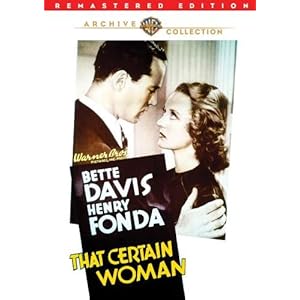
7. Bette Davis had her first onscreen pairing with Henry Fonda while under the direction for the first time of Edmund Goulding in That Certain Woman (1937). Bette gives a timelessly brilliant performance that foreshadows the roles that would soon define her career, beginning with William Wyler's Jezebel


8. As Julie Marsden, one of the greatest roles in film history, Bette Davis was in love with Henry Fonda onscreen and in love with director William Wyler offscreen. The career-defining Jezebel was a blockbuster in 1938, and in 1939 it won Bette her second Oscar and cemented her status as a legend.


9. Bette Davis had a famous romance with co-star George Brent onscreen and off when she gave what she considered her greatest performance in what she also considered her finest film: Edmund Goulding's Dark Victory. It was one of the signature blockbusters of 1939, the year considered by film fans to be the peak of Old Hollywood greatness, and remains perhaps the most powerfully affecting film ever made about meeting death with dignity.


10. Bette Davis and Miriam Hopkins are both in love with George Brent, even decades after his character's death, in one of the biggest and most beloved films of 1939: Edmund Goulding's The Old Maid


11. Bette Davis's first time playing Queen Elizabeth and last time working opposite Errol Flynn remains one of the greatest films ever made about a powerful older woman in love with an ambitious young man: Mike Curtiz's The Private Lives of Elizabeth and Essex (1939). 


12. Bette Davis gives one of her subtlest, finest performances and shares one of the screen's greatest quiet romances with Charles Boyer in their only film together: Anatole Litvak's epic adaptation of Rachel Field's All This...And Heaven, Too (1940). Bette was nominated for an Oscar for The Letter that year, or else this film, a Best Picture nominee, would have no doubt earned her a fourth Best Actress nomination.


13. Do you think the universe has kept count of how many billions of times the final cigarette exchange in Now, Voyager has been rewatched?  The onscreen romance between offscreen friends Bette Davis and Paul Henreid in Irving Rapper's adaptation of Olive Higgins Prouty's Now, Voyager (1942) is one of the most beloved love stories in the history of film. In my book, it is also the greatest American movie ever made.

14. Bette Davis played one of her most atypical characters and gave one of her best performances opposite her favorite actor, Claude Raines, as the titular character in Vincent Sherman's Mr. Skeffington. One of the biggest hits of 1944, it earned Bette her seventh Best Actress Oscar nomination and, like so many Davis classics, has an ending that is powerful enough to transform a viewer's life...as it did mine.


15. The first of two movies in which Bette Davis played good and bad twins, Curtis Bernhardt's A Stolen Life was a box office smash and a film noir classic. It's also a touching love story opposite rising star Glenn Ford, set against an effective soundstage recreation of Bette's beloved Cape Cod. 


16. Bette Davis said that Bretaigne Windust's Winter Meeting (1948) could have been great if it had not been butchered by the censorship of its era. She was absolutely right. In spite of this, the connection between Bette Davis as a repressed New Yorker and Jim Davis as an aspiring priest also serves as an unintentional but devastatingly relatable parallel to unrequited love between a straight woman and a gay man.


17. What more can possibly be said about Joseph L. Mankiewicz's All About Eve? It is a perfect work of art in addition to being one of the great screen entertainments of all. It is also a beautiful love story between older actress Margo Channing and younger director Bill Sampson. Bette Davis and Gary Merrill's passionate offscreen romance in those respective roles no doubt adds to the film's pulsating energy and timelessness.


18. Sterling Hayden is in love with Bette Davis for the woman she is, not the Hollywood star she used to be. Stuart Heisler's The Star (1952) is as relevant today as sixty years ago, and its timeless love story is deeply affecting for anyone who has ever fought for a career while dreaming of a soul mate. 


19. Bette Davis's portrayal of a deranged Southern recluse in Robert Aldrich's Hush...Hush, Sweet Charlotte (1964) is a staple of 60s horror. But it is her obsession with her great love (Bruce Dern) whose life ended violently decades earlier that makes her performance, and the film, endlessly fascinating to watch. This rendition of the theme song, sung in character on "I've Got A Secret", speaks to the tragic romance at the heart of a suspense classic.


20. The equally legendary Bette Davis and Jimmy Stewart finally got to work together in one and only film: George Schaefer's Right of Way (1983). As a married elderly couple who have decided to end their lives together, two of America's most talented and beloved actors bring a vital, relatable warmth to a telefilm so controversial that it was rejected by the major networks and aired on HBO to great acclaim. Having explored countless facets of human emotion in her body of work, Bette Davis and Jimmy Stewart's lone collaboration is a truly beautiful insight into the depth of a love that has only grown over decades. Sadly, her second film with Schaefer and only film with Stewart unexpectedly capped off the "Silver Age" of Bette's career, during which time high quality telefilms provided some of the best roles she had played since Warner Bros. Right of Way was the last film Bette made before a devastating stroke impacted the rest of her acting career, and as such, it is almost unbearably sad to cite it as "her last great film". Yet, in many ways, it is the perfect book end to Dark Victory, her proudest accomplishment, and thus makes for an undeniably appropriate final chapter in what might be the richest body of work of any screen actor.