Showing posts with label Madonna. Show all posts

Monday, September 29, 2014

The FYI File: Honesty, Grace, and "MAD"-ness

Today marks six months since my last post, a new record for lengthy absences since I started blogging three years and three months ago. Resuming this is not “something that has slipped my mind”. It’s been on my mind constantly, and my failure to do so has illustrated the inertia and creative frustration that has dominated my life for most of 2014. Hence, a no-frills entry to bring us up to the present.

My feline son, Toby, looking especially angelic on 08/22/14.

Just Checking In


This past Spring, after I posted the clunkily titled "I Honestly Know Me: An Evaluation of an Evaluation", I found myself freaking out that I had just revealed way too much about the daily failures of my adult life and sunk into the scariest territory of all: humorlessness. At the time, I was writing down a lifetime's worth of experiences that lead to my self-diagnosis of Asperger's Syndrome, all part of massive preparations, several months in advance, for scheduled neurocognitive testing in July. I was reading John Elder Robison’s Be Different: My Adventures With Asperger's and Rudy Simone’s Asperger’s On The Job at the time, books that were crucial to my self-understanding and self-empowerment. I was inspired by these incredible Aspergian authors to record my own experiences and put them aside for future use in a book. I hoped that fearlessly yet humorously delving deep into my personal experiences, as John Elder Robinson and Rudy Simone had done, might just help fellow undiagnosed Aspies identify and appreciate their uniqueness, as opposed to the more commonly realized experience of suffering in silent confusion. (This is not to suggest that all undiagnosed Aspies endure such struggles: I suspect that most successful people in the entertainment industry, including nearly all of my favorite artists, are fellow Aspies.) Due to a desire to save what I was writing at the time for the potential book-to-be, I found myself without anything to say on the blog. And my drive to find something fresh to write about quickly dissipated when a close loved one was diagnosed with cancer.


In the months since, I have witnessed incredible bravery and strength and sacrifice as my extraordinary aunt has fought valiantly against terminal illness with her sister and children beside her every step of the way. It has been a truly awesome demonstration of humanity at its finest, one that I have been honored to witness. But I would still give anything not to have seen such exemplary integrity, and to instead be in an alternate reality without cancer constantly striking the world's bravest and most inspiring people. My beloved aunt continues her battle, and in the months since it began my family and I have said goodbye to a young friend who died in a matter of days after finding out he had cancer. His loss was felt the world over, for he lived and touched lives on nearly every continent. These past few months also saw the passing of my Mother's Mother. Though just a few months shy of eighty-nine years old, my grandmother's death blindsided all of us who expected her to be with us for another decade, at least. My grandmother was a deeply spiritual person, as am I, and I have felt and continue to feel her near ever since the time of her passing. But this blessed comfort does not change the radically altered landscape for all of us, and particularly my Mother, who have only ever known this world with our beloved Nana in it.

09/20/11: My mother, her parents, and their beloved dog, Blinky, on my happiest of birthdays.


I went into 2014 predicting a year that would be profound and beautiful and a happy end to seven years of bad luck that plagued me since I graduated college in 2007. I cannot say that this year brought with it the euphoria that I hoped for. But it certainly has been profound, and I cannot deny that it has been beautiful, for I have learned more about appreciating life in the present tense than I ever have before. It was not until I was sixteen years old that Madonna’s Ray of Light album/era introduced me to the notion of “living in the moment”. And it would take another sixteen years before I truly understood the vital, urgent importance of taking that approach to my and loved ones’ journey here on Earth. The moments shared with my loved ones in 2014 are among my most cherished moments of all. And each has made me realize how incredibly blessed I am.


"MAD" About Her


Despite the sadness, I would also like to celebrate how many happy times there have been in the six months since my last post. Among the most purely and unoforgettably enjoyable of these experiences was being interviewed for Matteo Maccarinelli’s MAD For Madonna, an upcoming documentary about Madonna’s passionate global fanbase. I was honored beyond words to partake in this film thanks to the fan popularity of my "Vogue Boy" video, because I knew it would give me a chance to speak from the heart about the artist who has had the greatest singular impact on shaping my creative output. 

I spent weeks preparing for my film debut, fearing how I would come across to people who had only ever seen me as the child in the video, worrying I would let them down with how I had turned out. I simultaneously feared that in my state of anxiety I might forget something important I wanted to convey, or just blank out altogether and make myself, and in turn my allegiance to Madonna, a joke. I was so worked up by the day before filming that I couldn't sleep that night. But twelve hours before the interview, I saw a shooting star overhead while outside listening to Madonna’s “Superstar”. And about eight hours prior, a single leaf fell from a tree and glided down near me as I watched the sun rise. I felt the Universe was letting me know that things would play out just fine. And indeed, they did. 

I only got about two hours of sleep before the cameras were to roll, but my adrenaline was pumping and the filming itself was even more enjoyable than I could ever have imagined. The dialogue prompted by the wonderful interviewer/co-filmmaker, Madeline Herec Poirier, yielded a number of unexpected insights that were as beneficial to my understanding of my relationship with Madonna as they were, hopefully, to the film itself. In deciding what I would wear onscreen, I unearthed my favorite Madonna t-shirt, from The Confessions Tour, which I had retired in 2010 after being photographed in it when I met my OTHER favorite living artist, Dario Argento. I opted to resurrect and immortalize this t-shirt on June 6th, 2014, an incredibly well-timed day for filming as it was exactly three years after I uploaded my childhood video to Vimeo. I’m obsessed with dates, and with fate, as anyone who’s read this blog for long enough knows. And filming my interview three years after "Vogue Boy" brought the experience full circle in the most divine way possible.

My sister Jen took this post-filming photo, perfectly capturing the elation of that beautiful June 6th!

There But For A Goddess Named Grace

Speaking of dates and divinity, today marks three months since I began to (also) worship at the altar of Grace Jones. I’d deeply respected her since I discovered her in the '90s and much later became enamored with several of her singles after I fell in love with her in Richard Wenk’s vastly underrated Vamp. But this past June 29th, I decided to finally take a long delayed, well-worth-the-wait dive into her discography. I was inspired by the artwork of one of my favorite blogs, GangsterSaysRelax.com, to start with her 1982 album Living My Life. By the time I reached the closing track, “Unlimited Capacity For Love”, which has since become my favorite, I knew I was about to become a HUGE Grace Jones fan. Ever since that fateful summer evening, Miss Grace Jones has become my most-played musical artist of 2014, dominating my use of Spotify and YouTube for the entire summer before I was fortunate enough to be gifted several of her albums and the DVD of her One Man Show for my birthday on September 20th. I was not surprised to find that the music of Grace Jones is so brilliant, but I was surprised to find that it is so spiritual, and indeed the combination has been key in making her body of work the soundtrack to an unprecedentedly monumental year in my life. This is not to suggest that I’m not still constantly listening to Madonna, Donna Summer, Diana Ross or ABBA. But if Grace has overshadowed these long-time favorites in 2014, it’s because I’ve got a lot of lost time to make up for. And making up for it has been an utterly sublime pleasure.

Jump to 3:05 to witness the overpowering energy that obliterates inhibition and arouses empowerment in everyone who comes into contact with Miss Grace Jones!


Just Like Starting Over

And now, I close with a confirmation: I have Asperger’s Syndrome. 

Of course, you probably don't need me to tell you this if you’re a longtime reader of this blog familiar with the passions, obsessions, and/or writing style of "Aspies". But if you’re not, or if you’re someone like me who can’t rest easy without the validation of a medical professional, I’m happy to say that my diagnosis is official. Following up on several hours of neurocognitive testing at a top Boston hospital on July 10th, an incredible neuropsychologist told me on July 22nd that she agreed with my self-assessment and formally diagnosed me with Asperger’s Syndrome and co-morbid anxiety disorder. (Anxiety tends to go part and parcel with ASD, but my anxiety is severe enough to warrant a separate mention.) Out of respect to this incredible doctor who inspired and empowered me, I’ll withhold further details except to say that it was an entirely positive experience. Insurance challenges notwithstanding, I urge anyone who suspects they are an undiagnosed Aspie to pursue neurocognitive testing: my neuropsychologist's report was, without a doubt, the single most accurate assessment of me that has ever been written. 

I never thought that, at thirty three years old, I would be living with my family with a dusty college degree and no money, no job, no experience, no prospects, and no idea of how to change all of that. I struggle with severe impairment in executive functioning and long-hidden learning disabilities that were revealed in my testing, the combination of which, along with my anxiety, has left me reclusive, afraid to drive, and struggling to function in society as a normal adult. I share all of this in solidarity with others like me on the autistic spectrum, (once) undiagnosed adult Aspies who are, in my neuropsychologist’s words, “incredibly bright” yet unable to apply the gifts that they possess the way everyone around us seems able to.

The gift that I possess, which has kept me from being swallowed up by the inevitable depression that comes from such grave realizations, is the ability to write. For months I have felt robbed of this ability, paralyzed by medical and financial crisis and overwhelmed by fear and confusion. But after six months, I am determined to find a means of taking this gift that I have been given and utilizing it. I have to believe that I can still pull myself, my partner, and my family out of the rut I ended up in after years of living my life as an individual with undiagnosed autism spectrum disorder. With the support of my incredible loved ones and, I hope, a return to regularly writing for this blog, I think I might just have a shot at turning the challenges that haunt me in 2014 into the salvation that defines me in 2015.

My all-time favorite performance of my 2014 theme song:
"NEVER stop the action!"

Tuesday, November 19, 2013

Twenty Years Of Living Dangerously


From the very beginning of my adoration of her, I have always viewed Madonna as an actress first and a singer second. Everything about her life is drenched in performance, and every performance she has ever given is drenched in her life. The lines blur in a fascinating way that no doubt plays a role in her longevity and ability to continually evolve both creatively and commercially. In fact, it is easier for me to understand people’s complaints about her singing than it is for me to get the whole “Madonna can’t act” stigma. She has managed to continually deflect criticism of her voice, at least publicly, but she has never been able to hide her vulnerability to critics' savagery about her performances on the big screen.


This paper was written in November/December 2005, when Confessions On A Dancefloor brought about a dramatic resurgence of interest in Madonna’s music after the relative failure of American Life. I was a student at Emerson College, and this was my final assignment in an “American Independent Cinema” course with the great Rachel Thibault. The course rejuvenated my love for indie cinema at the same time that Madonna’s “Confessions” rejuvenated my love for Euro-flavored disco. And when I revisited Abel Ferrara’s Dangerous Game on DVD that Fall, I bridged my in-class and out-of-class identities in celebration of the most criminally underrated work in Madonna’s filmography.


I was working on this up until the literal last minute, when I ran out the door after printing it out. Thus my hand-in version was rougher, and a lot less clear, than I would ever have wanted it to be.  That’s why I have trimmed and polished it a bit more than my other Emerson College compositions previously resurrected for this blog. I’m not sure how effective it is in its current form, as it is essentially a condensed chapter from a book I’ve always dreamed of writing about Madonna’s screen career. Nonetheless, I hope it makes a worthy tribute to a film that is most deserving of celebration on its 20th Anniversary.


Robert E. Jeffrey 12/13/05

MA421: Final.

                                  Dangerous Deconstruction


It could be said that the term “independent film” is an oxymoron. For an artist to make a film, the artist must accept the fundamental, perhaps shattering truth that they cannot be the sole creator of their work. Writing and live performance are forms of expression which can theoretically be executed anywhere, by anyone, with or without assistance. Cinema, on the other hand, necessitates that the most independently functioning of artists break free from a potential mindset of creating art solely for oneself and judging art solely by one’s own standards. Filmmaking is defined by constant interactions among a wide array of individual artists coming together to birth a work that will inevitably turn out to be quite different from what any one of them might have imagined on their own. This disparity between the vision and the aptly titled “product” probably serves to explain the careers of numerous artists whose work in film rarely, if ever, fulfills their artistic potential. In the case of Madonna, the world’s most famous artist of any medium, the perennial challenge of balancing the desire to control and the need to submit has resulted in one of the most high-profile yet almost universally dismissed film careers of any actor with two decades’ worth of leading roles under her belt.


People really need to see things now more than any time before. They want to build a fantasy around you. This is the age of escapism because the world is in such horrible shape right now. They want to enjoy looking at you and have fantasies about being with you, or they are going to have fantasies about being you. I did the same thing as a child. I do the same thing even now. I think it’s really important for people to have something tangible, and if it’s good looking, and interesting, then that’s even better.
                            
                                Madonna, 1984 UK Radio Interview
                                                   
From the beginning of her career, Madonna has continually sought refuge in the world of independent film, both to sharpen her craft as an actress and to shed, reveal, and reconstruct her media persona through self-financed productions. Excluding student films and avant-garde shorts that she filmed in New York, Madonna’s career in independent film began with the 1985 Susan Seidelman screwball satire Desperately Seeking Susan and peaked with Alek Keshisian’s Truth or Dare, a rockumentary cum sociological study centered around “Madonna ‘90” and her extravagant, cinematic Blond Ambition world tour. Both films are the most critically acclaimed of Madonna’s career. The low-budget “Susan” was one of the most profitable comedies of the 1980s, and Truth or Dare went on to be “the most financially successful documentary of all time” (Rettenmund 3, 48, 179) until the unprecedented success of Michael Moore’s Bowling for Columbine and Fahrenheit 9/11 over a decade later. They are also among the most analyzed American films of the past twenty-five years among post-feminists and media scholars—and, presumably, the incoming generations of young people who have been literally “growing up with” Madonna. Independent film, however, has rarely been discussed as a key component to the success of the world’s most recognizable female entertainer. Feminism, religion, sexuality, family, power, and American social mores are frequent points of discussion (or criticism) in the endless canon of books, magazine articles, and academic essays devoted to Madonna. Yet her role as “actress” has been so universally panned that acclaim or even serious discussion of this aspect of her career is as “uncool” as it is nearly unheard of. 
Since the release of the 1986 critical/commercial flop Shanghai Surprise, there seems to have been an inordinate amount of periodical space filled by scathing commentary on Madonna’s supposed inability to act, or the low grosses for most of her screen work, or pleas from film critics begging that Madonna please stop making movies. This would seem to have resulted in an inherent taboo around discussing her work on the big screen with the same level of seriousness with which one might be allowed to write about her songs, live shows, or overall cultural impact. Part of the reason for this is inevitably because Madonna continually demonstrates an ability to remain omnipotent in the media, aided by the rise of entertainment coverage in print, on television, and all over the internet. Madonna has been a perennial staple of MTV for well over twenty years thanks to distinctly cinematic music videos which have defined her public persona more than any other aspect of her work. But music videos are rarely acknowledged as screen performances. In the public eye, Madonna thrives as “international icon” and “a legendary entertainer”. This makes Madonna’s task of forging a distance between audience perception and on-screen characterization an even more difficult challenge than for most other “stars”. Nowhere else in her film career was the desire to meet this challenge as apparent as in Abel Ferrara’s Dangerous Game (aka Snake Eyes), the most emotionally challenging film of Madonna’s career—for both the actress and the audience. 


Excepting his director-for-hire job helming the 1993 Body Snatchers remake, Snake Eyes (Dangerous Game’s shooting title) was Abel Ferrara’s first film after the success of Bad Lieutenant the previous year. It was also the first project to be released by Madonna’s Maverick Films production company (“Interviews: Vol. 2”), and by all accounts Madonna went into Snake Eyes with nothing short of rabid enthusiasm. In a January 1993 American press conference to promote her upcoming film Body of Evidence, Madonna admitted that, in the years since her big screen triumph as “Susan”, she had made mistakes in selecting scripts based on a desire to be a movie star. She suggested that Body of Evidence and the upcoming Snake Eyes offered more substantive characters than the roles she had played in the past, and would ideally boost her reputation as a serious actress. “I love all of [Abel’s] movies. I think he’s a brilliant director and I love his unrelenting honesty about everything. [Snake Eyes] is written by Abel and Nick St. John, and it’s a psychological drama kind of like Truffaut’s Day for night”. (“Interviews: Vol. 2”) Ahead of production, Disney president Joe Roth personally told Madonna that Snake Eyes would only further damage her screen career when he forced her to choose between filming the studio’s Angie I Says or Ferrara’s “dark” new film, both of which began shooting at the same time. Madonna was forced to turn down the title role in what would ultimately be released as Angie—a vehicle written specifically for Madonna. (“Interviews: Vol. 2”)


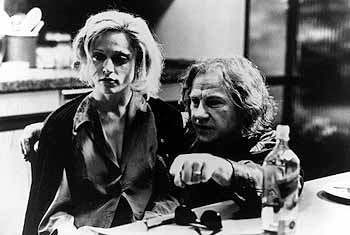
In Snake Eyes/Dangerous Game, Madonna plays Sarah Jennings, a successful American television star looking to be taken seriously as a screen actor by teaming up with independent film director Eddie Israel and drug-addled method actor Francis Burns in a dark Hollywood drama chronicling the final, violent night of a volatile marriage going down in flames. Harvey Keitel plays Eddie Israel, a director modeled after Abel Ferrara, and James Russo plays Francis Burns, a character possibly modeled after Madonna’s ex-husband, Sean Penn (Rettenmund 45).  The film weaves surreally between the dark lives of the actors and the dark lives of their characters, drawing parallels between the drug use, infidelity, sexual dysfunction, opportunism, and “spiritual death” going on in both worlds. The film rarely adheres to a narrative: it wanders aimlessly through the most uncomfortable sides of adult life, continually reminding its audience of how different the real world is from the movies we are raised on. Throughout its disparaging, boldly anti-commercial journey into Hollywood-as-Hell, Dangerous Game retains its ability to rivet due in large part to three of the most raw, explosive performances to be captured on film in the 1990s.


Madonna, in her first and last Abel Ferrara film, shed the mannered style of Old Hollywood goddesses with whom she had aligned herself in the past and delivered the most human, fearless performance of her career. The New York Times offered that “viewers may actually need to remind themselves that they’ve seen this actress somewhere before” (Rettenmund 45). Rather than attempt to subvert the audience’s past association with the film’s leading lady, Ferrara constantly finds sly, almost cruel ways to remind everyone that that is Madonna onscreen. The character’s sense of humor, fashion, and vampiric use of people to forward her career are all traits of the media myth of Madonna, the one born of scandal sheets and tabloid columns. Here, this unflattering image is satirized with an utterly realistic performance. As the New York Press put it, “Madonna has either learned how to act or finally found a character not so different from herself…either way, she’s terrific”. Madonna agreed with the sentiment, but was so horrified by the differences between the film she thought she was making and the final cut Abel Ferrara delivered that she refused to promote the film. (Rettenmund 45)

It was an entirely different movie when I made it—it was such a great feminist statement and she was so victorious at the end. I loved this character. I thought I could take the role and do a great performance. It was going to be this great thing for me. And even though it’s a shit movie and I hate it, I am good in it. But the way Abel edited it completely changed the ending. It was like someone punched me in the stomach. If I’d have known that was the movie I was making, I would never have done it, and I was very honest with him about that.

                                             Madonna, 1994
                                                                                                                                                  
          (St. Michael 104, 105)

Since the beginning of her career, Madonna's persona in film and on television has consistently equated sexuality with power and self-assurance. But in Dangerous Game, her character of Sarah Jennings is a stereotypically whorish wannabe movie star, one with so much disdain for herself that she uses sex and a lack of empathy as a means to an end in furthering her film career. In Mother of Mirrors, the film-within-a-film, we see this young actress being beaten and raped and humiliated, sometimes in character and sometimes out. This performance is a stark contrast to the “pornography-as-power” exercise in gender reversal that had caused an uproar one year prior with the release of Madonna’s Sex book, a work that she oversaw from conception to release—unlike Snake Eyes/Dangerous Game. “I don’t have the power in the film industry that I have in the music industry. The director is the one in control, and everyone else is a pawn. [The director] can take [your] performance in the editing room and completely change the character.” (St. Michael 105) 


                  In the years since its notoriously unsuccessful release, Dangerous Game has largely been overshadowed by Abel Ferrara’s subsequent films outside of Hollywood and Madonna’s subsequent achievements outside of film. It is scarcely touched upon in retrospectives of Madonna’s career, but Ferrara himself has no desire to mince words when it comes to Madonna. "She's a fuckin' jerk!  Like we sit around taking out the best scenes in the movie to spite her. You know how paranoid you gotta be to fuckin' say something like that?" (Jones 3)  Abel Ferrara’s ex-wife, Nancy Ferrara, who played the character of Eddie Israel's wife, Madlyn, recalls the vitriolic reaction Madonna gave Abel upon seeing the rough cut. Being interviewed for Andrew Morton's 2001 biography Madonna, she recalled a series of fuming fax letters that Nancy Ferrara felt revealed more about Madonna than about what was "wrong" with the film.

She was so angry about the movie. The faxes were just nasty. “You fucker, you’ve fucked my life”, that sort of thing. The whole tone was about her, “I” and “me”, “I” and “me". She looked very vulnerable and that was really pulling her apart. At the end she revealed that when she is not in control, she is not as secure or confident as she would like everyone else to think.  She revealed something of her humanity. That is why she wouldn’t endorse it. It hit too close to the bone. She hit on all that emotion and couldn’t face it.”     
Nancy Ferrara                                                       (Morton 257, 263)

           Madonna has clearly been influenced by Hollywood legends like Bette Davis in her attempts to build a body of cinematic work as both an actress and an icon. But Madonna never worked as often before the camera as stars like Bette Davis, making movies only sporadically and rarely making two films back to back without an album or tour in between. Thus the results of Madonna’s attempts to have a great screen career have more often than not been disappointing. Madonna has never been one to shy away from this, but in the case of Dangerous Game, a tremendous work was unfairly deemed a failure by none other than Madonna herself. One might theorize that Madonna’s violent hatred for the final cut stemmed from being unable to construct her own identity within a film that was, seemingly, the antithesis of values she had come to represent. Yet her dual turn as Sarah Jennings and Sarah’s movie-within-a-movie character, Claire, oozes with the “relentless honesty” that drew Madonna to Ferrara in the first place. One cannot help but wonder why she dared not embrace a performance that was so memorably uncompromising, especially when Ferrara’s assaultive approach to cinema was what prompted Madonna to put faith in his ability to bring out the best in her.

“In an interesting artistic inversion, the perceived realism of Madonna’s documentary, Truth or Dare, merely recorded the essential artifice and staginess of her Blond Ambition tour, while in Ferrara’s movie, supposedly an exploration of make-believe, Ferrara ripped away her carefully contrived mask, the director literally wrenching a draining and difficult performance out of her. Madonna never saw it coming.”
                                                             Andrew Morton
(Morton 260)


SPOILER ALERTDon't watch this unless you've either already seen the film....

or never intend to.


Abel Ferrara certainly did bring out the best in Madonna: she’s arguably never been better onscreen. At least as much as her Golden Globe-winning turn in 1996’s Evita, Dangerous Game is celluloid proof that a gifted actress lay within the seemingly fearless, seemingly unstoppable multimedia megastar cum superheroine known worldwide as “Madonna”. The film reveals human frailty behind the shining armor of a warrior goddess, but like a general snatching back plans before they can fall into enemy hands, Madonna was not ready to let down her guard. Perhaps, now a more evolved artist than ever, Madonna will be so willing to once again be this forthright and revealing on the big screen, as she continues to be in other mediums. Regardless, the immortality of film insures that Dangerous Game, like Desperately Seeking Susan before and Evita after, will live on as proof that “Madonna, Queen of Pop” could very well have been “Madonna, Queen of Hollywood”.  


WORKS CITED

Jones, Kent. “Abel Ferrara, The Man: Who Cares?” Culture Port: Ret. 12/7/05

Madonna. Interviews. Baktabak Recordings. 1995.

Madonna. Interviews: Volume 2. Baktabak Recordings, 1997.

Morton, Andrew. Madonna. New York: St. Martin’s Press, 2001.

Rettenmund, Matthew. Encyclopedia Madonnica. New York: St. Martin’s Press, 1995.

St. Michael, Mick. Madonna: In Her Own Words. Great Britain: Omnibus Press, 1999.

Friday, November 15, 2013

Confessions '13: It Came From Religion Class


Wow, the stars truly aligned.


I was planning to finally end the five month hiatus from my blog by once again posting for "Confessions Day", the anniversary of the U.S. release of Madonna’s Confessions On A Dancefloor. Then I figured I’d give that a rest since, well, I’ve already confessed enough. Besides, I’m working on a little something for another upcoming Madonna anniversary that I thought would make a more impactful comeback post.

Alas, The Universe had something else in mind: an entry that feels like déjà vu.

Once again, I discovered a piece of thought-lost writing from my Catholic high school years: in this case, a short assignment written in a notebook for religion class. And, wouldn’t you know, it was written just a few desks away from “James”, the straight classmate whose lone year at my alma mater came to define my adolescence. So I thought I’d precede the formal relaunch of my blog by posting my irrepressibly honest fifteen year old self’s every handwritten word. Try to keep in mind, this was written by a 9th grader in love. But, also, that nearly all of it of it still applies to me today.

That, for better or for worse, is my Confession ‘13.


Bob Jeffrey
1/22/97


  1.        Learning
  2.        Family/personality
  3.        Where You Are In Faith Experience
  4.        How Is Freshman Year Going For You?
1
  1.   I’m not really a smart person. I get distracted a lot while doing my homework, and I usually take a long time because of this. I often “drift off” in class, and will sometimes start falling asleep while taking notes or listening to a lecture.
  2. I am kind of a bizarre person. I always try to reach out and help people, but I keep a lot of things “bottled up”, so it can result in a short-temper. I think I might be manic-depressive. I had a horrible experience in junior high, and I believe this brought about manic-depression. I am very sensitive and I am always worried about what other people think of me. I often make myself think that they think bad things about me, and I make myself believe I am a horrible person. I try to be as outgoing as possible, but in reality I am very shy and self-conscious. I am very close to my family.
  3. I used to go to church just about every week, but I haven’t gone in a long time. Still, I believe in God and Jesus Christ and I pray all the time about various things. Though I attend CCD, I find that I miss it often. Still, I consider myself a very religious person. 
  4. So far, freshman year is a blast! I hated junior high, and so far high school is fantastic. After my Jr. High experience, I became really shy and a loner, but I am gradually getting back to the way I used to be. I want so bad to be popular, though. I think that right now I am average. I’m not popular, but not unpopular. I have a lot of people who I consider my friends, and no one here is mean to me, that I can recall. Fortunately here there isn’t as much of a rat race. People all seem to be on the same level, like everybody here is friends with everyone else. Hope that won’t change now that I said it.


Suffice to say, the high I was on when I wrote this certainly did not last for the rest of high school, and I would never again take such an unnecessarily revealing approach to in-class assignments. Or, if I did, I blocked it out of my memory. So allow me to close by dedicating this performance of one of my favorite "Confessions" tracks to the inner fifteen year old in us all.


Monday, April 22, 2013

A Decade Of Madonna's So-Called "Life"


Madonna’s American Life album put me on the path towards completing my very first screenplay, the title of which would go on to be the theme of every script I have written in the ten years since: Disillusion. The realization that I was fantasy-obsessed, and patterning my life after Madonna's career, was obvious to my loved ones ever since I poured all of my nine year old creative energies into that video tribute to "Vogue". But my own epiphany would not come about until the release of American Life, ten years ago today. I figured there would already be plenty of fellow SuperFans putting this album and its unprecedented commercial failure against the backdrop of the cultural climate that followed the horrors of 9/11 and preceded the horrors of The Iraq War. So instead of a sociopolitical context, I thought I'd do what I do best and put this album into the context of....Me.

Hi. 

Rather than a proper multimedia retrospective, I offer a random assembly of thoughts, linked by some of my favorite tracks from one of my favorite albums. It's me at my most honest and unstructured because American Life is Madonna at her most honest and unstructured. And who would I be if not someone who lives and breathes to pay tribute to Her? Whereas now I can say that as a tongue-in-cheek nod to my trademark penchant for idol worship, such a statement would have been a lot less ironic ten years ago. Up until “The American Life Era”, my devotion to Madonna could theoretically have been read as amusing, admirable, or pathetic. It was Madonna herself who not-so-subtly encouraged me to look deeper into myself and how I could contribute to the world with the same passion with which I contributed to her record sales. It was, specifically, a statement she made when performing before an audience of SuperFans at an HMV Record Store in London on May 9th, 2003. 

"In the process I forgot....that I was special too."


It was the sort of promotion one would expect from an artist at the launch of their career, not the relaunch. Fans slept on the street to get into that ultra-exclusive, never-broadcast mini-concert. Yet while Madonna thanked them for their worship, she also encouraged them to put it towards their own betterment, not just hers. As she worded it herself that day: 

“If you want to pay tribute to me, do something important with your life.”


Those three words rang through my head, for they gave me permission to love myself as much as I loved Madonna. Initially, “maximizing my own potential”, as a guru might put it, was the ultimate tribute to my idol. But in time (thanks to my impeccable taste in idols) the desire to do good had (roughly) as much to do with love for humanity as it did with worshipping a Goddess. Thanks to the impact that Madonna’s American Life had on my American life, today my devotion to Madonna is defined by self-respect and a commitment to my own growth as an artist and human being. It all began the summer after the album was released, when I sacrificed my busy social life to commit myself to the isolation I required in order to complete a screenplay. Whereas my life before American Life was dominated by watching movies, my life after American Life has been dominated by writing movies: nearly all of my film viewership since 2003 has, for better or worse, been a part of my own artistic process. And it was Madonna's "Life" which opened the creative floodgates. 

Thanks, Madonna!

Even though American Life continues the journey Madonna embarked upon with Ray of Light and subsequently Music, in many ways this is, in fact, a reboot of her career—hence those record store gigs on both sides of the pond.  If Confessions On A Dancefloor was the 21st century reincarnation of her eponymous first album, then this was the debut record of the artist who Madonna was before she ever signed a recording contract, back when she shifted between rock and disco in New York clubs. Her guitar work on this album is apparently amateurish (I wouldn't know one way or another) but it's also as painfully honest as an adolescent love letter (which I can vouch for with more assurance). Ditto her youthful, almost child-like singing, a far cry from the post-Evita vocal training that impressed and divided listeners of Ray of Light and Music. For the "calculating" SuperDiva to have been so vulnerable and unpolished remains among the ballsiest moves Madonna ever made. It also defined the "screw the career, I'm finally happy" quality of both the album itself and how it was sold to the record-buying public.


The first televised performance of one of my all-time favorite songs. 

I was convinced American Life would be a smash, though that didn't stop me from buying ten copies of the CD in its first week of release to help it debut at #1 in America—which it did, giving Madonna her first back-to-back #1 albums in the U.S. since the 80s. Alas, it was soon to tumble down the charts. Fearing my overspending was bad karma and lead to weak sales, I went on to buy another eighteen copies on CD, vinyl, and eventually digital download between 2003-2005. This meant a lot of people were gifted copies of American Life during the two and a half years when it was "the new Madonna album". I gave a copy to the security guard at my building. I handed out a few to fellow college stoners after passing around my old bong, “Veronica Electronica”, while not-so-subtly playing the full length album. (Cannabis has never diminished my ability to be a fascist host to my company.) I even mailed CDs to friends and relatives along with a wordy letter about how Madonna's new album was her best ever and yet was being totally ignored by radio stations and in turn record buyers. In fact, quite a few of those friends and relatives became bigger Madonna fans after they actually heard the album. I even gave a CD to one of the first guys I ever hooked up with on his way out my door. The encounter was lovely, but the greatest pleasure that came out of that afternoon was learning that the album made him a bigger Madonna fan, too.

"How could it hurt you when it looks so good?"

Like many fans, I often wonder where Madonna's career would have lead, or what completely new shape it might have taken, had American Life sold as many copies in America as did the two albums that preceded it. It could have been the political mood of the country. It could have been the hostile reaction to the panned performances Madonna gave onstage in Up For Grabs and on the big-screen in Swept Away and Die Another Day. Or maybe it was just the same good old-fashioned misogyny that made the life-after-forty years of Bette Davis and Joan Crawford an uphill battle against "you already made it, so now be quiet" ageism.

"Do I have to chaaaange?!"


Ultimately, American Life's commercial failure shaped the subsequent decade of Madonna's career. She began to embrace her "greatest hits" catalogue on The Re-Invention Tour, and returned to a full-on dance music album after American Life's commercial and promo-only remixes dominated the Billboard Dance/Club Play charts for two years. Like most fans, I thought Confessions On A Dancefloor was an even better album--in fact, it's my personal favorite of all time, and I imagine it always will be. But “Confessions” is not simply a great album: it is the perfect companion to the downtempo American Life, and I could never have loved "Confessions" if I had not first fallen in love with "Life". Personally, I have always regarded both as Disc 1 & Disc 2 of a haphazard Double LP sent from the Gods and Goddesses of Pop Utopia. You cannot fully appreciate the exquisite pleasures of one without the other, and you cannot deny that each takes the listener on a journey from hard thumping to pleasant release. (Feel free to view those words as an aural, lyrical, sexual, or spiritual reference: all four interpretations apply to both albums.) And so today I honor not only American Life, one of Madonna's best albums and one of my favorite works of art, but also the incomparable changes it lead to in my life. I cannot put into words just how grateful I am to Madonna for weathering an embarrassing commercial failure in the (X-static) process of inspiring countless artists like myself. And to think, it's only been ten years....I'm thrilled to imagine the influence that this truly timeless, ever-listenable album will continue to have on my life and millions of others in the decades to come.

"And the world can look so sad....only you make me feel good."