Showing posts with label 90s. Show all posts

Wednesday, March 19, 2014

FYI File: Fantasy, Nostalgia, and "The 2014 Project"

Now that this blog has been given its third and final (I swear!!) name, I thought I would shake things up a bit. Nothing so crazy as dropping the pink text color or updating the general appearance to a post-1997 look, of course. But there's a lot I've been wanting to say, so rather than post a succession of lengthy blog posts, I thought I'd post this variety pack of short ones. 

The Twentieth Anniversary of My Obsession With Anniversaries


The hits package that redefined my life. Like, seriously!

January '14 marked the 20th anniversary of my obsession with anniversaries. My first-time viewings of Starman, The Shining, Dawn of the Dead, and Working Girl on blistery and/or snowy Friday nights in January '94 mobilized in me a 1980s nostalgia that never went away. But it wasn't just the movies I watched that month, it was also buying THE album: Totally 80s, the 2-CD Razor & Tie compilation that was advertised on TV all the time before becoming the soundtrack to most of my life in the sixth grade. From 1994 on I was fetishizing every aspect of '80s pop culture while lambasting everything I could about the '90s. However, happy Friday nights ritualistically spent at the local multiplex limited my aptness for thrashing then-contemporary film. 


It is now a time capsule for what the world looked like in March '94,
but The Paper also remains grown-up Hollywood fare at its most brilliantly entertaining.

For the Class of 2000, 1994 was the year when the sixth grade ended and the seventh grade began. Thus the year closed with my being knee deep in adolescent angst, which only kept me going back into the past. I continually found myself disappointed by reality, so I was constantly choosing fantasies that were constructed in another era. My pre-pubescent childhood had been so happy, and the spirit of the '80s was so inextricably linked to my own soul, that I lamented the decade until it became an over-idealized Heaven that I dreamed of dying and going back to. I was not unaware of this being unhealthy, but that didn't make it any less painful to push forward, not when I discovered that being a teenager was to be a lot less pleasant than I had been imagining in the '80s. Instead of forging a new path that would make childhood dreams come true, I clung to the past as an escape while reality came crashing down in the present. And, for better or for worse, I've been inclined to do this ever since.


I related to Tess McGill when I was twelve. I still do now.
And I'll bet many of you reading this feel the exact same way.


A Sorta-Facade On The Verge of Sorta-Crumbling

There has been so much that I have wanted to communicate through this blog over the last fifteen months, but during said fifteen months my life has been in a major state of upheaval. Actually, it was in upheaval when I started this blog back in 2011. But way back then, things in my life were just starting to turn upside down, and the coinciding mini-phenomenon of “Vogue Boy” allowed me to escape reality like never before. For a moment in Summer '11, it felt like my dreams of being an artist and a star had been instantly realized when that video achieved its peak popularity in one weekend. It was during that delightfully manic moment that I quickly decided to become a blogger, and my early entries here are thus defined by an optimism, and even a sense of fulfillment, that apparently represents me at my purest.  
The-blog-formerly-known-as-RobWorld has been a tremendous outlet in the three years since since then, for it has allowed me to unlock and release parts of myself through the written word in a way that I could never do within the format of a screenplay. But for well over a year, I have not been inclined to do any unlocking or releasing, for I have discovered that my life experiences are a lot less vivid in my mind after I make them public here. And, as evidenced in past entries, my memories, and the role they play in shaping my creative output, are too precious to me to be sacrificed.
On some level, I've gotten more screenwriting done by not blogging. But on most levels it has denied me an outlet that I need: not only to write, but to be read. I might not have a huge readership on here, but the feedback I've received in personal messages has been too awesome to be ignored. There is no better feeling than knowing a handful of people were affected by work that they personally related to, or which made them look at a movie or a person or a similar life experience in a new light. I don’t know if I’ll start writing again more regularly, because I thought that that would be the case last November....and it wasn’t. But I think this has a lot to do with my wanting to make every post an event, in turn defeating the purpose that this blog serves, for me, in the first place. I am a hopeless neurotic, still in the middle of a challenging and annoyingly long life chapter, and I need a place to let all this shit out. Some people go to therapy. I go to the stage. And that’s exactly what this blog is to me.


From Sixteen To Thirty-Two: "The 2014 Project"

Like the film itself, I'll NEVER forget the first time I saw this trailer!

When I was sixteen, I realized that Wes Craven's Scream was released exactly eighteen years after John Carpenter's Halloween, which itself had been released exactly eighteen years after Alfred Hitchcock's PsychoYears later, I would realize that Val Lewton and Jacque Tourneur's Cat People’s limited release in December 1942 meant it was the movie that launched this every-eighteen-years cycle. Since then, I’ve been anticipating "The 2014 Project", a film that would, like the aforementioned four films, inject the horror-viewing experience with enough wit and suspense to change the cinematic landscape and redefine the genre for another two decades.


The most bewitching of Hollywood films and
possibly the most influential horror movie ever made.


Since the late '90s, I have secretly hoped that the Universe would see fit to choose me to write this 2014 horror film, and much of my creative life has been spent preparing myself to be worthy of such an opportunity. Alas, I've proven far more adept at writing screenplays than actually getting them made into movies. And without ever seeing your work on some screen, one can hardly feel like a real screenwriter. So last year I attempted to put work of which I remain as proud as ever temporarily behind me, and to instead take a stab at crafting "The 2014 Project". I spent the entirety of 2013 working on eight different scripts, each of which I had hoped could potentially reinvent "the American horror film", but none of which ever made it to their respective finish lines. By New Year’s Eve, I was forced to admit defeat. I was proud of the work I had done, and confident that one day the characters and story elements from this arsenal of partial completion would find their way into my future projects. But by no means did I come close to striking the gold that I was digging for.


If every attempt at crafting a pure suspense picture was even half
as effective as Halloween, the world would be a much better place.

It was not until the very end of 2013 and the very beginning of 2014 that a burst of renewed inspiration and ambition (my favorite cocktail) launched me on a new path. My dream, in this easy-to-shoot-but-hard-to-distribute world of modern indie filmmaking, was that the work flowing out of me would find its way into the right hands, and a quickly-realized project (Cat People, Psycho, Halloween, and Scream were themselves low-cost/high-speed shoots) could theoretically find its way onto a VOD platform or into an early 2015 film festival. But nearly a third of the way into 2014, I'm inclined to believe that that dream will not come true....and I'm okay with that. It’s very likely that a great horror film will come along and make the impact I was hoping to make while I'm still pining away, and if that happens, I can finally say I was right all along. And hopefully, if that happens, 'my little horror film', whenever it makes its way to the screen, will still earn itself a place in the hearts of like-minded movie lovers. But for now, I think I'll put my faith in "The 2032 Project": I have good reason to believe I might be capable of writing something worthy of comparison to the aforementioned films when I'm fifty. In the meantime, I intend to enjoy the writing process instead of mourning my failure to be where I thought I would be when I was half the age that I am right now. 


No movie-going experience has come close to the first two times I saw Scream on the big screen. And I'm 99.44% sure that this will always be the case.

Furthermore, assuming that the every-eighteen-years cycle really does extend into this century, I'll be keeping my eyes peeled for the film that will ultimately redefine our collective concept of modern horror movies. There are already a few potential contenders in the pipeline, and 2014 has only just begun...


Tuesday, November 19, 2013

Twenty Years Of Living Dangerously


From the very beginning of my adoration of her, I have always viewed Madonna as an actress first and a singer second. Everything about her life is drenched in performance, and every performance she has ever given is drenched in her life. The lines blur in a fascinating way that no doubt plays a role in her longevity and ability to continually evolve both creatively and commercially. In fact, it is easier for me to understand people’s complaints about her singing than it is for me to get the whole “Madonna can’t act” stigma. She has managed to continually deflect criticism of her voice, at least publicly, but she has never been able to hide her vulnerability to critics' savagery about her performances on the big screen.


This paper was written in November/December 2005, when Confessions On A Dancefloor brought about a dramatic resurgence of interest in Madonna’s music after the relative failure of American Life. I was a student at Emerson College, and this was my final assignment in an “American Independent Cinema” course with the great Rachel Thibault. The course rejuvenated my love for indie cinema at the same time that Madonna’s “Confessions” rejuvenated my love for Euro-flavored disco. And when I revisited Abel Ferrara’s Dangerous Game on DVD that Fall, I bridged my in-class and out-of-class identities in celebration of the most criminally underrated work in Madonna’s filmography.


I was working on this up until the literal last minute, when I ran out the door after printing it out. Thus my hand-in version was rougher, and a lot less clear, than I would ever have wanted it to be.  That’s why I have trimmed and polished it a bit more than my other Emerson College compositions previously resurrected for this blog. I’m not sure how effective it is in its current form, as it is essentially a condensed chapter from a book I’ve always dreamed of writing about Madonna’s screen career. Nonetheless, I hope it makes a worthy tribute to a film that is most deserving of celebration on its 20th Anniversary.


Robert E. Jeffrey 12/13/05

MA421: Final.

                                  Dangerous Deconstruction


It could be said that the term “independent film” is an oxymoron. For an artist to make a film, the artist must accept the fundamental, perhaps shattering truth that they cannot be the sole creator of their work. Writing and live performance are forms of expression which can theoretically be executed anywhere, by anyone, with or without assistance. Cinema, on the other hand, necessitates that the most independently functioning of artists break free from a potential mindset of creating art solely for oneself and judging art solely by one’s own standards. Filmmaking is defined by constant interactions among a wide array of individual artists coming together to birth a work that will inevitably turn out to be quite different from what any one of them might have imagined on their own. This disparity between the vision and the aptly titled “product” probably serves to explain the careers of numerous artists whose work in film rarely, if ever, fulfills their artistic potential. In the case of Madonna, the world’s most famous artist of any medium, the perennial challenge of balancing the desire to control and the need to submit has resulted in one of the most high-profile yet almost universally dismissed film careers of any actor with two decades’ worth of leading roles under her belt.


People really need to see things now more than any time before. They want to build a fantasy around you. This is the age of escapism because the world is in such horrible shape right now. They want to enjoy looking at you and have fantasies about being with you, or they are going to have fantasies about being you. I did the same thing as a child. I do the same thing even now. I think it’s really important for people to have something tangible, and if it’s good looking, and interesting, then that’s even better.
                            
                                Madonna, 1984 UK Radio Interview
                                                   
From the beginning of her career, Madonna has continually sought refuge in the world of independent film, both to sharpen her craft as an actress and to shed, reveal, and reconstruct her media persona through self-financed productions. Excluding student films and avant-garde shorts that she filmed in New York, Madonna’s career in independent film began with the 1985 Susan Seidelman screwball satire Desperately Seeking Susan and peaked with Alek Keshisian’s Truth or Dare, a rockumentary cum sociological study centered around “Madonna ‘90” and her extravagant, cinematic Blond Ambition world tour. Both films are the most critically acclaimed of Madonna’s career. The low-budget “Susan” was one of the most profitable comedies of the 1980s, and Truth or Dare went on to be “the most financially successful documentary of all time” (Rettenmund 3, 48, 179) until the unprecedented success of Michael Moore’s Bowling for Columbine and Fahrenheit 9/11 over a decade later. They are also among the most analyzed American films of the past twenty-five years among post-feminists and media scholars—and, presumably, the incoming generations of young people who have been literally “growing up with” Madonna. Independent film, however, has rarely been discussed as a key component to the success of the world’s most recognizable female entertainer. Feminism, religion, sexuality, family, power, and American social mores are frequent points of discussion (or criticism) in the endless canon of books, magazine articles, and academic essays devoted to Madonna. Yet her role as “actress” has been so universally panned that acclaim or even serious discussion of this aspect of her career is as “uncool” as it is nearly unheard of. 
Since the release of the 1986 critical/commercial flop Shanghai Surprise, there seems to have been an inordinate amount of periodical space filled by scathing commentary on Madonna’s supposed inability to act, or the low grosses for most of her screen work, or pleas from film critics begging that Madonna please stop making movies. This would seem to have resulted in an inherent taboo around discussing her work on the big screen with the same level of seriousness with which one might be allowed to write about her songs, live shows, or overall cultural impact. Part of the reason for this is inevitably because Madonna continually demonstrates an ability to remain omnipotent in the media, aided by the rise of entertainment coverage in print, on television, and all over the internet. Madonna has been a perennial staple of MTV for well over twenty years thanks to distinctly cinematic music videos which have defined her public persona more than any other aspect of her work. But music videos are rarely acknowledged as screen performances. In the public eye, Madonna thrives as “international icon” and “a legendary entertainer”. This makes Madonna’s task of forging a distance between audience perception and on-screen characterization an even more difficult challenge than for most other “stars”. Nowhere else in her film career was the desire to meet this challenge as apparent as in Abel Ferrara’s Dangerous Game (aka Snake Eyes), the most emotionally challenging film of Madonna’s career—for both the actress and the audience. 


Excepting his director-for-hire job helming the 1993 Body Snatchers remake, Snake Eyes (Dangerous Game’s shooting title) was Abel Ferrara’s first film after the success of Bad Lieutenant the previous year. It was also the first project to be released by Madonna’s Maverick Films production company (“Interviews: Vol. 2”), and by all accounts Madonna went into Snake Eyes with nothing short of rabid enthusiasm. In a January 1993 American press conference to promote her upcoming film Body of Evidence, Madonna admitted that, in the years since her big screen triumph as “Susan”, she had made mistakes in selecting scripts based on a desire to be a movie star. She suggested that Body of Evidence and the upcoming Snake Eyes offered more substantive characters than the roles she had played in the past, and would ideally boost her reputation as a serious actress. “I love all of [Abel’s] movies. I think he’s a brilliant director and I love his unrelenting honesty about everything. [Snake Eyes] is written by Abel and Nick St. John, and it’s a psychological drama kind of like Truffaut’s Day for night”. (“Interviews: Vol. 2”) Ahead of production, Disney president Joe Roth personally told Madonna that Snake Eyes would only further damage her screen career when he forced her to choose between filming the studio’s Angie I Says or Ferrara’s “dark” new film, both of which began shooting at the same time. Madonna was forced to turn down the title role in what would ultimately be released as Angie—a vehicle written specifically for Madonna. (“Interviews: Vol. 2”)


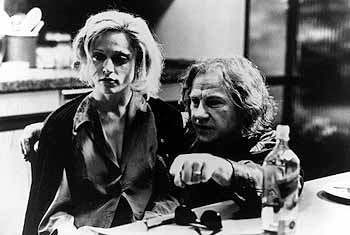
In Snake Eyes/Dangerous Game, Madonna plays Sarah Jennings, a successful American television star looking to be taken seriously as a screen actor by teaming up with independent film director Eddie Israel and drug-addled method actor Francis Burns in a dark Hollywood drama chronicling the final, violent night of a volatile marriage going down in flames. Harvey Keitel plays Eddie Israel, a director modeled after Abel Ferrara, and James Russo plays Francis Burns, a character possibly modeled after Madonna’s ex-husband, Sean Penn (Rettenmund 45).  The film weaves surreally between the dark lives of the actors and the dark lives of their characters, drawing parallels between the drug use, infidelity, sexual dysfunction, opportunism, and “spiritual death” going on in both worlds. The film rarely adheres to a narrative: it wanders aimlessly through the most uncomfortable sides of adult life, continually reminding its audience of how different the real world is from the movies we are raised on. Throughout its disparaging, boldly anti-commercial journey into Hollywood-as-Hell, Dangerous Game retains its ability to rivet due in large part to three of the most raw, explosive performances to be captured on film in the 1990s.


Madonna, in her first and last Abel Ferrara film, shed the mannered style of Old Hollywood goddesses with whom she had aligned herself in the past and delivered the most human, fearless performance of her career. The New York Times offered that “viewers may actually need to remind themselves that they’ve seen this actress somewhere before” (Rettenmund 45). Rather than attempt to subvert the audience’s past association with the film’s leading lady, Ferrara constantly finds sly, almost cruel ways to remind everyone that that is Madonna onscreen. The character’s sense of humor, fashion, and vampiric use of people to forward her career are all traits of the media myth of Madonna, the one born of scandal sheets and tabloid columns. Here, this unflattering image is satirized with an utterly realistic performance. As the New York Press put it, “Madonna has either learned how to act or finally found a character not so different from herself…either way, she’s terrific”. Madonna agreed with the sentiment, but was so horrified by the differences between the film she thought she was making and the final cut Abel Ferrara delivered that she refused to promote the film. (Rettenmund 45)

It was an entirely different movie when I made it—it was such a great feminist statement and she was so victorious at the end. I loved this character. I thought I could take the role and do a great performance. It was going to be this great thing for me. And even though it’s a shit movie and I hate it, I am good in it. But the way Abel edited it completely changed the ending. It was like someone punched me in the stomach. If I’d have known that was the movie I was making, I would never have done it, and I was very honest with him about that.

                                             Madonna, 1994
                                                                                                                                                  
          (St. Michael 104, 105)

Since the beginning of her career, Madonna's persona in film and on television has consistently equated sexuality with power and self-assurance. But in Dangerous Game, her character of Sarah Jennings is a stereotypically whorish wannabe movie star, one with so much disdain for herself that she uses sex and a lack of empathy as a means to an end in furthering her film career. In Mother of Mirrors, the film-within-a-film, we see this young actress being beaten and raped and humiliated, sometimes in character and sometimes out. This performance is a stark contrast to the “pornography-as-power” exercise in gender reversal that had caused an uproar one year prior with the release of Madonna’s Sex book, a work that she oversaw from conception to release—unlike Snake Eyes/Dangerous Game. “I don’t have the power in the film industry that I have in the music industry. The director is the one in control, and everyone else is a pawn. [The director] can take [your] performance in the editing room and completely change the character.” (St. Michael 105) 


                  In the years since its notoriously unsuccessful release, Dangerous Game has largely been overshadowed by Abel Ferrara’s subsequent films outside of Hollywood and Madonna’s subsequent achievements outside of film. It is scarcely touched upon in retrospectives of Madonna’s career, but Ferrara himself has no desire to mince words when it comes to Madonna. "She's a fuckin' jerk!  Like we sit around taking out the best scenes in the movie to spite her. You know how paranoid you gotta be to fuckin' say something like that?" (Jones 3)  Abel Ferrara’s ex-wife, Nancy Ferrara, who played the character of Eddie Israel's wife, Madlyn, recalls the vitriolic reaction Madonna gave Abel upon seeing the rough cut. Being interviewed for Andrew Morton's 2001 biography Madonna, she recalled a series of fuming fax letters that Nancy Ferrara felt revealed more about Madonna than about what was "wrong" with the film.

She was so angry about the movie. The faxes were just nasty. “You fucker, you’ve fucked my life”, that sort of thing. The whole tone was about her, “I” and “me”, “I” and “me". She looked very vulnerable and that was really pulling her apart. At the end she revealed that when she is not in control, she is not as secure or confident as she would like everyone else to think.  She revealed something of her humanity. That is why she wouldn’t endorse it. It hit too close to the bone. She hit on all that emotion and couldn’t face it.”     
Nancy Ferrara                                                       (Morton 257, 263)

           Madonna has clearly been influenced by Hollywood legends like Bette Davis in her attempts to build a body of cinematic work as both an actress and an icon. But Madonna never worked as often before the camera as stars like Bette Davis, making movies only sporadically and rarely making two films back to back without an album or tour in between. Thus the results of Madonna’s attempts to have a great screen career have more often than not been disappointing. Madonna has never been one to shy away from this, but in the case of Dangerous Game, a tremendous work was unfairly deemed a failure by none other than Madonna herself. One might theorize that Madonna’s violent hatred for the final cut stemmed from being unable to construct her own identity within a film that was, seemingly, the antithesis of values she had come to represent. Yet her dual turn as Sarah Jennings and Sarah’s movie-within-a-movie character, Claire, oozes with the “relentless honesty” that drew Madonna to Ferrara in the first place. One cannot help but wonder why she dared not embrace a performance that was so memorably uncompromising, especially when Ferrara’s assaultive approach to cinema was what prompted Madonna to put faith in his ability to bring out the best in her.

“In an interesting artistic inversion, the perceived realism of Madonna’s documentary, Truth or Dare, merely recorded the essential artifice and staginess of her Blond Ambition tour, while in Ferrara’s movie, supposedly an exploration of make-believe, Ferrara ripped away her carefully contrived mask, the director literally wrenching a draining and difficult performance out of her. Madonna never saw it coming.”
                                                             Andrew Morton
(Morton 260)


SPOILER ALERTDon't watch this unless you've either already seen the film....

or never intend to.


Abel Ferrara certainly did bring out the best in Madonna: she’s arguably never been better onscreen. At least as much as her Golden Globe-winning turn in 1996’s Evita, Dangerous Game is celluloid proof that a gifted actress lay within the seemingly fearless, seemingly unstoppable multimedia megastar cum superheroine known worldwide as “Madonna”. The film reveals human frailty behind the shining armor of a warrior goddess, but like a general snatching back plans before they can fall into enemy hands, Madonna was not ready to let down her guard. Perhaps, now a more evolved artist than ever, Madonna will be so willing to once again be this forthright and revealing on the big screen, as she continues to be in other mediums. Regardless, the immortality of film insures that Dangerous Game, like Desperately Seeking Susan before and Evita after, will live on as proof that “Madonna, Queen of Pop” could very well have been “Madonna, Queen of Hollywood”.  


WORKS CITED

Jones, Kent. “Abel Ferrara, The Man: Who Cares?” Culture Port: Ret. 12/7/05

Madonna. Interviews. Baktabak Recordings. 1995.

Madonna. Interviews: Volume 2. Baktabak Recordings, 1997.

Morton, Andrew. Madonna. New York: St. Martin’s Press, 2001.

Rettenmund, Matthew. Encyclopedia Madonnica. New York: St. Martin’s Press, 1995.

St. Michael, Mick. Madonna: In Her Own Words. Great Britain: Omnibus Press, 1999.

Friday, November 15, 2013

Confessions '13: It Came From Religion Class


Wow, the stars truly aligned.


I was planning to finally end the five month hiatus from my blog by once again posting for "Confessions Day", the anniversary of the U.S. release of Madonna’s Confessions On A Dancefloor. Then I figured I’d give that a rest since, well, I’ve already confessed enough. Besides, I’m working on a little something for another upcoming Madonna anniversary that I thought would make a more impactful comeback post.

Alas, The Universe had something else in mind: an entry that feels like déjà vu.

Once again, I discovered a piece of thought-lost writing from my Catholic high school years: in this case, a short assignment written in a notebook for religion class. And, wouldn’t you know, it was written just a few desks away from “James”, the straight classmate whose lone year at my alma mater came to define my adolescence. So I thought I’d precede the formal relaunch of my blog by posting my irrepressibly honest fifteen year old self’s every handwritten word. Try to keep in mind, this was written by a 9th grader in love. But, also, that nearly all of it of it still applies to me today.

That, for better or for worse, is my Confession ‘13.


Bob Jeffrey
1/22/97


  1.        Learning
  2.        Family/personality
  3.        Where You Are In Faith Experience
  4.        How Is Freshman Year Going For You?
1
  1.   I’m not really a smart person. I get distracted a lot while doing my homework, and I usually take a long time because of this. I often “drift off” in class, and will sometimes start falling asleep while taking notes or listening to a lecture.
  2. I am kind of a bizarre person. I always try to reach out and help people, but I keep a lot of things “bottled up”, so it can result in a short-temper. I think I might be manic-depressive. I had a horrible experience in junior high, and I believe this brought about manic-depression. I am very sensitive and I am always worried about what other people think of me. I often make myself think that they think bad things about me, and I make myself believe I am a horrible person. I try to be as outgoing as possible, but in reality I am very shy and self-conscious. I am very close to my family.
  3. I used to go to church just about every week, but I haven’t gone in a long time. Still, I believe in God and Jesus Christ and I pray all the time about various things. Though I attend CCD, I find that I miss it often. Still, I consider myself a very religious person. 
  4. So far, freshman year is a blast! I hated junior high, and so far high school is fantastic. After my Jr. High experience, I became really shy and a loner, but I am gradually getting back to the way I used to be. I want so bad to be popular, though. I think that right now I am average. I’m not popular, but not unpopular. I have a lot of people who I consider my friends, and no one here is mean to me, that I can recall. Fortunately here there isn’t as much of a rat race. People all seem to be on the same level, like everybody here is friends with everyone else. Hope that won’t change now that I said it.


Suffice to say, the high I was on when I wrote this certainly did not last for the rest of high school, and I would never again take such an unnecessarily revealing approach to in-class assignments. Or, if I did, I blocked it out of my memory. So allow me to close by dedicating this performance of one of my favorite "Confessions" tracks to the inner fifteen year old in us all.


Monday, June 10, 2013

Me '93 On The Future Of American Horror Movies


Today marks twenty-five years since the U.S. release of Gary Sherman’s Poltergeist III, a film that has been derided far too much over the last quarter century. It bombed at the box office before terrifying a generation of small-screen viewers (specifically, my generation), and is most infamous for being released four months after the death of its lead actress, Heather O’Rourke. An unbelievably talented child star who would have evolved into a truly great adult star, Heather O’Rourke was so synonymous with the role of "Carole Anne Freeling" that her tragic death before filming was complete seems almost like a ghastly extension of this uniquely nightmarish film. Although savaged by critics upon its initial release, I assume that it has since earned itself a place high in the ranks of 80s cult horror films. It’s as frightening a picture as Gary Sherman’s earlier 80s gems, the darkly comic voodoo masterpiece Dead and Buried and the gritty prostitution thriller Vice Squad. The cast is uniformly exceptional, especially the pitch-perfect performances by its two late stars. Heather O’Rourke was at her most controlled and impressive by the third film, and once again Zelda Rubinstein expertly walks the fine line between genius and camp as filmdom’s most famous medium: the legendary “Tangina”. Despite its stellar performances and effectiveness as a relentlessly claustrophobic and surreal horror film, it does have its fair share of unintentionally hilarious shortcomings. This is best illustrated in this priceless (negative) review of the film by the late, great Gene Siskel & Roger Ebert, arguably one of the funniest segments ever broadcast on their classic TV series


Poltergeist III was a film that I did not see until my life-changing Summer of 1991. For years I’d only been allowed to either gaze at the 80s horror movie covers at the video store or “settle” for classic movies of the 30s and 40s like Bride of Frankenstein and I Walked With A Zombie. But then one day near the end of the third grade my Dad told me he would let me see Alfred Hitchcock’s Psycho if I put more effort into Little League. (I was never one for sports, so movie privileges were often an incentive during my thankfully brief baseball chapter.) I can’t remember if he showed it to me or I watched it by myself, as I most remember subsequently watching it over and over that summer. I was not frightened, but I LOVED everything about it, and consider it a great blessing that the film which birthed modern horror should be my own starting point. Viewing Poltergeist and its sequels followed shortly thereafter. Like Psycho, I watched the Poltergeist movies so many times that summer that memories of the repeat viewings all absorb into one another. But unlike Psycho, the Poltergeist movies freaked me out.


Two years later, my wonderful 5th grade teacher, Mrs. Quinn, had everyone in class create our own magazines. My magazine was called Boston Entertainment, and was a mish-mash of Entertainment Weekly and Premiere Magazine—literally. I spliced ads from both into my magazine, along with a few reviews by my favorite local film critic, James Verniere of The Boston Herald, with full credit of course. In addition to the collage of cut-outs and capsule reviews, the magazine contained a number of articles which I wrote myself, including this one about the future of the American horror film. I rediscovered this “magazine” in my parents’ attic and thought I would share my favorite article in honor of Poltergeist III's 25th Anniversary and Boston Entertainment's 20th (!) anniversary. I still remember the urgency with which I wrote it: as someone who aspired to make horror films, I felt that my own future was at stake. I wanted to insure that a market would still exist when I was old enough to make my dreams come true, and my fears in those dismal days of early 90s horror were all too valid. The genre has come a long way since. But now corporate influence, economic turmoil, changing technology, and unprecedented piracy are all drowning out the voices of independent filmmakers. Indeed, there is once again reason for those of us pursuing a career in horror films to proceed with caution. And so, without further adieu, here is another blast from my past, peppered with a bit of present-day commentary . 

My lone foray into magazine publishing. 


                                                                   The Horror of Horrors:
                                                                     Will Scary Movies Be
                                                                     Here For Us To Look
                                                                                Back On?
                                                                                                  By Robert Jeffrey

                Have you ever heard of “Jaws”? You probably have, because it IS a classic. Still, have you ever heard of the movie “Leprechaun”? In my opinion, it is a true horror, blending comedy and scary special effects to make it perfect, but just the title probably sounds strange to you, although some people are familiar with it. “Jaws” was a box office smash, but “Leprechaun” was out for less than a week in Peabody.

Alas, I would never again rave on about Leprechaun 
as much as I did at the age of eleven.

                These are just two examples of what people may realize is happening in theaters, or may not care to notice. What is it that makes a horror movie popular? Is it special effects, suspense, black humor, or a hip, cool style? The reason I don’t mention a “foundation” such as a bestselling novel is because many Stephen King movies, such as “The Dark Half”, are movies that are not only bombs at the movies, but I don’t even consider most of them to be real horrors.

Sorry, I don't know why I was so mean to Stephen King adaptations! Worse yet, I hadn't even seen The Dark Half when I wrote this--and it's a GREAT movie.

                Maybe special-effects is the way to go. In the “Nightmare on Elm Street” series, part three made forty-seven million (1987), and part four made forty-nine million (1988). Both of these movies were the most popular of the “Nightmare” movies, and these were both crammed with mind-boggling special effects. Still, other movies like “Dr. Giggles” also had fairy gory special effects, but it didn’t quite pack ‘em in the aisles.

I haven't seen Dr. Giggles since childhood, and it MIGHT be a terrible movie... 
but, to this day, I still LOVE the ad campaign! 

                Maybe it is a campy style. In the movie “Fright Night” which starred Fox 25 regulars William Ragsdale of “Herman’s Head” and Amanda Bearse of “Married…With Children”. I found this 1985 movie which was supposedly a hit at the ticket booths to have real wit, suspense, comedy, some great FX, and camp. Yes, I found this movie to have really cool style that most Stephen King horrors miss by a mile, which made this one of my favorite, if not my very favorite, horror movies. Still, some hated this movie, so don’t rely on modern gimmicks.

My #1 favorite scene in my #1 favorite vampire movie of all time. 
(I think it's safe to say I still love Fright Night as much as I did at eleven.)

                Maybe it is suspense. Lots of suspense movies get better reviews by critics and make more money at the box office than some horrors. Still, that doesn’t mean horrors don’t have suspense. The classic “Jaws” was not only one of the biggest (meaning made the most money) movies of all time, but it keeps audiences on the edge of their seats. Another horror noted for its superb suspense was the terrifying “Halloween”. Not only was the music in this just as bad as “Jaws”, but its great acting by Jamie Lee Curtis (“My Girl”) and Donald Pleasance (The 1979 version of “Dracula”) and its plot that WAS creative at this time, the movie is excellent.


The night I saw Halloween deserves its own blog post, 
because it's been one of my biggest cinematic/life influences ever since. 

                As we see, there are lots of good reasons to see a horror, but if you see a bad one, the rest you’ll see will be bad too. With that in mind, here are the horrors that I consider to be the best (although some have the gore that I don’t usually like):

                                                                Fright Night
                                                                Halloween
                                                                A Nightmare On Elm Street 1, 3, and 4
                                                                Jaws 1 and 2
                                                                Leprechaun
                                                                Dr. Giggles


It would not be until the 6th grade that I saw most of the great American horror films--hence that pitiful list. But with the exception of Dr. Giggles and Leprechaun, I still LOVE those movies, and Wes Craven's A Nightmare On Elm Street remains my favorite horror movie of all.