
From the very beginning of my adoration of her, I have always viewed
Madonna as an actress first and a singer second. Everything about her
life is drenched in performance, and every performance she has ever given is
drenched in her life. The lines blur in a fascinating way that no doubt plays a
role in her longevity and ability to continually evolve both creatively and
commercially. In fact, it is easier for me to understand people’s complaints
about her singing than it is for me to get the whole “Madonna can’t act”
stigma. She has managed to continually deflect criticism of her voice, at least
publicly, but she has never been able to hide her vulnerability to critics' savagery about her performances on the big screen.
This paper was written in November/December 2005, when Confessions On A Dancefloor brought about a dramatic resurgence of interest in
Madonna’s music after the relative failure of American Life. I was a student at
Emerson College, and this was my final assignment in an “American Independent Cinema” course with the great Rachel Thibault. The course rejuvenated my love for indie cinema at the same time that Madonna’s “Confessions” rejuvenated my love for Euro-flavored disco. And when I revisited Abel
Ferrara’s Dangerous Game on DVD that Fall, I bridged my in-class and out-of-class
identities in celebration of the most criminally underrated work in Madonna’s
filmography.
I was working on this up until the literal
last minute, when I ran out the door after printing it out. Thus my hand-in version
was rougher, and a lot less clear, than I would ever have
wanted it to be. That’s why I have
trimmed and polished it a bit more than my other Emerson College compositions previously resurrected for this blog. I’m not sure how effective it is in
its current form, as it is essentially a condensed chapter from a book I’ve
always dreamed of writing about Madonna’s screen career.
Nonetheless, I hope it makes a worthy tribute to a film that is most deserving of celebration on its 20th Anniversary.

Robert E. Jeffrey 12/13/05
MA421: Final.
Dangerous Deconstruction
It could be said
that the term “independent film” is an oxymoron. For an artist to make a film,
the artist must accept the fundamental, perhaps shattering truth that they
cannot be the sole creator of their work. Writing and live performance are
forms of expression which can theoretically be executed anywhere, by anyone, with
or without assistance. Cinema, on the other hand, necessitates that the most
independently functioning of artists break free from a potential mindset of
creating art solely for oneself and judging art solely by one’s own standards. Filmmaking
is defined by constant interactions among a wide array of individual artists coming
together to birth a work that will inevitably turn out to be quite different
from what any one of them might have imagined on their own. This disparity
between the vision and the aptly titled “product” probably serves to explain
the careers of numerous artists whose work in film rarely, if ever, fulfills
their artistic potential. In the case of Madonna, the world’s most famous
artist of any medium, the perennial challenge of balancing the desire to control
and the need to submit has resulted in one of the most high-profile yet almost
universally dismissed film careers of any actor with two decades’ worth of
leading roles under her belt.
People
really need to see things now more than any time before. They want to build a
fantasy around you. This is the age of escapism because the world is in such
horrible shape right now. They want to enjoy looking at you and have fantasies
about being with you, or they are going to have fantasies about being you. I
did the same thing as a child. I do the same thing even now. I think it’s
really important for people to have something tangible, and if it’s good
looking, and interesting, then that’s even better.
Madonna, 1984 UK Radio Interview
Madonna, 1984 UK Radio Interview
From the beginning of her career, Madonna has continually sought refuge in the world of independent film, both to sharpen her craft as an actress and to shed, reveal, and reconstruct her media persona through self-financed productions. Excluding student
films and avant-garde shorts that she filmed in New York, Madonna’s career in
independent film began with the 1985 Susan Seidelman screwball satire Desperately Seeking Susan and peaked
with Alek Keshisian’s Truth or Dare,
a rockumentary cum sociological study centered around “Madonna ‘90” and her
extravagant, cinematic Blond Ambition world
tour. Both films are the most critically acclaimed of Madonna’s career. The
low-budget “Susan” was one of the most profitable comedies of the 1980s, and Truth or Dare went on to be “the most
financially successful documentary of all time” (Rettenmund 3, 48, 179) until
the unprecedented success of Michael Moore’s Bowling for Columbine and Fahrenheit
9/11 over a decade later. They are also among the most analyzed American
films of the past twenty-five years among post-feminists and media
scholars—and, presumably, the incoming generations of young people who have
been literally “growing up with” Madonna. Independent film, however, has rarely
been discussed as a key component to the success of the world’s most
recognizable female entertainer. Feminism, religion, sexuality, family, power,
and American social mores are frequent points of discussion (or criticism) in
the endless canon of books, magazine articles, and academic essays devoted to Madonna.
Yet her role as “actress” has been so universally panned that acclaim or even
serious discussion of this aspect of her career is as “uncool” as it is nearly
unheard of.
Since the release of
the 1986 critical/commercial flop Shanghai
Surprise, there seems to have been an inordinate amount of periodical space
filled by scathing commentary on Madonna’s supposed inability to act, or the
low grosses for most of her screen work, or pleas from film critics begging
that Madonna please stop making movies. This would seem to have resulted in an
inherent taboo around discussing her work on the big screen with the same level
of seriousness with which one might be allowed to write about her songs, live
shows, or overall cultural impact. Part of the reason for this is inevitably because
Madonna continually demonstrates an ability to remain omnipotent in the media, aided
by the rise of entertainment coverage in print, on television, and all over the
internet. Madonna has been a perennial staple of MTV for well over twenty years
thanks to distinctly cinematic music videos which have defined her public
persona more than any other aspect of her work. But music videos are rarely
acknowledged as screen performances. In the public eye, Madonna thrives as “international
icon” and “a legendary entertainer”. This makes Madonna’s task of forging a
distance between audience perception and on-screen characterization an even more
difficult challenge than for most other “stars”. Nowhere else in her film
career was the desire to meet this challenge as apparent as in Abel Ferrara’s Dangerous Game (aka Snake Eyes), the
most emotionally challenging film of Madonna’s career—for both the actress and
the audience.
.jpg)
Excepting his
director-for-hire job helming the 1993 Body
Snatchers remake, Snake Eyes (Dangerous Game’s shooting title) was Abel Ferrara’s first film after the success of
Bad Lieutenant the previous year. It
was also the first project to be released by Madonna’s Maverick Films
production company (“Interviews: Vol. 2”), and by all accounts Madonna went
into Snake Eyes with nothing short of
rabid enthusiasm. In a January 1993 American press conference to promote her
upcoming film Body of Evidence,
Madonna admitted that, in the years since her big screen triumph as “Susan”,
she had made mistakes in selecting scripts based on a desire to be a movie
star. She suggested that Body of Evidence
and the upcoming Snake Eyes offered
more substantive characters than the roles she had played in the past, and
would ideally boost her reputation as a serious actress. “I love all of
[Abel’s] movies. I think he’s a brilliant director and I love his unrelenting
honesty about everything. [Snake Eyes] is written by Abel and Nick St. John,
and it’s a psychological drama kind of like Truffaut’s Day for night”.
(“Interviews: Vol. 2”) Ahead of production, Disney president Joe Roth personally told Madonna that Snake Eyes would only further damage her
screen career when he forced her to choose between filming the studio’s Angie I Says or Ferrara’s “dark” new
film, both of which began shooting at the same time. Madonna was forced to
turn down the title role in what would ultimately be released as Angie—a vehicle written specifically for
Madonna. (“Interviews: Vol. 2”)
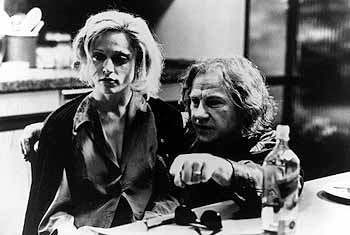
In Snake Eyes/Dangerous Game, Madonna plays
Sarah Jennings, a successful American television star looking to be taken
seriously as a screen actor by teaming up with independent film director Eddie
Israel and drug-addled method actor Francis Burns in a dark Hollywood drama
chronicling the final, violent night of a volatile marriage going down in
flames. Harvey Keitel plays Eddie Israel, a director modeled after Abel
Ferrara, and James Russo plays Francis Burns, a character
possibly modeled after Madonna’s ex-husband, Sean Penn (Rettenmund 45). The film weaves surreally between the dark lives of the actors
and the dark lives of their characters, drawing parallels between the drug use,
infidelity, sexual dysfunction, opportunism, and “spiritual death” going on in
both worlds. The film rarely adheres to a narrative: it wanders aimlessly
through the most uncomfortable sides of adult life, continually reminding its
audience of how different the real world is from the movies we are raised on.
Throughout its disparaging, boldly anti-commercial journey into
Hollywood-as-Hell, Dangerous Game retains
its ability to rivet due in large part to three of the most raw, explosive
performances to be captured on film in the 1990s.
Madonna, in her first
and last Abel Ferrara film, shed the mannered style of Old Hollywood goddesses
with whom she had aligned herself in the past and delivered the most human, fearless
performance of her career. The New York
Times offered that “viewers may actually need to remind themselves that they’ve
seen this actress somewhere before” (Rettenmund 45). Rather than attempt to
subvert the audience’s past association with the film’s leading lady, Ferrara constantly
finds sly, almost cruel ways to remind everyone that that is Madonna
onscreen. The character’s sense of humor, fashion, and vampiric use of people
to forward her career are all traits of the media myth of Madonna, the one born of scandal sheets and tabloid columns. Here, this unflattering image is satirized with an utterly realistic performance.
As the New York Press put it,
“Madonna has either learned how to act or finally found a character not so
different from herself…either way, she’s terrific”. Madonna agreed with the
sentiment, but was so horrified by the differences between the film she thought she was making and the
final cut Abel Ferrara delivered that she refused to promote the film. (Rettenmund 45)
It was an entirely different movie when I made it—it was such a great
feminist statement and she was so victorious at the end. I loved this
character. I thought I could take the role and do a great performance. It was
going to be this great thing for me. And even though it’s a shit movie and I
hate it, I am good in it. But the way Abel edited it completely changed the
ending. It was like someone punched me in the stomach. If I’d have known that
was the movie I was making, I would never have done it, and I was very honest
with him about that.
Madonna, 1994
Madonna, 1994
(St. Michael 104, 105)
Since the beginning of her career, Madonna's persona in film and on television has consistently equated sexuality with power and self-assurance. But in Dangerous Game, her character of Sarah Jennings is a stereotypically
whorish wannabe movie star, one with so much disdain for herself that she uses
sex and a lack of empathy as a means to an end in furthering her film career. In
Mother of Mirrors, the
film-within-a-film, we see this young actress being beaten and raped and
humiliated, sometimes in character and sometimes out. This performance is a
stark contrast to the “pornography-as-power” exercise in gender reversal that
had caused an uproar one year prior with the release of Madonna’s Sex book, a work that she oversaw from
conception to release—unlike Snake Eyes/Dangerous Game. “I don’t have the power in the film industry that I have in the music
industry. The director is the one in control, and everyone else is a pawn. [The director] can take [your] performance in the editing room and
completely change the character.” (St. Michael
105)
In the years since its notoriously
unsuccessful release, Dangerous
Game has largely been overshadowed by Abel Ferrara’s subsequent films outside of Hollywood and Madonna’s subsequent achievements outside of film. It is scarcely touched upon in retrospectives of Madonna’s
career, but Ferrara himself has no desire to mince words when it comes to Madonna. "She's a fuckin' jerk! Like we sit around taking out the best scenes
in the movie to spite her. You know how paranoid you gotta be to fuckin' say
something like that?" (Jones 3) Abel
Ferrara’s ex-wife, Nancy Ferrara, who played the character of Eddie Israel's wife, Madlyn, recalls the vitriolic reaction Madonna gave Abel upon seeing the rough
cut. Being interviewed for Andrew Morton's 2001 biography Madonna, she
recalled a series of fuming fax letters that Nancy Ferrara felt revealed more about Madonna
than about what was "wrong" with the film.
She was so angry about the movie. The faxes were just nasty. “You
fucker, you’ve fucked my life”, that sort of thing. The whole tone was about
her, “I” and “me”, “I” and “me". She looked very vulnerable and that was really
pulling her apart. At the end she revealed that when she is not in control, she
is not as secure or confident as she would like everyone else to think. She revealed something of her humanity. That
is why she wouldn’t endorse it. It hit too close to the bone. She hit on all
that emotion and couldn’t face it.”
Nancy Ferrara (Morton 257, 263)
Madonna has clearly been influenced by Hollywood legends
like Bette Davis in her attempts to build a body of cinematic work as both an
actress and an icon. But Madonna never worked as often before the camera as
stars like Bette Davis, making movies only sporadically and rarely making two
films back to back without an album or tour in between. Thus the results of
Madonna’s attempts to have a great screen career have more often than not been disappointing.
Madonna has never been one to shy away from this, but in the case of Dangerous
Game, a tremendous work was unfairly deemed a failure by none other
than Madonna herself. One might theorize that Madonna’s violent hatred for the
final cut stemmed from being unable to construct her own identity within a film
that was, seemingly, the antithesis of values she had come to represent. Yet her
dual turn as Sarah Jennings and Sarah’s movie-within-a-movie character, Claire,
oozes with the “relentless honesty” that drew Madonna to Ferrara in the first
place. One cannot help but wonder why she dared not embrace a performance that
was so memorably uncompromising, especially when Ferrara’s assaultive approach
to cinema was what prompted Madonna to put faith in his ability to bring out
the best in her.
“In an interesting artistic inversion, the perceived realism of
Madonna’s documentary, Truth or Dare, merely recorded the essential artifice
and staginess of her Blond Ambition tour, while in Ferrara’s movie, supposedly
an exploration of make-believe, Ferrara ripped away her carefully contrived
mask, the director literally wrenching a draining and difficult performance out
of her. Madonna never saw it coming.”
Andrew Morton
(Morton 260)
SPOILER ALERT: Don't watch this unless you've either already seen the film....
or never intend to.
Abel Ferrara certainly
did bring out the best in Madonna: she’s arguably never been better onscreen. At least as much as her Golden Globe-winning turn in 1996’s Evita, Dangerous Game is celluloid proof that a
gifted actress lay within the seemingly fearless, seemingly unstoppable multimedia
megastar cum superheroine known worldwide as “Madonna”. The film reveals human frailty behind the shining
armor of a warrior goddess, but like a general snatching back plans before
they can fall into enemy hands, Madonna was not ready to let down her
guard. Perhaps, now a more evolved artist than ever, Madonna will be so willing to once again be this forthright and revealing on the big
screen, as she continues to be in other mediums.
Regardless, the immortality of film insures that Dangerous Game, like Desperately
Seeking Susan before and Evita
after, will live on as proof that “Madonna,
Queen of Pop” could very well have been “Madonna, Queen of Hollywood”.

WORKS CITED
Madonna. Interviews. Baktabak Recordings. 1995.
Madonna. Interviews: Volume 2. Baktabak Recordings,
1997.
Morton, Andrew. Madonna. New
York : St. Martin ’s Press, 2001.
Rettenmund, Matthew. Encyclopedia Madonnica. New York : St. Martin ’s
Press, 1995.
St. Michael, Mick. Madonna: In Her Own Words. Great Britain


