Showing posts with label prostitution. Show all posts

Tuesday, November 20, 2012

Like A Virgin Sacrifice: My Very First Time

I believe all human animals are sexual creatures, but some more than others. I fall into the “some” category. This is not to say that I have more sex than other people (sadly, I don’t), nor that I need it more than the rest of the population. Rather, it means that sex plays a huge role in dictating my behavior, as it has my entire life. At the dawn of my pubescence, this was what drew me to my like-minded idol, Madonna, and it’s why some people find my “Vogue Boy” video profoundly uncomfortable to watch. I wasn’t fully aware of my sexuality at the age of nine, but I was beginning to appreciate that it was already a lot more potent than that of my peers. I will never forget one of my grade school classmates that year informing me that there were rumors about me at the junior high school, where I didn’t know anyone. I asked what he referred to, and the rumor, apparently, was that I was practicing sexual experiments at home. When I heard “experiments”, my young mind immediately pictured a mad scientist laughing maniacally in a laboratory with beakers full of glowing liquid, and I wondered how any of that tied into sex.
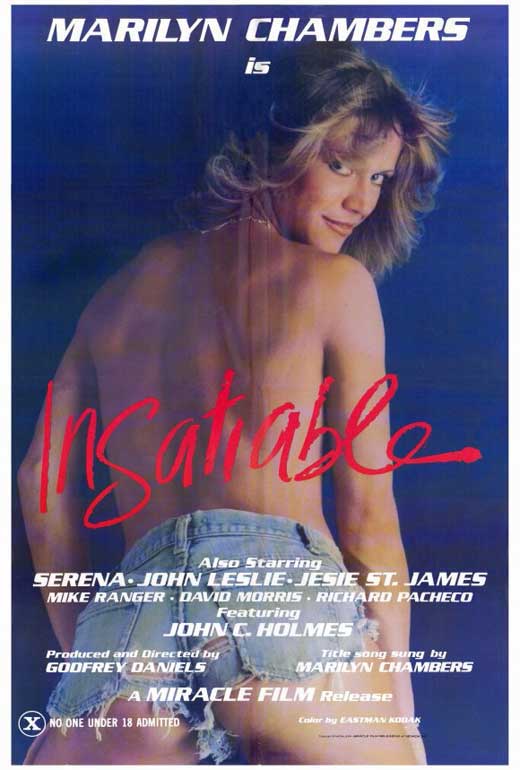

GODDESS WORSHIP:
The poster that adorned the living room wall of my first apartment. 


Until I was just one month shy of my twentieth birthday, my exposure to sex was limited to my exposure to porn, a pastime I picked up the summer after seventh grade. The first adult film I ever saw was Debbie Does Dallas, which still bothers me because I wish my introduction had been by way of the Marilyn Chambers classic Insatiable. Debbie Does Dallas, special place in my heart aside, is not a movie that I care for a great deal. Insatiable, on the other hand, is my favorite picture to emerge from the Golden Age of Adult Film. Even moreso than the genre-defining Deep Throat or Marilyn's breakthrough, Behind The Green Door, Insatiable is a profoundly liberating celebration of how much fun sex is supposed to be, regardless of gender or orientation. Debbie Does Dallas sends a different kind of message. For viewers sexually attracted to women, it is titillation in the form of a physical control fantasy about a woman in need of what her partner has. For those of us sexually attracted to men, the titillation is about mental control of the man who has what we want and how his partner will use sex to get it. To me, from “Debbie” onward, sex was always a means to end. It was about pleasing the guy I was with but hiding the power that his pleasure gave to me. It fulfilled my innate desire to be an Old Hollywood actress: like any great female movie star, having the ideal male co-star was crucial to making our happy ending work for an (imaginary) audience.


Drenched in "Drowned World" sweat: the last photograph of my virginal face.

During my late teens and early twenties, I was utterly infatuated with a virtual stranger whom I was certain I was meant to be with. While waiting for my secretly admired (aka "James") to fall for me too, I abstained altogether from physical intimacy: there was no sex, there were no encounters, and I never got in on any of the “let's try it out” action that was a part of so many people's high school and/or college years. I craved sex, but I also valued my virginity. After all, it had earned me a dedication in Madonna's Like A Virgin album--"to all the virgins of the world"--and I hoped that selling it off on eBay could earn me big bucks and lots of controversy and launch a phenomenal career in gay porn. But fearing that my chastity would not be able to compensate for my poor physical shape--or that police would find my ad before the press--I avoided negative feedback and/or jail time by nixing this idea.


The first night of The Drowned World Tour in Boston was the very first time I ever saw Madonna live, and her first moment onstage was the very first time I ever made direct eye contact with her. The second night of Drowned World in Boston…..well, let’s just say that that, as referenced in my recent Sex book post, was a different kind of “very first time”. It was August 8th, 2001, and I was loving the second show even more than the first, but feeling heartbroken that I wasn't sharing the experience with James. The music that fueled that particular Madonna tour was almost entirely from her 1998 Ray of Light album and 2000's Music. The former had been the soundtrack to the years that followed James leaving my school, while the latter was a constant presence in those final months before he left my life. Coupled with my loneliness was a raging case of sexual frustration. After two full decades without sex, the dazzling work of Madonna's beautiful male dancers aroused my mind and my libido, and the effects of that killer combo would soon redefine my life. 


After the show, I was still fueled by a longing for James, a lust for Christian Vincent (my favorite DWT dancer), and the lingering effects of a white-wine-and-klonipin cocktail used to calm my pre-show anxiety. I felt truly evolved after two nights of finally seeing Madonna live, as though the journey that began when I paid tribute to "Vogue" in Hampton Beach had lead me to Boston Garden exactly ten years later. A new journey was about to begin, but could only happen with a ritual sacrifice....of my own virginity. I was not consciously thinking of that metaphor at the time. But looking back, I cannot view my spontaneous and relentless determination to shed my chastity any other way.


Once my fellow Madonna concert-goers had gone home, I went to my gay sanctuary: the America Online “M4M” chat rooms. It was during my freshman year of high school that I began tiptoeing out of the closet by way of openly expressing myself online, but I never met the people who I chatted with and refrained from sharing photos of myself until James was out of the picture. But in 
the all-nighter that I pulled after the second “Drowned World” show in Boston, I was on a warpath against my own virginity, and determined to experience gay sex by way of AOL. I had a fantasy that Christian Vincent would be in one of those chat rooms, looking for the company of a nineteen year old virgin while the dancers were spending their last night in Boston. But assuming that fantasy might not come true, I was searching for a consolation prize in the form of the perfect guy--at least, the most perfect guy of whomever happened to be online in the wee small hours of August 9th, 2001. 

There was one guy whose general appearance was close enough to what James looked like to make  me crave his company, a'la Hitchcock's Vertigo. Alas, he turned me down. When I pleaded with him (by way of Instant Message) to reconsider indulging in the pleasures of my sexual inexperience, he encouraged me to cease my search. It’s funny that someone who did not know me at all, save for a few overlong IMs, could tell so quickly how naïve I was. This complete stranger knew that I’d very likely end up arranging my own destruction, and broke character from the coolness of "cruising mode" in a sincere attempt to get that across to me. The Universe is constantly sending me blatantly obvious alert messages like that, and I’m forever ignoring them for one reason or another. Perhaps my love of horror movie archetypes gives me a need to end up wishing I’d listened to wisdom instead of impulse. One way or another, I remember that guy only because I did NOT take his advice.


"I'm open...and ready....for you.....to justify my love."


It was somewhere around 7 AM the morning after "Drowned World" that I finally found the perfect candidate. I thought he looked like George Clooney in his (blurry) picture, and how could I possibly turn down losing my virginity to George Clooney? By the time he came over, I was falling asleep. In fact, I was woken up by his arrival at my door around 9 AM. Most unfortunately, and with all due respect, he did not look anything like George Clooney. It's not that he
 was unattractive, it's just that he was not the fantasy man that I opened the door ready to give myself over to.


Farewell, fantasy...

I was ashamed of myself and didn’t want him to know about my sudden lack of interest. So I said "hello" and immediately began making out with him. It was the first time I had ever passionately kissed anyone, and within moments, we were in bed. I was surprised by how naturally it all came, how effortlessly my body moved with his, how much I suddenly wanted to have sex with someone I was barely attracted to. Barring the rapid-fire showers we were required to take after high school gym class, it was the first time I had ever been naked with another man. And unlike in the locker room, I was neither covering my body for fear of being out of shape nor covering my eyes for fear of being outed. 

As this hot-'n-hairy stranger weighed down on me, ferociously pawing at my mouth and neck and chest, I found my mind going back and forth. One second, I was in the moment, absorbing something that felt so right. The next, I was having an out-of-body experience, looking at myself with my suitor and amazed that this was actually happening off of my TV screen. I was definitely impressed with my performance, and a “performance” it definitely was. In the months since James had ceased to be the active object of my affections, I turned my obsessive gaze to someone who looked a great deal like him: Lukas Ridgeston. I learned a great deal from watching the Slovakian gay porn superstar whose indescribable beauty made him king of the Bel Ami studio, and I put those acting lessons to use that morning. My suitor did not believe me when I kept insisting I was a virgin, and I took this as a great compliment. 

As a matter of fact, I still do.


Jeroen Krabbe & Renee Soutendijk in my favorite "gay film": Paul Verhoeven's De Vierde Man

I refer to this gentleman as “my first suitor” because I have no idea what his name was. For some reason, out of all the details I can remember from that life-changing day, his identity is not one of them. I think it was David, because that name kept popping out of my subconscious and into my creative work over the next two years. But it was very possibly an alias, anyway. He told me he was a lawyer, which I don’t entirely believe, and he also said he was thirty-six, though I suspected that he was probably closer to forty-six. Either way, he was a nice enough guy, but I was too convincing an actor, in no way letting on how uncertain I was about how far I wanted to go with someone who I desired so much more in fantasy than in the flesh. The naturalness and fulfillment of intimacy with another man was amazing, but the more I sensed his pleasure, the less I felt that my own reactions were genuine. We never fully consummated the traditional gay male sexual encounter, as defined by porn movies. He wanted to, but I did not, so I came up with a lame excuse to get him out of my apartment, though not before he left me with my first and only hickey. He pointed it out with pride, and told me to tell people I got it from shaving. By my own avoidance, I never saw him again. 


I immediately felt stained with shame, for the years I’d spent saving myself for James had just been flushed down the toilet by a horny stranger whose day got off to a GREAT start. After he left, I washed the sheets and did everything I could to get the hair and overpowering scent of his sweat out of the place. In retrospect, it really didn’t smell so bad at all: it was the aroma of animal lust, of consummated desires, of a bottled up passion finally let loose in the final weeks of my teen years. But at that time, it was the odor of sleaze and sin. It wasn’t that I felt sinful for being with a man, but rather that I felt sinful for being with a man other than my (imaginary) betrothed. Everyone I knew rightfully thought I should have gotten over James years earlier, and told me that putting my romantic life in the context of a ninth-grade classmate was, among other one-word reactions, absurd. The Catholic guilt I took with me when I graduated from St. John’s Prep reared its head that morning, and would continue to haunt me for months to come. But when I let go of that day's shame, and finally got over that James, my defining "Emmanuelle Era" truly began...


Monday, September 17, 2012

Streetwalker/Goddess: Loving "Crimes of Passion"


During the epic life chapter that I spent as a part-time student at Emerson College, I wrote a number of academic papers which serve not only as appreciations of my favorite films but as precursors to the screenplays I would go on to write. One such example was this favorite essay, written about the 1984 Ken Russell classic Crimes of Passion. The film was introduced to me in high school and instantly became one of my all-time favorites. After years of endlessly rewatching and introducing it to friends, I was given the chance to cement my passion for the film for one of my favorite classes in college. The class was "American Independent Cinema", with one of my favorite professors, Rachel Thibault, guiding us on a journey through many of the most important American indie film staples from Jim Jarmusch’s Stranger Than Paradise through Gus Van Sant’s Elephant. At that time, I was resistant to embracing the canon of films that had set Sundance on fire over the preceding twenty years. The appeal that many of the great modern American indie films had to pretentious audiences lead me to believe, foolishly, that they were all pretentious films. As a passionate film fan with an antipathy for insincere filmmaking, I vastly preferred the video store cult classics that originated from the worlds of classic porn and low-budget horror. Ken Russell’s Crimes of Passion is neither pornography nor a horror movie, but it appealed to me with a colorful excitement that I usually derived from these less reputable film genres. I consider it to be the best work ever done by all involved, and it is by far one of the movies that has most influenced my pursuits as a writer.


I should note that I had never seen Lewis Milestone's Rain, Lloyd Bacon's Marked Woman, or Gary Sherman's Vice Squad until after writing this paper. Each was well worth the wait, but all would provided additional points of reference had I seen them before attempting to draw a connection between 80s politics and Crimes of Passion. I am not an academic, and at times in high school and college it was clear that I was struggling to express my creativity within the confines research assignments. As a result, many of my papers read like personal essays backed up by other people’s expert opinions…because that’s exactly what they all were. I am proud of this paper, but its being one of my personal favorites is primarily because my statements were read by the film’s screenwriter, Barry Sandler, and  I went on to form a friendship with him as a result. I am grateful not only for his friendship but for his screenplay being brilliant enough to still make me forget, after all these years, how fortunate I am to know the man who crafted such a work of art. Crimes of Passion affects me even more now, as a thirty year old, than it did in my teens and twenties. I can only begin to imagine what it will mean to me as I continue to rewatch it at every subsequent stage of my life.  


Robert E. Jeffrey
MA421E
Prof. Rachel Thibault
October 20th, 2005

                     Ken Russell's Crimes of Passion: 
                     The Politics of Female Sexuality 


America in the 1980s was a land of opportunity and a land of uniquely displayed dissent. Technology, the economy, and global communications were moving forward at an accelerated pace. Pop culture played a major role in American life, and American life played a major role in popular culture. Americans had elected the most charismatic President since John F. Kennedy, and like JFK, President Ronald Reagan teemed—only this time literally—with the presence of Hollywood royalty. Reagan’s popularity likely  fueled the proliferation of Hollywood films that applied modern technological and cultural influences to age-old screen circumstances in the pursuit of box-office millions: Raiders of the Lost Ark, Tootsie, Flashdance, Top Gun, Working Girl, etc. The ensuing popularity of such a film formula no doubt further popularized Reagan’s throwback to early 20th century values. In the wake of this societal turnaround, a film as remarkably daring and profound as Ken Russell’s 1984 “prostitution-as-reinvention” opus Crimes of Passion was prevented from making the cultural impact that it should have.  


“Ronald Reagan’s America” is one term that could be used to describe the mainstream sentiments of America in the 1980s. It was defined by the national pursuit (at least in appearance) of earlier 20th century moral traditions, an unprecedented emphasis on power and status in terms of how the United States related to the rest of the world and how Americans related to each other, and, finally, free-wheeling capitalistic glee. All of this was overseen by an unbelievably popular and influential President who would become a Christ-figure to Conservatives and a semblance of Satan to Liberals.

Between 1981 and 1989, Reaganism sought to contain Soviet expansionism, comfort bourgeois culture, and remind the public of values that were dominant in the nation before the social disorders of the late sixties. The venerable political concept of an honorable opposition faded; to its opponents, Reaganism was a ridiculous or sinister political force.
                                                                        (Sewell xiii, xii)


“Camille Paglia’s Feminism” is one term for a distinct brand of feminist theory, popularized by the iconic Camille Paglia, the celebrated professor, academic, and author of 1991’s Sexual Personae. This brand of feminism has been championed and reviled for its emphasis on forthright sexual authority, neutralization of traditional gender-roles, and unsentimental principles of self-responsibility, perhaps at the expense of support from more popular and conventionally accepted brands of feminist thinking. In her 1993 essay collection Vamps and Tramps, Paglia’s central written piece, “No Law In The Arena: A Pagan Theory of Sexuality”, explains her “libertarian views” (Paglia xiv) on numerous gender and sexual issues.

Equal opportunity feminism, which I espouse, demands the removal of all barriers to woman’s advance in the political and professional world—but not at the price of special protections for women. As a Sixties libertarian, I also oppose overregulation of sexuality, which has risen to a totalitarian extreme over the past decade in America. Professional functioning in the capitalism machine—which I laud as the vehicle of women’s modern liberation—must not be confused with full human identity. Nor can office politics dictate our understanding of sexuality, which begins as a force of nature outside the social realm.
                                                            (Paglia x)

In the same essay, Camille Paglia laments the negative connotation associated with not only prostitutes but the profession of prostitution itself in America.

I respect and honor the prostitute, ruler of her sexual realm, which men must pay to enter. In reducing prostitutes to pitiable charity cases, middle-class feminists are guilty of arrogance, conceit, and prudery. “Pagan goddess!” I want to call out, as I sidle reverently by [a prostitute]. Not only are these women not victims, they are among the strongest and most formidable women on the planet. For me, they are heroines of outlaw individualism.
                                                                                    (Paglia 59)


In Ken Russell’s Crimes of Passion, Kathleen Turner’s central dual-role of “Joanna Crane”/“China Blue” offers a divine representation of Paglia’s whore-as-feminist-goddess, set against a Reagan-influenced landscape of materialism, hypocrisy, and conservatism—as evidenced by both the film itself and the controversy surrounding its botched 1984 release. Kathleen Turner portrays Joanna Crane, an ambitious and successful Los Angeles fashion designer so devoted to her career by day that she lives vicariously through her own creation by night, moonlighting as a Hollywood streetwalker called ‘China Blue’.  It is a tale told by Ken Russell through a dazzling palette of candy colors, quintessentially kinetic editing techniques, and a heavily synthesized, distinctly 80s-sounding Rick Wakeman score based quite intentionally on Antonin Dvorak’s 9th Symphony, “From the New World” (Hanke LaserDisc).  “Crimes” places Joanna in a scenario that finds her being forced to confront the hypocrisy of her existence and the realization of her need for romantic sexual fulfillment.  She is put through a process of playing numerous roles-within-roles: before her clients arrive, the character that is “China” suddenly takes on one of several vulnerable sexual roles (professional, virgin, bimbo, et al) and subsequently modifies her creation-within-a-creation to match her client’s fantasy. Her relationships with two such clients set into motion a chain of events that leads to her own transformation from a woman voluntarily segregating the various sides of her identity into separate lives to a woman who no longer feels the need to do so. Along the way, she is “guided” by both the dangerously obsessive Reverend Shayne (Anthony Perkins), who mirrors Joanna/China more than either persona would care to admit,  and the good natured Bobby (John Laughlin), a hapless, thirty-ish former football stud trapped in an emotionally and sexually barren marriage with his high school sweetheart, Amy (Annie Potts).

In the decade preceding the release of Crimes of Passion, the role of prostitute-as-unwitting-victim had proven a critically and commercially viable option in American cinema. In Alan J. Pakula’s 1971 drama-thriller hybrid Klute, Jane Fonda played Bree Daniels  as a beautiful but hardened woman using prostitution solely as a means to an end until her profession gives way to an obsessive sex maniac’s murderous attempts. In the end, she leaves behind spiritual numbness to embark on a journey into uncharted domestic territory with the boring but respectable title character (Donald Sutherland) who saved her life. Realizing that her chosen line of work comes with a demoralizing and ultimately fatal potential for implosion, she chooses to leave behind her risky life of self-definition for a less threatening experimentation in country subservience. Jane Fonda won an Academy Award for Best Actress for her work in the film.


            In Martin Scorsese’s 1976 classic Taxi Driver, Robert DeNiro’s Travis Bickle is obsessed with protecting the world-weary youth Iris, played by young Jodie Foster, from a violent pimp (Harvey Keitel), and the character is ultimately rescued from her streetwalking life and returned to the normalcy of her country family. Jodie Foster was nominated for a Best Supporting Actress Academy Award for her role. Portraying a similarly youthful but seemingly sharper prostitute did not earn television actress Donna Wilkes any awards as the title character in Robert Vincent-O’Neill’s 1984 exploitation mini-classic Angel. A low-budget rip-off of both Klute and Taxi Driver served up in campy exploitation style, Angel sold its plot in the tagline “High school honor student by day, Hollywood hooker by night” (Parish 15). A serial killer claims the lives of several members of her extended family of runaways and transvestites, and she is ultimately ushered into the life of “a normal teenage girl” by the paternal police detective (character actor Cliff Gorman) who saves her from the killer’s grip. Released earlier the same year as Crimes of Passion by the same distributor, New World Pictures, Angel defied critical hostility to become a box office hit and an early video-store success, ultimately prompting two sequels by decade’s end. (Parish 15-16)


            Ken Russell’s Crimes of Passion deals with the familiar plot device of a female prostitute stalked by an obsessed male—in fact, two of them. But in “Crimes”, the prostitute never registers much fear, for her existence is a by-night altar ego, one controlled by its daylight puppet-master, who is the same woman. Joanna’s unusual choice is not driven by money—she’s so successful at her job that a sexist male superior has her followed at night to learn of her means of being such a fashion powerhouse. But she is certainly not a prostitute out of some enslavement to sexual activity, either: at one point she reveals that she’s “never horny”. Her escapades within a colorfully sleazy hotel room that she rents by night are as theatrical as they are sexual—in fact, even more so. “One learns eventually the Freudian basis for Joanna/China Blue’s split life: only in her guise as a prostitute does she feel safe and uninhibited, free to be anyone she wishes and do whatever appeals to her” (Parish 96). “Turner's day work is photographed in a matter-of-fact way. The nighttime street scene is seen by Russell, however, as a lurid film noir world of flashing red neon signs, garter belts, squirming sadomasochists, and perverts” (Ebert RogerEbert.com).


            The notion of a life of “fantasy sex” existing for a woman, by her own terms and even in her own predestined “secret location”, would make Joanna/China quite the Camille Paglia heroine. Not only does she defy “white middle class style” and its “puritanical” origins through her duplicitous life (Paglia 59), but her habits also represent a shifting trend towards merging the worlds of sex and suburbia in the seemingly conservative 1980s. In her essay “The New Porn Wars”, Jean Bethke Elshtain elaborates on one of the two biggest impacts on sexuality in the 1980s.

Pornography has always been with us, but now it seems to be coming at us. Once the secret vice of upper-class males, porn is now a growth industry ($7 billion a year by most estimates), and clever entrepreneurs have fulfilled the classic dream of capitalist society by going from the humblest beginnings to the pinnacle of success. Porn has been democratized. The progress of pornography from shameful twilight zones in major cities to grocery-store counters in small towns is a story of the spread of an aesthetic of mechanistic and often cruel sexuality of profit and of vast social change—some would say disintegration.
                                                           (Elshtain, 70, 71)


            The commercial boom in pornography in the 1980s was not entirely unanticipated. In fact, couple the growth of a pornographic feature film industry throughout the 1970s and the rapid rise of technology throughout the 80s and it would seem a likely equation. But such an equation is indubitably in the shadow of a four-letter-word that emerged in the 80s and forever altered the human sexual landscape: AIDS.

The sudden rise of the incurable disease with a 100 percent mortality rate shaped how we lived and what we thought in the 80s. The disease first struck the gay male community in 1981 but was generally understood to be a nondiscriminatory plague by decade’s end. Since having sex with someone could win you a death sentence, sex in movies, on TV, in music, and in music videos became a voyeuristic substitute. Though due partially to the availability of videos for home consumption, the sale of porn videos ballooned into a multibillion-dollar business. There is not one facet of life that was unaffected by the unexpected impact of AIDS. In the 80s, the adult movie boom certainly owed a great deal to the threat of real-life sex.
                                                             (Rettenmund 3-4)


            Despite the craze for voyeuristic, in-your-own-home sexual tittilation, conservatism ruled Hollywood thinking at the time of the film’s release, and New World Pictures, the distributor of Crimes of Passion, eliminated much of what gave Crimes of Passion its dramatic and visual impact—including much of the sex itself. “The picture that emerged was far from a wholly flattering one and it is therefore not surprising that the film was greeted with a great deal of hostility upon its release“ (Hanke LVD9523). Screenwriter and producer Barry Sandler, who “wrote Crimes of Passion in response to watching the marriages and interpersonal relationships of his friends disintegrating around him” (Hanke LaserDisc), has stated that he felt the production was “victimized in 'Reagan-era America' by the Ratings Board and New World insisting on an R rating” (Hanke “Re: Re. Crimes of Passion”). Among the most damning cuts necessary to obtain an R-rating was an entire sequence involving a violent sexual ritual with a sadomasochistic police officer. It serves as the turning point for China’s character, as well as being one of the bravest, most effectively unrestrained moments in Kathleen Turner’s film career. A significant portion of the transformative sexual rites performed by the characters of Bobby and China/Joanna was omitted from their love-making scene, further dampening the characters’ arcs and thus the film’s meaning. (Russell & Sandler, IMDB).


In addition to explicit sex, though, several minutes of expository dialogue and characterization were significantly altered. Some of these cuts were made by New World, and altered the film’s honesty to such a degree that the message of the film itself was tainted—Ken Russell, in response, washed his hands of the theatrical cut (Hanke LaserDisc). Among these subtle changes to the film’s sociopolitical structure was the removal of women talking about sex—or, more explicitly, women speaking in the same sexually pervasive language as men were “allowed” to at the time of the film’s release. Dialogue plays over the opening title cards, revealing characters at a counseling session for divorcees who are confronting issues with the opposite sex. It includes an early line in which a woman responds to a man’s misogynistic joke by stating that she would “rather get fucked by a vibrator than your cock any day. It’s honest, loving, and I don’t have to make breakfast for it in the morning.” In the theatrical cut, that line was deleted, but one of two misogynistic jokes remains. Later on in the film, China’s reference to a client as “sweetdick” was overdubbed as “sweetheart”, and in another sequence, where she tells a client in her most authoritative that she is “ready for cock” in the director’s cut, the theatrical print substituted the word “cock” with “love”. When the Reverend Shayne accuses China/Joanna of sinfulness, she mockingly attacks him with a sarcastic “why don’t you fuck me, that’ll save me!”. (In the theatrical cut, the line becomes “why don’t you fix me, that’ll save me!”. (Russell & Sandler, IMDB) Perhaps attempting to edit the film to more closely match New World’s similarly themed Angel earlier in the year, what once was a woman expressing defiance, self-assurance, and a voluntary rejection of a patriarchal religious influence is quietly reworked into the suggestion of a repentant hooker-with-a-heart-of-gold—a much more appealing stereotype for the masses, and a much more bankable character for New World.


Having significantly altered a Ken Russell film to the point that Russell wanted nothing to with the finished product, New World released the film to “controversy surrounding the film’s perceived sexual excesses, which were really not that excessive in the mangled R-rated version” (Hanke LVD9523). The divisive critical response suggested that New World would perhaps have been wise to have put more faith in Russell. The theatrical version of the film did earn praise from the likes of People’s Peter Travers, who called it “one of the most funny and original movies about sex in years”, while The New York Post’s Rex Reed raved that it was “amazing, revolutionary, [and] as a frank and scalding expose of the dark side of human nature, unlike anything I’ve experienced” (Hanke LVD9523). Other critics were less kind, but made notice of the distinction between the film that they were reviewing and the film that was withheld by New World. Leonard Maltin called the theatrical cut “a watchable mess” (Maltin 297), while Roger Ebert lamented “the double standards of the movie ratings system, which prizes violence more highly than sex” and put partial blame on “New World Pictures, which was too chicken to release the movie with an X. The purpose of Crimes of Passion was apparently to explore the further shores of sexual behavior, [but] a great deal of the behavior is missing from the movie, and what is left is a steamy, bloody thriller. I’m not sure that’s what Russell had in mind. (“Crimes of Passion”, RogerEbert.com). Although the film “flopped at the box office” (Parish 96), since its success on home video in its original, uncut form, the film has gained a reputation as one of Russell’s finest works and “one of the great cult films of the 80s”. (Hanke LVD9523)


In a 1992 review of Madonna’s astonishingly successful book Sex, Camille Paglia applauded Madonna for acknowledging “the sluttishness of the fully sexual woman” in an empowered context (Paglia 369). Nearly a decade prior to that work, Ken Russell’s Crimes of Passion made a similar artistic statement, but was greeted with far less commercial receptivity. It is not until the end of the film that Joanna reaches true fulfillment, symbolized by her plunging a vibrator into the Reverend Shayne’s back while he dons China’s trademark attire: platinum wig and “little blue dress”. At that moment, she is conquering not only the threat of patriarchal rigidity—as brilliantly realized in the shape of a preacher who has seemingly snapped in response to all the sex-selling on Hollywood boulevard—but also the need to escape into another character to explore her sexual fantasies. Her previous sexual encounters were performance-oriented, compensating for the lack of emotional and sexual satisfaction in Joanna that gave birth to “China Blue” in the first place. When Joanna chooses to maintain a relationship with the character of John Grady after she has abandoned her duplicitous life, it is not because he has “saved” her, physically or spiritually. Rather, it is Joanna, in her evolved state, who decides to be with him, on her terms, for as long as she feels happy. “Sluttish” or not, Joanna has become a fully sexual woman, no longer compartmentalized and completely worthy of Paglia’s “Pagan Goddess” moniker as she finally allows herself to be vulnerable in her last close-up of the film.  


WORKS CITED

Ebert, Rogert. Rev. of Crimes of Passion, dir. Ken Russell.
            Chicago Sun-Times 1 Jan. 1984: RogerEbert.com.


Elshtain, Jean Bethke. “The New Porn Wars”. The Eighties.
Ed. Gilbert T. Sewall. ReadingMA: Persus Books, 1997. 70-81.

Hanke, Ken. “Re: Re. Crimes of Passion.”
E-mail to the author. 10/15/2005.

Hanke, Ken. “Liner Notes”. Crimes of Passion Laserdisc Special Edition.
            Denver, CO: Luminvision Entertainment, 1995. LVD9523.

Maltin, Leonard. Leonard Maltin’s 2001 Movie and Video Guide.
            New York: Signet, 2000.

Paglia, Camille. Vamps and Tramps. New York: Vintage Books, 1994.

            North Carolina: McFarland and Company, 1992.

Rettenmund, Matthew. Totally Awesome 80s. New York: St. Martin’s Griffin, 1996.

Russell, Ken, and Sandler, Barry. “Audio Commentary”.
Crimes of Passion Laserdisc Special Edition.
Denver, CO: LuminvisionEntertainment, 1995. LVD9523.

            Ed. Gilbert T. Sewall. Reading, MA: Perseus Books, 1997, xi-xxiv.


Additional Citations Credited to
Crimes of Passion (Alternate Versions) on IMDB.com
http://www.imdb.com/title/tt0087100/alternateversions

Monday, June 25, 2012

My Adventures In The Oldest Profession

“High School Honor Student By Day. Hollywood Hooker By Night.” 

My parents’ worst nightmare. My greatest fantasy.


I have always loved movies about prostitutes, and have always related to them in ways that made little sense to others. Maybe it’s because I wanted to please everyone and didn’t feel that I’d done a good job unless I left a room smiling. Perhaps it’s because I felt I had to play so many different roles with so many different people in order to achieve such a goal. Whatever the reason, I definitely loved that tagline from Robert Vincent O'Neill's Angel every time I passed it in the video store. It would not be until the 2003 DVD release that I finally saw the movie and loved it. But by then I’d already formed a fantasy, based on the concept, and on the cover, and on Roger Ebert’s oft-reprinted original review. The movie lived up to that fantasy. I myself could not.


In 2000, I was working at a store that sold rare laserdiscs and DVDs. Before throwing out a batch of semi-defective laserdiscs, the owner asked me if I had ever seen the film pressed onto all of the slightly marred copies: Ken Russel’s Crimes of Passion. Then and now, I am ashamed to say I had not. It was yet another film that I had formed a video store fantasy around, and even my own version of the movie in my head that starred Andie MacDowell and Madonna and had absolutely nothing to do with the plot of the actual movie. I didn’t even know that it was about a career woman who shields herself from heartbreak by masquerading as a streetwalker named “China Blue” and engaging in outrageous encounters.  Seeing the movie was a turning point, not least of all because I better understood where my desire to be a streetwalker came from: I wanted to be wanted, but didn't want to need that.


I don’t remember when I first wanted to be a prostitute, but I do remember when I first put up an ad for myself online. I had been reading about the escort industry and looking into reviews of some of New York’s more popular male sex workers. I even befriended one through a chat room, a nurse from Maine who I could have seen myself falling in love with at the time. I was flagrantly open with friends and even family about my sex industry ambitions because I found nothing about them dishonorable. In my school of thought, being a whore is nowhere near as sinful as being a freeloader. I also felt that it would be an invaluable insight for my writing, a means of understanding some of the “fallen women” in film who had most inspired me and to get a view of life from the other side of privilege. Of course, such an endeavor has since become a stereotype for naïve young college students and overambitious journalists. I could have lost my life. I could also have gotten arrested. Between the two, I would have taken the former: death scares me way less than cops. 


The closest I came to being a male escort was the closest I came to being arrested, and so that’s why I ultimately closed up shop right before the grand opening. I put up an ad online—ahem, on an “AOL Personal Homepage” no less—and included pictures I’d taken of myself looking pouty and sweet. I don’t remember much about my description, but I do remember that my rate was $100/hr. At that time, in 2002, the going rate for male escorts was around $300/hr, so I thought that I might have a shot at establishing a good customer base thanks to being twenty years old and relatively low-priced. I was insecure about being overweight, but even so, I thought I was a bargain. After all, I ALWAYS aim to be fair. 

Rob '02: Trying to sell myself on AOL as a precocious boy next door. 

I was so proud of myself for thinking of my customers that I failed to remember prostitution is illegal in this particular country. I remembered that reality vividly when an “interested customer” called me up and seemed a little too interested in the details of my one-man business operation. So I told him I’d decided to give up being a male escort and, at that moment, I did.


Bette Davis played my favorite screen prostitute of all.

I often regretted not being brave enough to do what I wanted to do in spite of the warnings of everyone in my life and, indeed, the state and federal government of the United States of America. I can admit now that they were right and I was wrong—not because it’s bad to be a prostitute, but rather because I would have been bad at it. I had never even met a sex worker until a visit to Amsterdam in 2006 lead me to one of the most popular male brothels in the city: Singel 21. There I met one of the most interesting fellows I have ever encountered, and the one who made me realize that prostitution was not nearly as appropriate a line of work for me as I hoped it would be.


His name was Zortak, or that’s what it sounded like. Something Hungarian. He was thirty seven and a twenty seven year old Dutchman, the youngest of the employees, was shocked that I wasn’t going off with him. But I didn’t know that I had a choice. Zortak spotted me first, and I thought that it was only right that I should go with him, despite the fact that the twenty-seven year old was beautiful enough to remain in my dreams forever. 

As we enjoyed mixed drinks in the lounge together, I told Zortak that I had such tremendous respect for his profession, and that it had in fact been my dream to be a sex worker. He looked at me in stunned disbelief. I could see that he was at once confused and insulted, so I just smiled and looked at the twinkling city of Amsterdam outside. I had dreamed of being a sex doctor to beautiful male patients. But Zortak's reality was entirely scripted and rooted in money, not sexual adventure. He and his co-workers were all laughing and joking with one another in Dutch while we waited for the room to be free, and I was convinced they were making fun of me. It bothered me because I wanted to be viewed as an ally, not a john, and also because I really wished I’d learned to speak the language before I left America. For a wannabe sex worker like me, nothing could be worse than rejection by Dutch prostitutes. However, a year later, one of my friends said they were probably laughing over the only twenty-four year old in the establishment being a client.


From the moment I walked into the room and until the time I walked out of the place, I put on a show. I got to be Marilyn Chambers, and I got to give back to an experienced sex worker all of the attention and affection that he had given to countless men before me. But that was the problem, too. I was throwing off the whole transaction by playing the part of “desirable one”, and upon realizing this I had to switch gears. That’s where the guilt came in.

Spending time with a sex worker is like getting a massage or a pedicure: you can feel guilty about it, or you can enjoy it. My experience with a prostitute was a combination of the two. After our intimate encounter, we somehow got into a discussion of AIDS minutes before I left. I forget the full context, but I believe that the man who owned the brothel had inherited it from his partner, who had died of AIDS. It was an awkward intrusion of reality, one which instantly burst the fantasy bubble moments before the fantasy was complete. 


As I walked down the steps, I somehow managed to accidentally make a call on my cell phone. I looked and realized someone was on the other line, and it was my best friend’s father. My best friend, I might add, was also my first love. We had broken up six months earlier, but remained as close as ever. With that having been said, I had no intention of calling he or his parents after my evening with a sex worker. All this came about only hours after I had arrived in Amsterdam, so between jet lag, White Widow, and afterglow, my mind wasn’t absorbent enough of the details for me to recall whether my phone got an answering machine or if I actually spoke to his father that night. I’m still convinced that that gorgeous young Dutchman, who took my politeness to Zortak as a rejection, cast a spell to cause the snafu. He could only be a witch, for as I walked back to the hotel that night, his was the spell I was under.