Showing posts with label James. Show all posts

Tuesday, November 20, 2012

Like A Virgin Sacrifice: My Very First Time

I believe all human animals are sexual creatures, but some more than others. I fall into the “some” category. This is not to say that I have more sex than other people (sadly, I don’t), nor that I need it more than the rest of the population. Rather, it means that sex plays a huge role in dictating my behavior, as it has my entire life. At the dawn of my pubescence, this was what drew me to my like-minded idol, Madonna, and it’s why some people find my “Vogue Boy” video profoundly uncomfortable to watch. I wasn’t fully aware of my sexuality at the age of nine, but I was beginning to appreciate that it was already a lot more potent than that of my peers. I will never forget one of my grade school classmates that year informing me that there were rumors about me at the junior high school, where I didn’t know anyone. I asked what he referred to, and the rumor, apparently, was that I was practicing sexual experiments at home. When I heard “experiments”, my young mind immediately pictured a mad scientist laughing maniacally in a laboratory with beakers full of glowing liquid, and I wondered how any of that tied into sex.
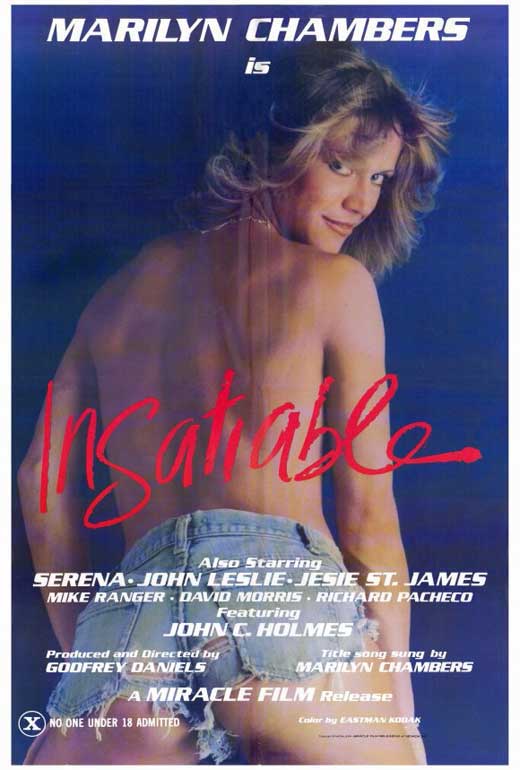

GODDESS WORSHIP:
The poster that adorned the living room wall of my first apartment. 


Until I was just one month shy of my twentieth birthday, my exposure to sex was limited to my exposure to porn, a pastime I picked up the summer after seventh grade. The first adult film I ever saw was Debbie Does Dallas, which still bothers me because I wish my introduction had been by way of the Marilyn Chambers classic Insatiable. Debbie Does Dallas, special place in my heart aside, is not a movie that I care for a great deal. Insatiable, on the other hand, is my favorite picture to emerge from the Golden Age of Adult Film. Even moreso than the genre-defining Deep Throat or Marilyn's breakthrough, Behind The Green Door, Insatiable is a profoundly liberating celebration of how much fun sex is supposed to be, regardless of gender or orientation. Debbie Does Dallas sends a different kind of message. For viewers sexually attracted to women, it is titillation in the form of a physical control fantasy about a woman in need of what her partner has. For those of us sexually attracted to men, the titillation is about mental control of the man who has what we want and how his partner will use sex to get it. To me, from “Debbie” onward, sex was always a means to end. It was about pleasing the guy I was with but hiding the power that his pleasure gave to me. It fulfilled my innate desire to be an Old Hollywood actress: like any great female movie star, having the ideal male co-star was crucial to making our happy ending work for an (imaginary) audience.


Drenched in "Drowned World" sweat: the last photograph of my virginal face.

During my late teens and early twenties, I was utterly infatuated with a virtual stranger whom I was certain I was meant to be with. While waiting for my secretly admired (aka "James") to fall for me too, I abstained altogether from physical intimacy: there was no sex, there were no encounters, and I never got in on any of the “let's try it out” action that was a part of so many people's high school and/or college years. I craved sex, but I also valued my virginity. After all, it had earned me a dedication in Madonna's Like A Virgin album--"to all the virgins of the world"--and I hoped that selling it off on eBay could earn me big bucks and lots of controversy and launch a phenomenal career in gay porn. But fearing that my chastity would not be able to compensate for my poor physical shape--or that police would find my ad before the press--I avoided negative feedback and/or jail time by nixing this idea.


The first night of The Drowned World Tour in Boston was the very first time I ever saw Madonna live, and her first moment onstage was the very first time I ever made direct eye contact with her. The second night of Drowned World in Boston…..well, let’s just say that that, as referenced in my recent Sex book post, was a different kind of “very first time”. It was August 8th, 2001, and I was loving the second show even more than the first, but feeling heartbroken that I wasn't sharing the experience with James. The music that fueled that particular Madonna tour was almost entirely from her 1998 Ray of Light album and 2000's Music. The former had been the soundtrack to the years that followed James leaving my school, while the latter was a constant presence in those final months before he left my life. Coupled with my loneliness was a raging case of sexual frustration. After two full decades without sex, the dazzling work of Madonna's beautiful male dancers aroused my mind and my libido, and the effects of that killer combo would soon redefine my life. 


After the show, I was still fueled by a longing for James, a lust for Christian Vincent (my favorite DWT dancer), and the lingering effects of a white-wine-and-klonipin cocktail used to calm my pre-show anxiety. I felt truly evolved after two nights of finally seeing Madonna live, as though the journey that began when I paid tribute to "Vogue" in Hampton Beach had lead me to Boston Garden exactly ten years later. A new journey was about to begin, but could only happen with a ritual sacrifice....of my own virginity. I was not consciously thinking of that metaphor at the time. But looking back, I cannot view my spontaneous and relentless determination to shed my chastity any other way.


Once my fellow Madonna concert-goers had gone home, I went to my gay sanctuary: the America Online “M4M” chat rooms. It was during my freshman year of high school that I began tiptoeing out of the closet by way of openly expressing myself online, but I never met the people who I chatted with and refrained from sharing photos of myself until James was out of the picture. But in 
the all-nighter that I pulled after the second “Drowned World” show in Boston, I was on a warpath against my own virginity, and determined to experience gay sex by way of AOL. I had a fantasy that Christian Vincent would be in one of those chat rooms, looking for the company of a nineteen year old virgin while the dancers were spending their last night in Boston. But assuming that fantasy might not come true, I was searching for a consolation prize in the form of the perfect guy--at least, the most perfect guy of whomever happened to be online in the wee small hours of August 9th, 2001. 

There was one guy whose general appearance was close enough to what James looked like to make  me crave his company, a'la Hitchcock's Vertigo. Alas, he turned me down. When I pleaded with him (by way of Instant Message) to reconsider indulging in the pleasures of my sexual inexperience, he encouraged me to cease my search. It’s funny that someone who did not know me at all, save for a few overlong IMs, could tell so quickly how naïve I was. This complete stranger knew that I’d very likely end up arranging my own destruction, and broke character from the coolness of "cruising mode" in a sincere attempt to get that across to me. The Universe is constantly sending me blatantly obvious alert messages like that, and I’m forever ignoring them for one reason or another. Perhaps my love of horror movie archetypes gives me a need to end up wishing I’d listened to wisdom instead of impulse. One way or another, I remember that guy only because I did NOT take his advice.


"I'm open...and ready....for you.....to justify my love."


It was somewhere around 7 AM the morning after "Drowned World" that I finally found the perfect candidate. I thought he looked like George Clooney in his (blurry) picture, and how could I possibly turn down losing my virginity to George Clooney? By the time he came over, I was falling asleep. In fact, I was woken up by his arrival at my door around 9 AM. Most unfortunately, and with all due respect, he did not look anything like George Clooney. It's not that he
 was unattractive, it's just that he was not the fantasy man that I opened the door ready to give myself over to.


Farewell, fantasy...

I was ashamed of myself and didn’t want him to know about my sudden lack of interest. So I said "hello" and immediately began making out with him. It was the first time I had ever passionately kissed anyone, and within moments, we were in bed. I was surprised by how naturally it all came, how effortlessly my body moved with his, how much I suddenly wanted to have sex with someone I was barely attracted to. Barring the rapid-fire showers we were required to take after high school gym class, it was the first time I had ever been naked with another man. And unlike in the locker room, I was neither covering my body for fear of being out of shape nor covering my eyes for fear of being outed. 

As this hot-'n-hairy stranger weighed down on me, ferociously pawing at my mouth and neck and chest, I found my mind going back and forth. One second, I was in the moment, absorbing something that felt so right. The next, I was having an out-of-body experience, looking at myself with my suitor and amazed that this was actually happening off of my TV screen. I was definitely impressed with my performance, and a “performance” it definitely was. In the months since James had ceased to be the active object of my affections, I turned my obsessive gaze to someone who looked a great deal like him: Lukas Ridgeston. I learned a great deal from watching the Slovakian gay porn superstar whose indescribable beauty made him king of the Bel Ami studio, and I put those acting lessons to use that morning. My suitor did not believe me when I kept insisting I was a virgin, and I took this as a great compliment. 

As a matter of fact, I still do.


Jeroen Krabbe & Renee Soutendijk in my favorite "gay film": Paul Verhoeven's De Vierde Man

I refer to this gentleman as “my first suitor” because I have no idea what his name was. For some reason, out of all the details I can remember from that life-changing day, his identity is not one of them. I think it was David, because that name kept popping out of my subconscious and into my creative work over the next two years. But it was very possibly an alias, anyway. He told me he was a lawyer, which I don’t entirely believe, and he also said he was thirty-six, though I suspected that he was probably closer to forty-six. Either way, he was a nice enough guy, but I was too convincing an actor, in no way letting on how uncertain I was about how far I wanted to go with someone who I desired so much more in fantasy than in the flesh. The naturalness and fulfillment of intimacy with another man was amazing, but the more I sensed his pleasure, the less I felt that my own reactions were genuine. We never fully consummated the traditional gay male sexual encounter, as defined by porn movies. He wanted to, but I did not, so I came up with a lame excuse to get him out of my apartment, though not before he left me with my first and only hickey. He pointed it out with pride, and told me to tell people I got it from shaving. By my own avoidance, I never saw him again. 


I immediately felt stained with shame, for the years I’d spent saving myself for James had just been flushed down the toilet by a horny stranger whose day got off to a GREAT start. After he left, I washed the sheets and did everything I could to get the hair and overpowering scent of his sweat out of the place. In retrospect, it really didn’t smell so bad at all: it was the aroma of animal lust, of consummated desires, of a bottled up passion finally let loose in the final weeks of my teen years. But at that time, it was the odor of sleaze and sin. It wasn’t that I felt sinful for being with a man, but rather that I felt sinful for being with a man other than my (imaginary) betrothed. Everyone I knew rightfully thought I should have gotten over James years earlier, and told me that putting my romantic life in the context of a ninth-grade classmate was, among other one-word reactions, absurd. The Catholic guilt I took with me when I graduated from St. John’s Prep reared its head that morning, and would continue to haunt me for months to come. But when I let go of that day's shame, and finally got over that James, my defining "Emmanuelle Era" truly began...


Thursday, November 15, 2012

Confessions Of A Love Whore

During my freshman year at an all-male Catholic high school, I was infatuated with a straight classmate. As in past entries, I refer to him as "James", because he so strongly resembled my teen romance ideal: James Marsden. James was only in two of my classes, and we never hung out off campus because he lived in another city. Yet I spent the next several years of my life in love with him—even though I never saw him again after the ninth grade. 

Just over a year ago, I rediscovered a love letter that I wrote to James back in high school. I never sent it, but I decided to share it with the world, because  it captured being hopelessly in love and hopelessly sixteen in a way that is universally relatable regardless of gender or sexuality. I timed its posting with the anniversary of Madonna’s Confessions On A Dance Floor, because I love that album like no other and wanted to underline that with an extra special blog post. This year, as the first in a series of deeply personal new entries, I thought I would celebrate “Confessions Day” by sharing the sobering follow-up to my unrequited high school love story. For some of you, it may turn out to be as empathetic as last year’s post, if less nostalgic and more humiliating.


I was convinced that James had feelings for me during that first year of high school, based on many brief but seemingly revealing exchanges. Even accounting for my overemotional adolescent perspective, I don’t doubt I was a little bit right: he was straight, but there still appeared to be something between James and I when we were fifteen...despite of our lack of any physical contact. It was fleeting and youthful, so much so that it would not have lingered on in the memories of people like James who live and grow in the real world. But for a cinematically inclined escapist such as myself, the experience was an unbelievably potent high, and I refused to leave it in my past. So I shed any semblance of shame and relentlessly pursued this literal dream romance. That is, until what began so subtly in our freshman year of high school came to an operatic finish in our freshman year of college.

I spent my sophomore and junior years waiting for my secretly admired to phone me out of the blue, revealing he’d been in love and waiting for my call until it became unbearable to harbor his feelings any longer. After two years of that never happening, I spent much of senior year trying to arrange an opportunity to hang out, hopeful that we could reignite a friendship if I could hide my feelings long enough to make him fall in love with me. Every effort to see one another failed, and I should have left it at that. But I could not allow myself to believe that James would not love me one day. I knew that to an outsider (which, at thirty-one, is what I am today) all of this would appear crazy. But to my eighteen year old self, the craziness was precisely what made it feel so romantic. Or, should I say, “so romantic comedy”.


By the first year of the 21st century, everyone but James knew about my feelings for James. Endlessly bemoaning the hole in my heart took its toll on my social life in the first semester of college, and never more than on New Year's Eve 2000. I was lonely and depressed, so I deliberately avoided Midnight by sitting in a movie theater by myself for the late show of The Family Man. It was my second viewing of the Brett Ratner film in which Nicolas Cage was a wealthy businessman who found happiness in an alternate reality where he’d married and had children with his great love, played by Tea Leoni.  At that time, I was living a life of privilege and being afforded opportunities that I would not be able to fully appreciate until many years later. But I was consumed by the perceived void left behind when James went to a new school and I turned him into a benchmark which no other guy could match. I constantly dreamed of giving up all the monetary perks of my life in order to be with him, if only because such a sacrifice, I thought, would prove that my love had always been real.

My freshman year at Emerson College, and James’s first year in the military, both coincided with the peak of AOL Instant Messenger’s popularity. Somehow I got a hold of James’s screen name on there, and before long we were, like in my dreams come true, "talking" all the time. 
Right after Valentine’s Day 2001, following weeks of daily correspondence, I decided to throw caution to the wind and tell James everything. And when I say everything, I mean EVERYTHING. What I wrote was not that far off from my unsent love letter in its massive length and total shamelessness. But the difference was that what was sweet when I was sixteen was desperate when I was nineteen. I shared the unsent love letter with the world because I thought it was relatable for anyone who remembers being that age and feeling those feelings. But I cannot bring myself to ever re-read the one that I did send.

James did not get to read the letter for several days, during which time we continued chatting online regularly. Then, one afternoon, I decided to escape my anticipation anxiety with film that I felt paralleled my longing: John Cromwell’s 1934 Bette Davis-Leslie Howard adaptation of W. Somerset Maughm’s Of Human Bondage. It was my second viewing, having seen the film two years prior when I began appreciating the films that made Bette Davis a star. But that day, it was not a piece of cinema history. It was a piece of reflective glass, and it was my life that was being reflected. 


As soon as it ended, I went from my living room to my bedroom, where my pre-wireless laptop was connected to the modem. My AIM Away Message was onscreen, awaiting a response from James. That day, the message was a quote from Edgar G. Ulmer’s film noir classic Detour.

“That’s life: whichever way you turn, fate sticks out a foot to trip you.”

There was no word from James when I got to my laptop, but seconds later, before I could look away from the screen, his response appeared before my eyes. I don’t remember all of what he wrote, except that it was the longest piece of text I’d ever seen on AOL Instant Messenger written by anyone but me. Only the Cliffs Notes version remains in my mind: that he appreciated my friendship and respected me tremendously as a person but that he didn’t share these romantic feelings and would not be comfortable continuing to communicate with me at that point in his life. He was never anything but respectful, kind, classy….all the traits that made me fall for him in the first place. He did not respond the way I had dreamed of, but he wished me well on the rest of my life journey. Had I respected his wishes, we might have crossed paths down the line and formed some sort of friendship as mature adults. I should have left things there, because his message, while unbelievably disheartening, gave me the chance to quit while I was (sort of) ahead.

Alas, I had to continue playing the role, in my mind, of the hopelessly-in-love ingénue who would stop at nothing until she won the heart of her leading man. We shared our last correspondence mere minutes after I’d watched Bette Davis die onscreen in Of Human Bondage, and yet I was still convinced that my relationship with James was following a screwball comedy archetype. At the time, I thought I was being quirky. I now realize I was overbearingly obsessive. I continued to send long emails. I uncovered his new AIM contact information after he changed screen names.  I even tried to buy his love the following Christmas by mailing him a gift: a CD book containing twenty favorite movies on forty Video CDs. The package, and its included letter, was opened and returned to me, minus any written response. From that moment on, I feared I was, to James, becoming the star of a different kind of film. The movie collection looked like a generous peace offering when I mailed it out. But it looked more like a threat than a gift when it was spat back at me. I trembled at the thought that James now saw me as Jessica Walter in Play Misty For Me, whereas all along I saw myself as Madonna in Who’s That Girl. Mainstream audiences clearly never appreciated the outrageous charm of Who's That Girl the way that I did. And James, clearly, did not find anything charming about my outrageous persistence.


Eighteen months after the worst Christmas gift idea of my life, I had finally purged this infatuation from my system. Prior to that, every few months I would find myself unable to resist emailing self-indulgent letters to James, letters that inevitably were really being written to/for myself.  With each letter I was deliberately inviting him to loathe me, instead of wanting him to love me. At that time in my life, the former came much easier to me than the latter, and I knew it would for James, too. I hoped we could share, if nothing else, that same contempt. As I grew to forgive and love myself for acting in such an over-the-top manner, I moved past that moment in my life, and opened the door to meeting my best friend and entering my first relationship. I don’t know if James ever did end up hating me, but I have often hoped that he forgot me.

The conclusion of my story about the young man I refer to as “James” may not be what some readers of last year’s entry had hoped for. It certainly was not what I was hoping for when I was a teenager. But today, I’m thankful for the way things turned out. In interviews collected in the book The Girl Who Walked Home Alone, Bette Davis told author Charlotte Chandler that “a watched telephone never rings”. I know that firsthand from the years I wasted as a lonely teenager relishing the role of “lonely teenager” far too much. Admitting my defeat forced me to finally acknowledge and improve upon the aspects of my personality that are adorable onscreen but destructive in real life. And, combined with my ABBA love, it gave me a unique appreciation that eventually lead to “Hung Up” becoming my favorite Madonna single of all time.


Tuesday, June 12, 2012

Straight vs. "Straight": Burning Down The Closet


I always felt like "a tomboy", not "a real boy". As such, I often fail to realize how “gay” I apparently seem to people. Never was I more unaware than during my four years at an all-boys’ Catholic high school. In my head, it was as though a straight girl had tricked everyone into thinking she was a boy and gotten into the almighty halls of hotness. At that age I aligned myself with twenty-something females who grew up in the 80s. I also I talked and acted like a girl in an 80s movie throughout my freshman year, even though I was now calling myself "Bob"As I slowly came out of the closet in high school, I became increasingly enmeshed in a more masculine image. Or, at least, I tried. I wanted to better the world by being the embodiment of a “gay tough guy”, an act I could never pull off since it only works when it’s authentic.


December 1999: The Peak of "Bob"

For years I’ve fought to remind people that guys with no relation to or interest in the hallmarks of “gay culture” can come out of the closet, too. This all originated from my experiences at St. John’s Prep. Personally, I have never associated my love of Madonna, Bette Davis, and the color pink with being a male homosexual. I don’t think that a straight man can’t be fond of such things. Quite the contrary, I pity our misogynistic culture for being resistant to such a concept. I associate it with having a fondness for femininity and fun. I associate the fact that I want to have sex with men with being a male homosexual. I take pride in my voracious sexual appetite because EVERYONE should. For one thing, it’s not about body lust—like Bette Davis, I can only be fulfilled if I’m convinced I’m in love with the person. But that person has to be a man. It’s how I am “wired”, physically. When I see a beautiful woman I react with awe and appreciation, because I LOVE beauty. But when I see a beautiful man my appreciation of beauty is subverted by the physical sensations that run through my body. There’s a lot of lust buried beneath the Catholic guilt and New England soil running through my veins. I’m helpless to it, and am certain I would be regardless of my gender or orientation. 

I hope this paper won't offend anyone, for while the message remains the same, the delivery was colored by loneliness. BITTER loneliness. But from the ashes of that hurt came the start of my personal mission when it comes to LGBT issues: to obliterate that fucking closet once and for all.

Robert E. Jeffrey 4/2/03

Intercultural Communications: Prof. Monique Meyers

     Gay or “Straight”:

Men and Homosexuality in 21st Century America


I spent a great deal of time trying to come up with a topic for this assignment. I went back and forth between issues that mattered a great deal to me, but were only vaguely related to the course objectives, and issues that would click with a more politically correct sensibility but with which I felt very little personal connection. Eventually I came back to an issue that has stirred my interest for the past several years. It is not an issue that pertains to my own culture or identity, but rather an issue facing a culture of which I am not a part, a culture that I am somewhat self-ostracized from.  The cultural issue that piqued my interest is the ramifications of the so-called “gay community” for heterosexual men questioning their sexuality.

The concept of “gay culture as threat” was borne from two conversations with close friends of mine over the past eight months. Both friends come from totally different social circles, have no contact with each other, and were totally unaware of the fact that the other had come forward to me with nearly the same confessions and suggestions. Both of these friends were people with whom I had felt open enough to disclose my own homosexuality. Both individuals were very accepting of this facet of my identity, but neither their response nor any other behavior would suggest that both men were actually going through their own sexual identity crisis before, during, and after my own coming out to them. I would learn this only when each of these men, on different occasions, contacted me through either phone or Internet interested in experimenting with me in gay sex.

The first friend who propositioned having sex with me underlined that it was part of an attempt to take his gay yearnings and “get it out of his system”. The second would, within a matter of hours, not only regret suggesting our having a sexual encounter (an understandable afterthought), but he even regretted ever telling me in the first place that he had ever felt any kind of gay feelings (a less understandable regret, as I felt the admission was a newfound form of openness and honesty). It was at this point that I realized my necessity to further explore this issue, though not with these two individuals; neither wanted to resurrect their respective situation, and both emphatically declined any further participation in this project.

In both cases, these individuals were, supposedly, under the influence of some form of narcotic. The first person claimed to have been high on cocaine, while the second assured me that his statements were made while heavily intoxicated.  At the respective times of their contacting me, both had been involved in a steady relationship with a girlfriend with whom they had been with for a period of several years. Both indicated that they are predominantly attracted to females, but occasionally find themselves fantasizing about members of the same sex. While the first individual stated that he had never shared any kind of physical intimacy with another man, the second individual admitted to having had a number of sexual encounters with older men since the age of 18. In each case, he had met them discreetly after having corresponded with them for an unspecified period of time through the Internet. And according to what he said, despite this activity having gone on for approximately three years, I was the first person to whom he had ever revealed this dark secret.

I began to question whether the notion of “gayness” itself as we in the 21st Century perceive it is what is in fact so threatening to questioning and closeted individuals living under the guise of a straight identity. I wondered if many of these people were afraid to come out because they did not feel a part of the culture that is branded as being “gay” by so many homosexuals themselves. I wondered if the commonality in homosexual circles to use terms like 'queer' and 'queen' and 'dyke', reference films for camp value, and label anyone with a taste for high art as a likely homosexual may in fact threaten many individuals, offering a negative portrayal of the gay community, despite the attempts at quite the contrary.

One of the most interesting resources I was able to search through for a definition of “gay culture” was the book Queer, a 2002 coffee-table gay cultural studies work written by Simon Gage, Lisa Richards, and Howard Wilmot, with a foreword by Boy George. Endearing, highly entertaining, and well-intentioned though it is, the book also serves to reiterate all too well the very images that have come to often negatively define the homosexual population. Presented in a loose, scrapbook style, the book is a compilation of lists, essays, Q&A sessions, and biographies which all somehow serve to illuminate every aspect of gay culture. Queer seems intended to offer a virtual summation of gay culture in contemporary Western society, but in many ways proves so blatantly stereotypical that it could have been written as an anti-gay satire piece.

In Chapter 1 of Queer, the authors present a “Top 10” list of “made-for-straight flicks…that queer cinema-lovers just can’t resist” (Gage, Richards, Wilmot 30), something which I felt was most representative of the general tone and decidedly mixed message of the whole book. The films selected consist of Mommie Dearest, G.I. Jane, Whatever Happened to Baby Jane?, Fried Green Tomatoes, Showgirls, Cabaret, Wizard of Oz, Serial Mom, All About Eve, and Thelma and Louise. The list consists of several renowned Hollywood classics, but their selection seems influenced less by stature than by potential kitsch appeal. The authors state that the film All About Eve’s “key elements of self-invention, transformation, and utter bitchiness that appeal to the homos”, and that “the overblown acting and showbiz glamour meant that the only people making up the bums on seats were the homos” in theaters showing the film Showgirls (Gage, Richards, Wilmot 31). 
                 Despite being written as a piece of gay-themed humor, I was struck by the impression that readers would likely come away with; specifically, that homosexuals like to watch English language, female-driven comedy/dramas that are loaded with kitsch and great to make fun of. To suggest such a narrow definition of “gay interest” is to suggest such a narrow demographic, and that this narrow demographic is intended to represent a significant portion of the population suggests little variation in this group of people. With homosexuals coming from all genders, countries, classes, races, ethnicities, and religions, interests in film would most likely be as varied as spiritual beliefs or shades of skin. The list and its text, while certainly amusing, ultimately ascribes to an entire group of people certain interests--and, by presupposition, traits that should inspire such interest—that simply does not represent the many varied interests and predilections of people born from so many different cultures and subcultures.

In the world of sports, homosexuality has always been a significant, if oft unspoken, cultural element. From the supposed homoeroticism of physical contact in male athletics to the controversial role of homophobia and anti-gay vitriol or violence, there is no question that the whole notion of gay men in sports is as provocative today as it was throughout the whole 20th century. In his 1998 book Jocks, Dan Woog, an openly gay author and soccer coach, examines the personal struggles of gay athletes in contemporary America. In a chapter entitled “The Suicidal Jock”, Woog tells the story of a young man named Greg, who is conflicted about his roles as “athlete” and “gay man”. As a high school student in the early 1990s, Greg lived what would seem an ideal image of an American teen male: a star athlete in soccer, lacrosse, and skiing; member of a church group; grade-A student; and the recipient of an academic/athletic honor from then President George Bush. However, and despite his string of steady girlfriends, Greg was a deeply closeted homosexual (Woog 92). In high school, Greg chose to respond to his homosexual yearnings by pursuing sex with women, assuming that “the more sex he had with women, the straighter he would become…but that approach never seemed to work” (Woog 92).

In college, Greg began to explore his previously repressed homosexual yearnings, but his search yielded little fulfillment. When Greg approached the student leader of the school’s gay alliance organization to confide in someone his most buried secrets, the student began trying to hit on Greg, seemingly using Greg’s vulnerability as a means of seduction (Woog 92). Greg found that the “gay people he saw on campus were ‘flamey’ or arrogant or used drugs” (Woog 92), and “seeing so many ‘flamboyant’ people…turned Greg off” (Woog 94). Greg “considers himself a jock” (Woog 96) and had thought “college would be a place to meet other gay jocks…with whom he could talk openly about anything” (Woog 95). Quite to the contrary, Greg found that his fellow athletes were all straight and often relentlessly homophobic. Despite this, Greg actually engaged in sexual activity with several of his “straight” lacrosse and soccer teammates, though “there was always an uneasy feeling that for [these teammates] it was nothing more than a sexual release” (Woog 95).

Unable to fuse his identities as an athlete and a homosexual, during Greg’s college years he attempted suicide on multiple occasions and purposefully engaged in risky or blatantly self-destructive behavior in the hopes of bringing about his own death (Woog 91). At the time of the book’s publication, Greg had still not completely come to grips with his identity. His parents refused to believe that their attractive, masculine, athletically gifted son was a homosexual and actually scoffed at his confession, telling him, “don’t even think that you’re gay” (Woog 90). At a gay support group meeting, Greg found that “because I didn’t ‘act’ gay, there were people who didn’t like me” and suggested that such stereotypically acting individuals “turn people like my parents against all gay people” (Woog 95).  Greg himself stated that he does “wish I could be open, out, not have anyone care other than that we’re all there for the same reason, to play. No one knows how much pain and suffering a gay male athlete goes through. I’ve spent hours crying in my room because people won’t accept me for who I am. So many people think gay people are limp-wristed fruits. [If I came out] they’d see a stereotypical gay person, not someone who’s on the dean’s list, who runs and works out and plays sports. I know they would not accept me for who I am” (Woog 96, 97).

One of the most well-known and well-respected gay activist athletes in America today is Bob Paris, a professional bodybuilder and former Mr. Universe who was thrust into the limelight as a gay man when he married his partner, model Rod Jackson, in 1989. Since then (and after the break-up of the couple in the decade to follow), Paris has been an active speaker and has authored several books on both gay-related issues and bodybuilding. In his 1998 book Generation Queer, Paris describes his own outlook on various gay issues through personal reflection and answering questions sent to him over the years. Like Greg, Bob Paris endured the pain of being a gay male athlete, and coming from a devout Southern Baptist family, he was often saddled with the guilt rooted in his religious upbringing. “In the eyes of those who hate queers ‘just because’, we are sinners bound for the everlasting pits of fire and damnation. That’s quite a burden to carry around throughout a lifetime” (Paris 9).

Despite being among the most recognizable and sought after gay activists in America, Bob Paris has suffered significant criticism from the group of people whom one might expect to be the most supportive: fellow gay activists. In Straight From the Heart, the 1994 co-autobiography written by Bob and his then husband, Rod Jackson, Jackson reveals that in the wake of their highly publicized marriage, the couple “found that some of the gay press was pretty hostile toward us…we were surprised at how little support we got from them” (Jackson-Paris 242). Jackson noted that Paris “worked for years to rise to the top of his sport”, but that because “most of the gay publications couldn’t make [the] distinction” between a bodybuilder and a gay nude model, the gay press failed to acknowledge that “he was still a professional athlete” (Jackson-Paris 243). Jackson goes on to say that “we were talking about love, family, and marriage and children, and many of the gay people who worked in the gay press at the time didn’t like what we were saying. We were just saying how we were trying to live. They criticized us for talking about monogamy…they criticized us constantly. We were talking about civil rights denied to gay and lesbian people simply because of our status” (Jackson-Paris 243-244).

Bob Paris finds criticism with the gay press and even the accepted norms of gay rights activism on numerous occasions in Generation Queer. On his convictions in a Higher Power, Paris states, “when you’re queer, according to the cynics, belief in anything even remotely spiritual is against the rules (Paris 28)”. Paris later admits that he often finds himself “wondering whether or not the entire concept of queer rights could ever truly succeed given the fact that so many of the movement’s journalists seem to spend more energy tearing down gay activists, over what could only be construed as quibbles, than fighting enemies" (Paris 166).  Paris argues that the only means of achieving equal status and openness for gays is through unification in the face of a common goal. Paris acknowledges that “when you have such a diverse group—many having sexuality as the only trait in common—all parties must continually find ways of setting differences aside in the interest of achieving a greater good. Common ground must be found and cultivated. The pettiness of labels…cannot, must not, stand in the way of working toward common priorities and goals that move toward a fully just society” (Paris 44).
As gay studies essays and books have always put a (rightful) emphasis on homophobia and its ramifications as causing factors in the plight of men to leave the closet, it may seem more than a bit strange to focus on aspects of gay rights activism as being similarly effective in creating an uncomfortable environment in which to come out. What I find somewhat distressing in the wake of my encounters with “questioning” men is the entire notion of a “gay culture”. Unlike, say, black culture, there is no ethnic linkage between the members of gay culture, nor is there the sense of making a choice and commitment to a shared set of beliefs, as is the case with various religious cultures.
Most would concede that homosexuality is not a personal choice, and many would argue that it is a genetic trait; regardless of one’s stance on the perennial “nature or nurture” debate, there is no doubt that homosexuality spans all racial and ethnic borders. As such, I would argue that gay culture is a construction of gay artists and activists, whose visible contributions laid the groundwork for what is known as "gay culture", or perhaps just simply “gay”. Gay culture is portrayed as less a demographic than it is a club that anyone of non-heterosexual orientation can join. This 21st Century variation on the “Grand Old Party” theme is, on the one hand, an inviting opportunity for young gay men and women to feel that they are not alone in the world. However, it also creates issues that burden any sort of group scenario: sharing, definition, absorption, and exclusion. It is this aspect, present in gay culture because of its self-creation, which I find potentially threatening to young men on the road to coming out.
The inability of many men to come to terms with their non-heterosexuality not only reflects a particularly dark side of the world in which we live but also, ultimately, harms everyone in such a position. Bob Paris suggests “although our gayness is a small part of who we are, we still live in a world that makes it into a big deal. Being queer [should be] something of a ‘so what?’ issue…we get to ‘so what?’ by telling our stories, by revealing our secrets and letting the world know that we are here and aren’t going away. Every time you cross the line, telling someone in your life about your experience as a gay person, you have participated in important activism. Our collective mission is to replace the old rocks of false myth with newer, stronger rocks of proud self-declaration” (Paris 20).
For this paper, I have journeyed through personal experiences and correspondences and reinforcing documentation from writers and academics and “everyday people” attempting to better understand the complicated world in which young men are expected to come out of the closet. My question was why, in the year 2003, is it still such a terrifying prospect for men to come out as gay or bisexual, and after personally leafing through books and interviews and articles and statistics, I myself still cannot answer that. Individuals like Bob Paris and “Greg” are representative of a potential majority within a minority: homosexuals who are simply not inclined to fit the stereotypes set forth by the bigoted, and in many ways underlined by the contemporary construction known as “gay culture”. Not unlike a man or woman feeling left out by the opposing ethnicities of his or her biracial identity, a homosexual or bisexual man may feel conflicted about his identity due to a failure to fit nicely into any stereotypical categorization. I would argue that it is this sense of being left out which keeps many men, including my aforementioned friends, from coming face to face with their sexuality.
Gay culture is vital to maintaining awareness and assuring that those in various depths of the closet feel that they are not alone. However, gay culture should be redefined to imply a sort of “network” of millions of people whose similarity in sexual persuasion invites the incorporation of numerous other cultures, as opposed to a sort of Millennial melting pot in which being gay means being absorbed into a stereotype-ridden universe of “dos” and “don’ts” and ultimately derision. Gay culture should be inclusive, not exclusive, and thus it should be less associated with any one, single image, inviting men from all walks of life to stand side-by-side, united and content with themselves and their role in the world. As Bob Paris states, it is through coming out of the closet, identifying your sexual identity and your identity outside of sexuality, that one person can impact those around him enough to alter the preconceived notions of what it means to be gay.


"THIS IS WHO I AM.....YOU CAN LIKE IT OR NOT!" 
Not surprisingly, it's my favorite Madonna anthem of all. 

I wrote this paper when I was unable to cope with a certain straight guy not loving me back. I wanted someone who I refused to believe could never want me, and wasted years trying to defy what wasn't meant to be. I'm embarrassed to say it's the same unrequited love of my Catholic school eraI was used to being rejected by men, but I wasn’t prepared to be so wrong about 'my First Love'I could deal with a guy not liking me, but this seemed like a cruel test of fate, my own Of Human Bondage. That’s the movie that was playing on my TV right before the last time I ever spoke to him, in February 2001. Two years later, I was a particularly boring person to be around because I was constantly glum and complaining about “the one that got away”I was convinced his same-sex desires were overridden by a more defining passion for sports, the military, and financial success, traits that did not correlate with his perception of what it is to "be gay". I may have been right, but it doesn't concern me now. At that time, it enraged me. 

From my bitterness sprung a desire to start a new alternative to gay culture, an alternative based on shared ideals between all genders and orientations.  But I deeply regret that I did not, at that time, have a better understanding of my complex transgender identity. In retrospect, I am truly embarrassed that the transgender demographic was not even touched upon in the paper. I must underline that I did not mean for the tone towards openly gay men to sound so resentful. It was not internalized homophobia, but it was not entirely unconscious—I felt REALLY left out by gay culture as an overweight twenty-one year old. Thus I apologize if my attempt at something positive occasionally comes off as hostile. For better or worse, I doubt that it would have if more cute guys had been talking to me at the age when I wrote it. 


Works Cited

Gage, Simon, Richards, Lisa, and Wilmot, Howard. Queer.
Thunder Mountain Press. New York: 2002.

Jackson-Paris, Bob and Rod. Straight from the Heart.
Warner Books Inc. New York: 1994

Paris, Bob. Generation Queer. Warner Books Inc. New York: 1998

Woog, Dan. Jocks. Alyson Publications, Inc. Los Angeles: 1998

Saturday, June 2, 2012

Fifteen Candles


When I was fifteen, I had a first love. And fifteen years ago today, I laid eyes on that first love for the last time. It was June 2nd, 1997, and I saw the side of his face for a split second while he was walking out of the classroom after finishing a math final exam ahead of me. We had made eye contact briefly before the exam, when I came into the classroom and caught his attention right away. I'm pretty sure it's because I was painted orange: I gave myself a spray-on tan in hopes it would make me irresistible. It didn’t. But my cartoonish appearance prompted my last glimpse of the face I associate with "first love". When he walked out, I didn't see his face, just a whoosh out of the corner of my spying eye. But I still remember what I heard in my head as he disappeared: "And that was the last time I ever saw him." The voice wasn't mine, not at that age. For years I was haunted by it, and wondered if I heard myself in the future, as though I were starring in a "Wonder Years"-ish reenactment of my life. I still don't know.

All I do know is that that voice was correct.

I've posted vintage writing about my first taste of romance to this blog twice before, in the form of a paper I wrote at twenty-one and an unsent love letter that was written when I was sixteen During the last three years of high school and throughout all of college, my unrequited teen love at an all boys' Catholic school was the most recurrent topic of my creative writing, both in and out of the classroom. This piece, written for a religion class in the 10th grade, was the first time I ever wrote about him. I wrote it as honestly as possible so that it could be a keepsake for my emotions. Then I went back and switched the gender and tweaked the details to mask my sexuality. With each paper that delved into this subject, I exerted less and less effort to hide myself. By college, there was no shame whatsoever in my creative confessionals--for better or for worse. This version presents the "honest" account, as originally written, but with the name changed to "James" as a nod to my other great unrequited love in high school: James Marsden.


I wrote this when I was sixteen years old and related way too much to Sixteen Candles. As with everything I wrote about first love at that time, the cynical thirty year old I've become can’t resist the urge to laugh at my shamelessness and naiveté. I survived middle school thanks in large part to John Hughes and Molly Ringwald. And thanks to the perfection of their first film, I spent high school waiting for my ‘Jake Ryan’ to return when I needed him most.


Bob Jeffrey 2/23/98

Value Sheet Essay
                        The Most Unforgettable Person In My Life
           
I have been fortunate enough to have a great deal of unforgettable people in my life. My parents have had a tremendous influence on me, and have loved and supported me every day of my life. I am also very close to all of my family members, and I have been blessed with many great friends. Yet the most unforgettable person in my life is someone who entered my world unexpectedly, changed my whole life, and then left as “cinematically” as he came.
I still remember the first time that I ever saw James. I was sitting in math class, feeling nervous and vulnerable because of my new setting. It was my first full week of being at St. John’s Prep, having just put behind me two painful years of Masconomet Junior High. I had lived a “social nightmare” at Masco, and my greatest fear was that because it had transformed me into this shy, insecure, almost reclusive teenager who found himself no longer trusting anyone, St. John’s would be like Masco revisited. I looked up from whatever it was that I wa doing, and I saw an absolutely beautiful person walking up to the teacher .He had short, dirty blonde hair, deep blue eyes, and soft, pouty lips. I sat there staring at him, all the while trying to make myself at least somewhat inconspicuous. I had a crush on him immediately, despite the fact that I knew nothing about him. Who knew that that beautiful, mysterious stranger would go on to become the love of my life.
I realized later that day that this “stranger” was also in my gym class. Gym was always my least favorite class, but once I learned that we were sharing the same class together, I immediately began trying my hardest to become at least somewhat athletic. I really wanted to impress him rather than come across as a scrawny little nerd who was always screwing up the game.
I began listening in math class to find out what his name was, and learned that his name was James. I saw James a lot in class and in the hallways, but never actually said anything to him. Yet I found myself noticing that we often made eye contact, and sometimes I would see him looking at me in the same “fascinated” way that I was looking at him. This seemed illogical to me since we had never actually spoken, and since I was neither attractive nor outgoing. As time went on, though , it became undeniable that we seemed to have a certain “connection” going on, just through eye contact. Then one day I was walking through an empty hallway at school when I noticed him approaching. I was nervous, but excited at the same time because I knew that this was an opportunity for me to finally converse with him. We merely said “Hey” to one another, but the word had a much deeper meaning at that moment than it ever had before. When we said it, we were staring right into one another’s eyes, and there was a certain flirtatious, almost erotic feeling in the air as if we were both madly in love with one another and knew it, yet for some incomprehensible reason we wanted to hide it. Part of this was likely fear, and part of it may have been a game of “hard-to-get”.
That greeting was definitely the spark of our friendship. Over the coming weeks, we gradually got to know each other better in Math and Gym class. Despite the fact that we were friends, I couldn’t help but be intimidated by his “social status”. James was extremely popular and well-liked, and while I wasn’t exactly unpopular anymore, I was far from being King of the Prom. James never gave me any reason to feel intimidated, though. In fact, he gave me every reason to feel anything but intimidated. Whenever I was called on in Math class and didn’t know the answer, he’d whisper it to me. Whenever I performed miserably in gym, he’d help me to do better, and he was always boosting my morale whenever I felt like I could never improve athletically. As our friendship grew, I realized that I didn’t have a crush on James. I was in love with him. It wasn’t teenage puppy love, nor was it just a sexual attraction. It was bona fide, old fashioned, true romance. I thought about him every minute of every day, I couldn’t take my eyes off of him in school, and often at night I would have dreams about professing my feelings of undying love to him. So many times before in my life I had thought that I was in love, and I probably was. Yet while the love I had felt for “the others” was real, it wasn’t true. When I saw James, I saw the man with whom I wanted to spend the rest of my life. I knew that James was, without a doubt, The One.
In spite of my feelings for James, I tried my hardest to hide my love from him. I was fearful of rejection, and feared that if I told him how I felt about him it would end our friendship. I couldn’t risk losing what I already had, and so I never revealed my love. Still, he did give me a lot of reason to think that he might feel the exact same way about me that I did about him. James was sort of a “tough kid”, and often hung around with that type of crowd. I really wasn’t, but I tried to act like I was to impress him. He was never really fazed when I would act this way, and he always treated me the same. When we would speak, he was always very kind, soft-spoken, and easygoing, which was quite different from the way that he might act with his friends. He was always very supportive and a great listener, and I still treasure the conversations that we had together. Towards the end of the year, when he joined a second semester religion class I was taking, I began to notice the reoccurrence of The Eye Game. One day in religion we were having a class discussion, and so the desks were arranged in a semi-circle. James was sitting directly across from me, and as usual I was gazing at him with every chance I got. Once again, I found that he was very often staring right back. Several times I would look up and meet his eyes. Sometimes he would look right away, other times he would wait a few seconds and keep staring. We continued this flirtatious behavior throughout the whole class, and it felt like we were both fully aware of what we were doing. Nonetheless, we never actually spoke of it.
In May of that year, I learned that James was leaving the school. To this day I don’t know why he left, but he had already had his files transferred and was set to start there in September. I was devastated when I heard him talking about this with some of his friends in religion class. Still, as always, I hid my feelings and didn’t let them know that I had even heard what they were saying.
That night, I wrote James a letter. I didn’t actually tell him that I loved him, but I did tell him that I had heard he was leaving and that I wanted to let him know that he had been an amazing friend to me that year, and that our friendship had really meant a lot to me. I left my number at the bottom of the letter, and said that I would really love to hear from him that summer if he ever got a chance. I held on to that letter for the last several weeks of school, and anxiously awaited the last day of school so that I could send it out. I didn’t want to send it out before school ended because I was worried that it would make our relationship somewhat uncomfortable in school I thought that maybe this letter would help make him realize that I loved him, or at least that it would strengthen our friendship and help to lead to something else.
The last time we spoke was about a week before school ended and our meeting was hauntingly reminiscent of our first “conversation”. It was in another empty hallway. I saw him walking towards me, only this time when he saw me, I am almost sure that I could see a smile light up across his face from ear to ear. We said that usual “Hey” to one another, only there was a certain feeling of happiness and love there that was more evident than ever. A week later, it was the last week of school, the end of that fateful year we had shared together. I walked into my first final exam, and unknowingly looked right at him. At that moment, our eyes met once again. As I was finishing my exam, I looked up just quick enough to glimpse him walking out the door, though he didn’t see me. After that day, I never saw James again.
            All summer long I waited for that fateful phone call, but never received it. I was so worried that perhaps he was offended somehow by the letter and that he hated me now and that we would never be friends again .I suppose my fears were a result of my own insecurity, for James certainly didn’t give me any reason during the year to feel this way. The three months of summer vacation went by fast, and during that whole period I never once took James off of my mind. Despite my secret devotion, I never heard from him over vacation.
            It was September 16th, four days before my birthday. I had just gotten home from school, and my Mom told me that there was a message from “James” on the answering machine. I have several friends with that name, so I hoped and prayed that it would be The James. Before I could go to listen to the answering machine, the phone rang and my Mom answered it. She said that a “James” was on the phone but she didn’t quite pick up his last name. Immediately, I knew he had called. I nervously picked up the phone, and was immediately soothed by the sound of his voice which was as soft and gentle as it was during all of our conversations in school .He called to thank me for the letter, and we ended up talking for a half an hour about the previous year of school and about his new school and about many other things I did my best not to lead him on about my true feelings, maybe even going too far to hide exactly what I wanted so much for him to know. Nonetheless, we had a terrific conversation and that day remains to be one of the best days of my life. All that night I felt completely optimistic, teeming with child-like joy and so very, very much in love. Sadly, that was the last time that I talked to James.
            Every day since then, I have prayed that we will be reunited and that we will be together forever. I still love James more than ever, and I know that he is The One, the one with whom I want to spend the rest of my life. I went into St. John’s Prep a scared boy and came out a confident man who finally knew what love really was. James changed my life in a way that no one else ever could have, and that no one else ever will again. I don’t have a girlfriend, or a boyfriend for that matter, nor do I have much desire to have one because James is the one I love. It simply wouldn’t be fair to the other party or to myself to go out knowing that there was someone else I wanted to be with. Very few people know about James. It has always been my own secret love story, but I know that it is, in fact, a love story that is just beginning. I firmly believe that we will be together again, and that when we are, we will stay that way forever.